Basics of Electric Fields

3. Electric field strength

Learning Outcomes
  • I can define an electric field as a region where a charge experiences a force.
  • I can define electric field strength as force per unit charge.
  • I can calculate electric field strength using appropriate equations.
  • I can determine the direction of an electric field around a charged object.
  • I can explain the relationship between electric force and electric field strength.

Key Topics:
  • Electric field: \( E = \frac{F}{q} \)
  • Units and dimensions of E

Electric Fields

A charged object can exert a force on another charged object even when the two objects are not touching.

We describe the region around a charged object where another charge experiences an electric force as an electric field.

In simple terms:

An electric field is a region where a charged object experiences an electric force.

The charged object that produces the field is called the source charge.

If another charge is placed in that field, it may experience an attractive or repulsive force.

Electric fields allow us to describe how charges influence the space around them.

https://images.openai.com/static-rsc-4/ERuG4lKvvCow1EdPRPsHq3JGEHaEgqmYyNAaH8Y6aKRz0ie0pe-L4LPqJtk79h0_JzCJawMN_gwNYj7RimkSqI359hCt7hZjvmG7URcJU094MoRQ2cwStY-GatP1nwicuYPQVNMqA3RyNqW_vk6zkfOf8fFqf1AC3NkqEugzQ8Q85LY3VyNEm1pnXr_fVDxI?purpose=fullsize
 
https://images.openai.com/static-rsc-4/SHd8S4hlXr364b8ln7g0a1FBBPx7whfgEt0wBhOSj8YMiw6llMDY9JGLMpR75fw0-f_tS_KrSqEw81XWelWq7qTx2sERHubfhUHRYt7ue7s2tas0a_v_hyIDhleq93OUxs2XqpBGjSjXaDzu3V43AN-bc4Cg8Xp_9nIYQEr0G3tzV8U213INClqt6nn5_4o1?purpose=fullsize
 
https://images.openai.com/static-rsc-4/6QY4XrZR8kZeSOTTJVZxcjaLsyPeINZWwZxOQEyQxRtN3TdBqPwfTEEz8OVirvSJulnbJdBIAq7raMupHNX-VGWac7Qa106fBXyXBiyGPTvxu0TQQvTX_j5umr3h5YXshwmiEl43lV368qOktNcltVSjqkWCne_9zlvctNJy4WZJLPoNxGaSNQpGY3T2ScMk?purpose=fullsize
 
5

Electric Fields and Forces

Suppose a positive source charge is placed by itself.

It produces an electric field throughout the space surrounding it.

If another positive charge is placed nearby, it experiences a repulsive electric force.

If a negative charge is placed nearby, it experiences an attractive electric force.

The electric field exists whether or not we actually place another charge there.

This is an important distinction:

  • A source charge creates an electric field.
  • Another charge placed in that field can experience an electric force.

Electric Field Strength

The strength of an electric field tells us how much force a charge would experience at a particular location.

Electric field strength is defined as:

Electric field strength = force per unit positive charge

The equation is:

E=FqE = \frac{F}{q}

where:

  • EE= electric field strength
  • FF= electric force on the charge
  • qq= charge experiencing the force

The SI unit of electric field strength is newtons per coulomb (N/C).

A large value of

EE

represents a strong electric field.

A small value of

EE

represents a weak electric field.


Worked Example: Calculating Electric Field Strength

A charge of

2.0×10⁻⁶ C2.0\times10^{-6}\text{ C}

experiences an electric force of

0.060 N0.060\text{ N}

.

Calculate the electric field strength.

Start with:

E=FqE = \frac{F}{q}

Substitute:

E=0.0602.0×10−6E = \frac{0.060}{2.0\times10^{-6}}

Therefore:

E=3.0×10⁴ N/CE = 3.0\times10^4\text{ N/C}

The electric field strength is 30,000 N/C, or

3.0×10⁴ N/C3.0\times10^4\text{ N/C}

.


Rearranging the Electric Field Equation

The equation

E=FqE = \frac{F}{q}

can be rearranged to calculate electric force.

Multiplying both sides by

qq

gives:

F=qEF = qE

This equation tells us the force experienced by a charge placed in an electric field.

We can also rearrange to find charge:

q=FEq = \frac{F}{E}

Therefore, the three useful forms are:

Electric field strength:

E=FqE = \frac{F}{q}

Electric force:

F=qEF = qE

Charge:

q=FEq = \frac{F}{E}

Worked Example: Calculating Electric Force

A positive charge of

4.0×10⁻⁶ C4.0\times10^{-6}\text{ C}

is placed in an electric field with strength

2.5×10⁴ N/C2.5\times10^4\text{ N/C}

.

Calculate the electric force.

Use:

F=qEF = qE

Substitute:

F=(4.0×10⁻⁶)(2.5×10⁴)F = (4.0\times10^{-6})(2.5\times10^4)

Therefore:

F=0.10 NF = 0.10\text{ N}

Because the charge is positive, the force acts in the same direction as the electric field.


Direction of an Electric Field

Electric field direction is defined using a positive test charge.

The direction of an electric field at a point is:

the direction that a positive test charge would be pushed if it were placed at that point.

This convention is extremely important.

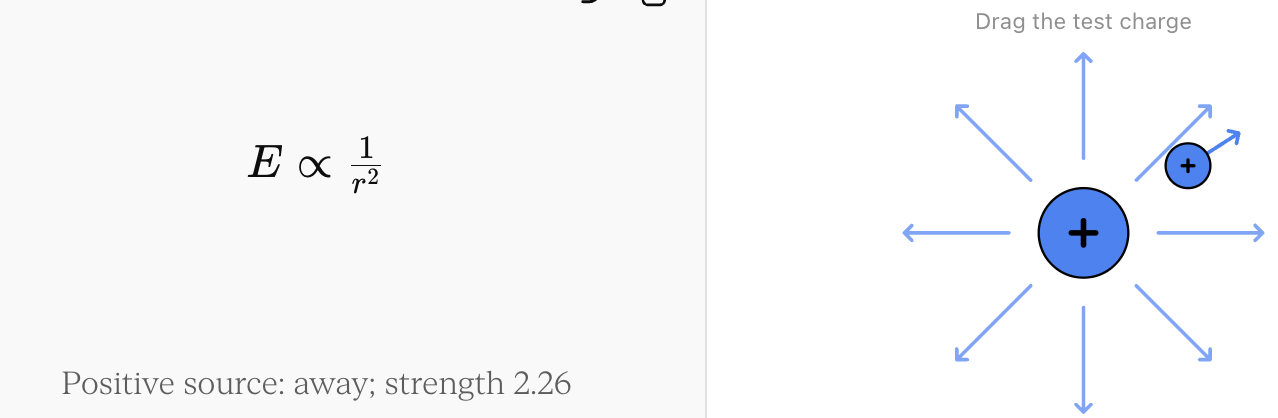
Around a positive source charge, a positive test charge would be repelled.

Therefore:

Electric fields point away from positive charges.

Around a negative source charge, a positive test charge would be attracted.

Therefore:

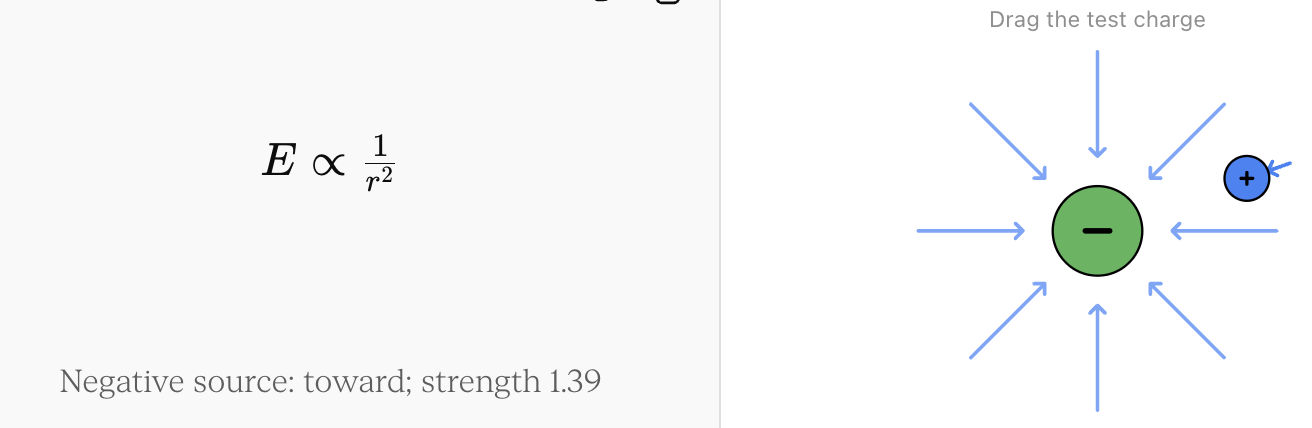
Electric fields point toward negative charges.

https://images.openai.com/static-rsc-4/TSUV1oz0Yq-1f-84tCL08UfgkqsqeTB7FzgDwcKLG2mYHjca0GSUC0BKg30lSJTiTyQWXNtCkzaLHFjYKR0VAREO2dqEnM-Dms2rmKpfUl3lKfN-w5KpGPMYzrwxAcxkJ8vBOBeAxTNRkwtiDSTt8zejSBwUp5mCbmOKJJmuHHCr0tW0gpqGxJI0CGM2UFnw?purpose=fullsize
 
https://images.openai.com/static-rsc-4/6QY4XrZR8kZeSOTTJVZxcjaLsyPeINZWwZxOQEyQxRtN3TdBqPwfTEEz8OVirvSJulnbJdBIAq7raMupHNX-VGWac7Qa106fBXyXBiyGPTvxu0TQQvTX_j5umr3h5YXshwmiEl43lV368qOktNcltVSjqkWCne_9zlvctNJy4WZJLPoNxGaSNQpGY3T2ScMk?purpose=fullsize
 
https://images.openai.com/static-rsc-4/ERuG4lKvvCow1EdPRPsHq3JGEHaEgqmYyNAaH8Y6aKRz0ie0pe-L4LPqJtk79h0_JzCJawMN_gwNYj7RimkSqI359hCt7hZjvmG7URcJU094MoRQ2cwStY-GatP1nwicuYPQVNMqA3RyNqW_vk6zkfOf8fFqf1AC3NkqEugzQ8Q85LY3VyNEm1pnXr_fVDxI?purpose=fullsize
 

Positive Source Charge

Imagine a positive point charge.

Because another positive charge would be repelled, the electric field points radially outward in every direction.

In text form:

← + →

Above the charge, the field points upward.

Below the charge, the field points downward.

To the left, it points left.

To the right, it points right.

The complete three-dimensional field extends outward in all directions.


Negative Source Charge

Now imagine a negative point charge.

A positive test charge would be attracted toward it.

Therefore, the electric field points inward toward the charge.

In text form:

→ − ←

The field direction is always toward the negative source charge.


Electric Field Lines

Electric fields are often represented using electric field lines.

These lines are a visual model of the field.

The arrows on the lines indicate the direction of the electric field.

Remember:

Field lines leave positive charges and enter negative charges.

The spacing of field lines can also indicate field strength.

Where the lines are closer together, the field is stronger.

Where the lines are farther apart, the field is weaker.

Field lines are a model. They do not represent physical strings or tracks in space.

https://images.openai.com/static-rsc-4/MXJvF6AMGhVu-m2rge7u-IV0bUZyUkk87XAQV6l6GlbRTumW4Y67GCVbH47rT6mMtfkSfpyFIGhEpkzjpxhs25wJc3HwRc6rOu0MyC2CR7IWdtaZHA4z1Ea-cbl9IftaSy-BXEap-dugcgRKpw6o6dTIMUTa6RuwmgSuCzkWVi_VEpotcNR7hRfFmebCdrmY?purpose=fullsize
 
https://images.openai.com/static-rsc-4/yFDpxgRnnG1gkTDMQxilM7poWmXLdOTh1pIVYquvsdcqLo-jYk-jXAPZVyI6QKUm6EtQYJ-v7sVNAR_j536AzLIJ8utgFBiH-Xyy7uPvrc3NN5BOKjpmfjPoGhUuOYf-vxJHzgZYjXUxERCxduoxbxhd2XHWlOTkaErJAzAq8tv_0-B8C6glCWycBf1ev6Q2?purpose=fullsize
 
https://images.openai.com/static-rsc-4/SHd8S4hlXr364b8ln7g0a1FBBPx7whfgEt0wBhOSj8YMiw6llMDY9JGLMpR75fw0-f_tS_KrSqEw81XWelWq7qTx2sERHubfhUHRYt7ue7s2tas0a_v_hyIDhleq93OUxs2XqpBGjSjXaDzu3V43AN-bc4Cg8Xp_9nIYQEr0G3tzV8U213INClqt6nn5_4o1?purpose=fullsize
 
5

Electric Field Around a Point Charge

The electric field produced by a point charge becomes weaker as distance from the charge increases.

For a point charge, the field strength can be calculated using:

E=k∣Q∣r2E = k\frac{|Q|}{r^2}

where:

  • E = electric field strength in N/C
  • k = Coulomb constant
  • Q = source charge in C
  • r = distance from the source charge in m

The Coulomb constant is approximately:

k=8.99×10⁹ N m2/C2k = 8.99\times10^9\text{ N m}^2/\text{C}^2

Notice that this equation uses Q

for the source charge producing the field.
Worked Example: Field Around a Point Charge

A point charge of

+3.0×10⁻⁶ C+3.0\times10^{-6}\text{ C}

produces an electric field.

Calculate the field strength at a distance of

0.20 m0.20\text{ m}

.

Use:

E=k∣Q∣r2E = k\frac{|Q|}{r^2}

Substitute:

E=(8.99×10⁹)3.0×10⁻⁶(0.20)2E = (8.99\times10^9)\frac{3.0\times10^{-6}}{(0.20)^2}

Square the distance:

(0.20)2=0.040(0.20)^2 = 0.040

Then:

E=(8.99×10⁹)3.0×10−60.040E = (8.99\times10^9)\frac{3.0\times10^{-6}}{0.040}

Therefore:

E≈6.74×10⁵ N/CE \approx 6.74\times10^5\text{ N/C}

The electric field strength is approximately

6.7×10⁵ N/C6.7\times10^5\text{ N/C}

.

Because the source charge is positive, the field points away from the charge.


How Distance Affects Electric Field Strength

For a point charge:

E∝1r2E \propto \frac{1}{r^2}

This means electric field strength follows an inverse-square relationship with distance.

If the distance from the source charge doubles:

Enew=E22=E4E_{\text{new}} = \frac{E}{2^2} = \frac{E}{4}

So:

Distance × 2 → Field strength × 1/4

If the distance triples:

Distance × 3 → Field strength × 1/9

If the distance is halved:

Distance × 1/2 → Field strength × 4

The electric field therefore becomes much stronger as you move closer to a point charge.

https://images.openai.com/static-rsc-4/pGy0TZqtixqK5CPlE4pBB84Jz4uMPuaztEJ4YT7tNhURlCE8LsEqm991UcoaNP0VQblo9cqxSH-X_mbXwaYBNfAI7STge7em6_7iBZZTi4sw5T1xpFaQV6ePjHUhPUVljo5B1XE2Z4EsDRniCP7YF9hq58c9kCsaApeZHhjrXT2o03FFnZBHhomypJFEL9--?purpose=fullsize
 
https://images.openai.com/static-rsc-4/-qhqO0Tlq9TmGumDYgQLNqCQIqA7Q9KOmxzinJ1KAITCIzwAzb6M5AwzjpYC1zo-_pfcC7JHrKDLTifwgxVzQaE1ffsnCLVQhdwWHey6zMb6YXIcTAB9Bq7hvKyRbtZdMbUGhRPRKL2E12cbffuEADfaTiKmEkx43cmt2-yQPHKJbutFYz1x6phXYPc4GmB8?purpose=fullsize
 
https://images.openai.com/static-rsc-4/kGULqslRwUo6SdtISnNYULMG5wBre5yGJ_54EX_O5MWMEMMUbkzWyn9HSdOUtCZLzf7vMYObrcSDzTSjqryg3ZM8K2cXjG08iKS0XaPA0Yk9q_Ax7VJTqFpFMReeeFYsgTzDDLZjvn3KUEuBTzeaR7TO8C61QGWl3Nkhbx_f_Zaic1_tZckh52tXdEpAPzan?purpose=fullsize
 

Worked Example: Changing Distance

The electric field strength at a certain distance from a point charge is 800 N/C.

A student moves to a position twice as far from the charge.

Because field strength follows an inverse-square relationship:

Enew=80022E_{\text{new}} = \frac{800}{2^2}

So:

Enew=8004=200 N/CE_{\text{new}} = \frac{800}{4} = 200\text{ N/C}

The new electric field strength is 200 N/C.


How Source Charge Affects Electric Field Strength

From the equation

E=k∣Q∣r2E = k\frac{|Q|}{r^2}

, field strength is directly proportional to the magnitude of the source charge.

Therefore:

Source charge × 2 → Field strength × 2

Source charge × 3 → Field strength × 3

Source charge × 1/2 → Field strength × 1/2

A larger source charge produces a stronger electric field at the same distance.


Electric Force and Electric Field Strength

Electric field strength and electric force are closely related, but they are not the same quantity.

Electric field strength describes a property of the field at a particular location.

Electric force describes what happens to a particular charge placed at that location.

The relationship is:

F=qEF = qE

This means that the force depends on:

  • the electric field strength
  • the size of the charge placed in the field

For the same electric field, a larger charge experiences a larger force.


Worked Example: Same Field, Different Charges

Suppose the electric field strength is:

E=5000 N/CE = 5000\text{ N/C}

A charge of

2.0×10⁻⁶ C2.0\times10^{-6}\text{ C}

is placed in the field.

The force is:

F=qEF = qE

So:

F=(2.0×10⁻⁶)(5000)=0.010 NF = (2.0\times10^{-6})(5000) = 0.010\text{ N}

Now replace it with a charge of

6.0×10⁻⁶ C6.0\times10^{-6}\text{ C}

.

The new force is:

F=(6.0×10⁻⁶)(5000)=0.030 NF = (6.0\times10^{-6})(5000) = 0.030\text{ N}

The second charge is three times larger, so it experiences three times the force.

However, the electric field strength has not changed.

The field is a property of the location created by the source charges.


Positive and Negative Charges in an Electric Field

The direction of the electric field is defined using a positive test charge.

Therefore, a positive charge experiences force in the same direction as the electric field.

Positive charge:

Electric field →

Force →

A negative charge behaves differently.

Because

qq

is negative, the force on a negative charge acts in the opposite direction to the electric field.

Negative charge:

Electric field →

Force ←

This distinction is extremely important.

https://images.openai.com/static-rsc-4/VhYsvPjqJCgAANGBjn_fXEomnnJDLR1hONHLw36OSAA0bw7W-STrKXpVAntKArI4Q9YMUrTnHMyX8UR99g2yyyRs1tucsCEVvMb_ua9Ch0VwotGHNTBp7Gs9pu5bB8SRNDYVKuItL0l41j16u1X6xe27BTCmgGXhgIySfgA9x8I9ypGyPSalu3n4epzfUqyI?purpose=fullsize
 
https://images.openai.com/static-rsc-4/btrB23h0aMIcZAy1ZHuAbeSuzmA7xx-p6JYDbABYFQJa8xU52ufi7w2DslzQQPgK8RIpSS0Mkxob5blBNvFK-no_q7YdU4NTMLbK30Ak3yqAzxwzLDuwPKFBgyT6eueWM8kmm57rjHegHuQx8kI2fBrhVy3ZcmIYVInERzA0ZzgfwTAcpMIve8Kocjo1N_If?purpose=fullsize
 
https://images.openai.com/static-rsc-4/ijhsat08voEFNEfROTIIltmL9XTFLE7H4X4DMUODiNvvSeQSuxJWlqpmOdLHU8P-piWdWiCo7KGzsOcx_XOS32iWvqNVyoh_g0jfrDY7enbSs_BFM-3j6J7jpByMTrPljfFCBoCYOAngQmVLdGXoNQJuxbDYJM30yg0JUqtAiTnqPH4iXE5oYoMduPCq8tG9?purpose=fullsize
 
5

Worked Example: Direction of Force

An electric field points to the right with strength

4.0×10³ N/C4.0\times10^3\text{ N/C}

.

A positive charge of

5.0×10⁻⁶ C5.0\times10^{-6}\text{ C}

is placed in the field.

The force magnitude is:

F=qE=(5.0×10⁻⁶)(4.0×10³)=2.0×10⁻² NF = qE = (5.0\times10^{-6})(4.0\times10^3) = 2.0\times10^{-2}\text{ N}

The force is 0.020 N to the right because the charge is positive.

Now imagine the charge is

−5.0×10⁻⁶ C-5.0\times10^{-6}\text{ C}

.

The force has the same magnitude, 0.020 N, but acts to the left because the charge is negative.


Electric Fields Between Opposite Charges

When a positive and negative charge are placed near each other, their electric fields combine.

Field lines:

  • leave the positive charge
  • curve through the surrounding space
  • enter the negative charge

This arrangement is called an electric dipole.

The field is not equally strong everywhere.

The strength and direction depend on the location.

https://images.openai.com/static-rsc-4/RFfm5fqon27FWPcQF3DUHDx3suiWPswvt3PglTFy_Ac_vU2RdklAQsrb_M5Xx3u9sLHaytc5TTCI7nq0fixAl63YiHJuXoJWPHzL9foSjuaEX_sgtLQ7MODrlDI7ysvVViCW8PEsTkrJI-xsm9ubrlK-hjVeVIZUr1v4E6Jz-1MZ6_IvP11XtyNQ2CMxPX9P?purpose=fullsize
 
https://images.openai.com/static-rsc-4/SHd8S4hlXr364b8ln7g0a1FBBPx7whfgEt0wBhOSj8YMiw6llMDY9JGLMpR75fw0-f_tS_KrSqEw81XWelWq7qTx2sERHubfhUHRYt7ue7s2tas0a_v_hyIDhleq93OUxs2XqpBGjSjXaDzu3V43AN-bc4Cg8Xp_9nIYQEr0G3tzV8U213INClqt6nn5_4o1?purpose=fullsize
 
https://images.openai.com/static-rsc-4/OYXIrebj6ZqiD1NFmTbIWgxAqfKVX5yR1ZEsKUnmKp0fZCZ-QwDLG3usvswgfZ1hKchN0pz--VSMUYSJxp7C4hSlXTyRID1T9bvufIWMDzHrcF-0-ocgWrQZg8IARMMwNzgPwWcICuJOLvVNurayeV_liLN2ZSZKQOBBPHm_0hbKaVYSIn4HnDL1Mqam3PF8?purpose=fullsize
 
4

Electric Fields Between Like Charges

Two positive charges both produce outward-pointing electric fields.

Between the charges, the two fields point in opposite directions.

If the charges are equal and the point is exactly halfway between them, the fields can cancel.

The net electric field at that point is then:

Enet=0 N/CE_{\text{net}} = 0\text{ N/C}

Two negative charges can produce a similar cancellation point.

This is an example of the principle of superposition: electric fields from different source charges combine as vectors.

https://images.openai.com/static-rsc-4/Jkm3thVM8QHPV-o1NQNrK2PaYo8HAZJVajn3Owg9CliZqPCq5MK9iJ3JC0ILK2hXqjL2wH2Ln-Q1ajcK465xjAPPxFag7flx07eWxnilfe3hlFMEuYssZb5YjpYmF7aOdav7NHsZNEj6ogMZ4y7454RC1oHaflAeP3sVolFga3cBKq5TnqUwmkQOGtZh87fL?purpose=fullsize
 
https://images.openai.com/static-rsc-4/_GrV9vid7Zc5jdBs1sz1rTgLQ-zGu5-2IDiPvHfOooIkCmDQA368EKuG7DSkBTmaFFHcp8FbmuKf1PiX9Tflj0h5U3HOomqazctNkZAY12ZqLNxtIhvuEnm6o0K3W98vyt8U37CTTo41K5D0D_WEvVeKJRdRyd3WSGfJ74s6EAZxDOUS1miFtckOtPzLgWtF?purpose=fullsize
 
https://images.openai.com/static-rsc-4/9R7JtTWoZoXIRd7D1IWhNExkY01EHYjCQ740ah7BROTp16RdPUxQzdAK3scTx1IXSHOiFrv_z4bvuh2R71Pcc1S4OEV-9cRfQnnd_eh8tWyNA2uvD45oap8ECkQx2_gRhGmPfgf8-tKKZXVV9NJoBXq50MlFHUHUu3w3ibIYRWCXIijZOOaMTT2Ll05YXlJj?purpose=fullsize
 
4

Electric Field Strength and Coulomb's Law

There is a direct connection between electric field strength and Coulomb's Law.

Coulomb's Law gives the force between two point charges:

F=k∣Qq∣r2F = k\frac{|Qq|}{r^2}

Electric field strength is:

E=F∣q∣E = \frac{F}{|q|}

Substituting the Coulomb force into the electric-field equation gives:

E=k∣Qq∣/r2∣q∣E = \frac{k|Qq|/r^2}{|q|}

The test charge

qq

cancels:

E=k∣Q∣r2E = k\frac{|Q|}{r^2}

This shows something important:

The electric field produced by a source charge does not depend on the size of the test charge used to measure it.

The field depends on:

  • the source chargeQQ
  • the distancerrfrom the source charge

Electric Fields Are Vectors

Electric field strength is a vector quantity.

It has:

  • magnitude
  • direction

If several charged objects produce fields at the same location, the individual fields must be added as vectors.

For fields along the same straight line, choose one direction as positive.

For example:

Field from Charge A = 600 N/C right

Field from Charge B = 250 N/C left

Then:

Enet=+600−250=+350 N/CE_{\text{net}} = +600 - 250 = +350\text{ N/C}

The net electric field is 350 N/C to the right.


Electric Field vs Electric Force

It is useful to keep these two ideas separate.

Electric field strength:

  • Describes the field at a location.
  • Measured in N/C.
  • Exists even if no test charge is present.
  • Depends on the source charges and position.

Electric force:

  • Acts on a particular charge.
  • Measured in newtons.
  • Depends on both the electric field and the charge placed in it.
  • Can be calculated using F = qE
  • A useful way to remember the difference is:

The field describes the environment.

The force describes what happens to a charge placed in that environment.


Real-World Applications of Electric Fields

Electric fields are important in many technologies and natural phenomena.

Examples include:

  • Photocopiers
  • Laser printers
  • Electrostatic paint spraying
  • Electrostatic precipitators
  • Capacitors
  • Lightning
  • Particle accelerators
  • Electronic devices
  • Charged-particle detectors

Electric fields are also fundamental to understanding interactions between charged particles at atomic and subatomic scales.

https://images.openai.com/static-rsc-4/cdkyWMDE_C_TF5veo9zoJqQ2Dvd6fuhh9voi9hrZLmLWzYrayJMvFDEhBUXYvvExOBun8Mdq3B-dlQrWoDKU4-o5FW0sYDQbczgBYl2Gb6W-VbV1BLZ7EYXB6Dfz6gEayt2bpyBL0xfBaUecLuHeWbJZjhzIaVgqVIReG5k5EqvejFB6Me8z2g8oPirev1fO?purpose=fullsize
 
https://images.openai.com/static-rsc-4/gFAWh0cCYznnikDXM1tK1Nob4kr9B0za7XAFLa3ETwMyhWNeB4r0aS6LjQUpUmvVzpeHpf1e_tWGm3TS6chixGXD-IBXE18rE8WjwCuQmyN4XHozE28Gzd8DsFGl0EGe-g2XlxbKQjoPjJx3YSoz_fuZmu16vJu0IjPHE651KkaolbM8pS9kaOf6rwfFj6V0?purpose=fullsize
 
https://images.openai.com/static-rsc-4/s81YCtind6_piqhqhyd4iT76musloeo93V0UC4aNFgiOXk5VosRhrr1_ZxuklnOVs7e1pfHnV7rBqhgNmwLNp5OLGPPXTgeJtGJVc1jQ2Uh3GPwz6Tj3Mgtwgjlb6LHYBE8TbKV8PCruJcExylDaBrPxFUjiYmD6YBShwWtNO83WcWSx0gBuF8HjHNGgG2zc?purpose=fullsize
 
6

Common Mistakes

Confusing Electric Field with Electric Force

They are related but not identical.

Electric field strength is measured in N/C.

Electric force is measured in N.

Forgetting the Meaning of Field Direction

Electric field direction is defined as the direction a positive test charge would experience a force.

Thinking Field Lines Point Toward Positive Charges

Remember:

Away from positive.

Toward negative.

Assuming a Negative Charge Moves in the Field Direction

A negative charge experiences force opposite to the electric field direction.

Forgetting to Convert Charge Units

For example:

4.0 μC=4.0×10⁻⁶ C4.0\ \mu\text{C} = 4.0\times10^{-6}\text{ C}

Do not substitute 4.0 directly when the equation requires coulombs.

Forgetting to Square Distance

For a point charge:

E∝1r2E \propto \frac{1}{r^2}

Doubling distance makes the field one-quarter as strong, not one-half.

Thinking the Test Charge Creates the Field Being Measured

The source charge creates the field. The test charge is used to determine how that field would affect a charge placed there.


Check Your Understanding

1. Define an electric field.

2. Define electric field strength.

3. State the equation relating electric field strength, force, and charge.

4. What is the SI unit of electric field strength?

5. In which direction does the electric field point around a positive point charge?

6. In which direction does the electric field point around a negative point charge?

7. A charge of

2.0×10⁻⁶ C2.0\times10^{-6}\text{ C}

experiences a force of 0.040 N. Calculate the electric field strength.

8. A positive charge is placed in an electric field pointing left. In which direction is the force on the charge?

9. A negative charge is placed in the same field. In which direction is its force?

10. What happens to the electric field strength around a point charge if the distance is doubled?

11. What happens to the field strength if the source charge is doubled?

12. Explain the difference between electric field strength and electric force.

13. Why can an electric field exist even when no test charge is present?

14. Two electric fields at a point are 900 N/C right and 400 N/C left. Calculate the net electric field.

15. Explain why a positive and negative charge placed at the same point in an electric field experience forces in opposite directions.


Key Terms

  • Electric field – a region in which a charged object experiences an electric force.
  • Electric field strength – electric force per unit positive charge at a point.
  • Source charge – a charge that produces an electric field.
  • Test charge – a small positive charge used conceptually to determine electric field strength and direction.
  • Electric force – an attractive or repulsive force acting on a charged object.
  • Field line – a line used to represent the direction and relative strength of an electric field.
  • Point charge – an idealized charge treated as being concentrated at a single point.
  • Newton per coulomb (N/C) – the SI unit of electric field strength.
  • Inverse-square relationship – a relationship in which a quantity varies as1/r21/r^2.
  • Electric dipole – a pair of opposite charges separated by a distance.
  • Superposition – the principle that individual electric fields combine through vector addition.
  • Vector – a quantity with both magnitude and direction.

Key Takeaways

  • An electric field is a region where a charge experiences an electric force.
  • Electric field strength measures force per unit positive charge.
  • Electric field strength can be calculated usingE=FqE = \frac{F}{q}.
  • Electric force can be calculated usingF=qEF = qE.
  • The field around a positive charge points away from the charge.
  • The field around a negative charge points toward the charge.
  • A positive charge experiences force in the direction of the field.
  • A negative charge experiences force opposite to the field direction.
  • The electric field around a point charge can be calculated usingE=k∣Q∣r2E = k\frac{|Q|}{r^2}.
  • Electric field strength decreases according to an inverse-square relationship with distance.
  • Electric field strength is a vector, so fields produced by multiple charges must be combined using vector addition.
  • The electric field describes the electrical environment at a location, while electric force describes how a particular charge responds to that field.