Gravitational Field Strength

4. Measuring Gravitational Fields

Learning Outcomes
  • I can explain how gravitational field strength can be measured or calculated.
  • I can relate gravitational field strength to acceleration due to gravity.
  • I can calculate field strength near planets and moons.
  • I can interpret data involving gravitational fields.
  • I can compare field strengths in different locations.

Key Topics:
  • Simple pendulum experiment
  • Measuring g on Earth and other planets

Measuring Gravitational Fields

A gravitational field cannot be seen directly, but its effects can be measured. Scientists determine gravitational field strength by observing how gravity affects masses, measuring the acceleration of falling objects, or calculating the field from the mass and size of an astronomical body.

Gravitational field strength is represented by:

g

and can be expressed in either:

N/kg

or equivalently:

m/s²

Near Earth's surface:

g ≈ 9.8 N/kg = 9.8 m/s²

This connection between force per unit mass and acceleration due to gravity is one of the most important ideas in gravitational physics.

https://images.openai.com/static-rsc-4/vtQrjsLkwHWJKSWYffcmG5Oa00NvBmwQzZKY-lgqpsrVLHNzWt0AMEwar3PTduN3-MwhJheSBCTWQsmCZhOfTXBT2piLqr_QynoQa9oXSL8Tad0BEJjS9VdxQlGZVWklsT4lj0FvUWAC2NxYNhGxuBvQX6Yy_0T7vl1DMFiZ4k967_cQnuFH6fktXYm2Po_V?purpose=fullsize
 

Gravitational Field Strength

Gravitational field strength tells us the gravitational force acting on each kilogram of mass at a particular location.

It can be calculated from:

g = F/m

where:

  • g = gravitational field strength in N/kg
  • F = gravitational force in N
  • m = mass placed in the field in kg

If a 2 kg object experiences a gravitational force of 19.6 N:

g = 19.6/2

= 9.8 N/kg

This tells us that every kilogram placed at that location experiences approximately 9.8 N of gravitational force.


Measuring g Using Force and Mass

One way to measure gravitational field strength is to measure the weight of a known mass.

Suppose a 5.0 kg mass is placed on a force meter.

The meter measures:

49 N

Then:

g = F/m

g = 49/5.0

g = 9.8 N/kg

A force meter or spring balance can therefore be used to estimate the local gravitational field strength.

https://images.openai.com/static-rsc-4/Sswy8Qhmtgg2aUbnDq1xWUD_k9fOfjVVeIxtTEZBUzE-G0mDDRdPWPVDu2OiedOO-7E7VYPEG3eT2z_aGky0V5_k4FstxLK-ueplxAPmE6r3RWGW8xkbTqf-yyjp5Da8I85fnK_byJqty1k2ULYnHFRs4aln2ndhwtFBLa-MZ5Km_4FjR42EPbQv1R43kuf0?purpose=fullsize
 
https://images.openai.com/static-rsc-4/Fb7HLX4EFf3roH9oYesGhhbct4Z0isahxzACNU-jdEBD81fjmyYb4JvpYeqtonBIkvxDCTwSOLj4cNVC6T2xoGxyITZGhmQ8LQctRuKuRMq614Pe3THt74UDC5JPwfhykPgkYBnvsT9L2E_kMAduINltzXakO6E8WO-znh0yp9xeMj-uR4YivkCeF_5VccP6?purpose=fullsize
 
https://images.openai.com/static-rsc-4/ABpFKq4ug-WzwH9daC9qoKFRwnusEAyzPDRPHO3zLGxXOlH4zsp2dYR1x9RS9MtwmQen8bx3sJkK2sFeXVZ9VxvXKoiniM88Np071Trhj_LquF2NaiDQgvpPBjPUh9kmLe-6sZfB5Zgs-_Z1r88N-B9St4xJsln9Uj9DNCticbfzSYERjHV7SOR0cbEIvfL7?purpose=fullsize
 
7

Weight and Gravitational Field Strength

Weight is the gravitational force acting on an object.

Therefore:

F = mg

or:

weight = mass × gravitational field strength

If mass is known and weight is measured, we can rearrange:

g = F/m

For example, suppose a 0.50 kg mass has a measured weight of 4.9 N.

g = 4.9/0.50

= 9.8 N/kg


Why Different Masses Can Be Used

Suppose several masses are tested at the same location.

Mass (kg) Weight (N) F/m (N/kg)
0.5 4.9 9.8
1.0 9.8 9.8
2.0 19.6 9.8
5.0 49.0 9.8

The weight changes with mass.

However:

F/m remains constant.

This constant value represents the gravitational field strength at that location.


Measuring g from a Graph

The relationship:

F = mg

has the same general form as:

y = mx

If we plot:

weight F on the vertical axis

against:

mass m on the horizontal axis

then:

gradient = g

For example:

gradient = ΔF/Δm

If:

ΔF = 39.2 N

and:

Δm = 4.0 kg

then:

g = 39.2/4.0

= 9.8 N/kg

A weight-versus-mass graph therefore provides an experimental method for measuring gravitational field strength.


Gravitational Field Strength and Acceleration

Gravitational field strength is closely related to the acceleration of an object falling freely under gravity.

Start with Newton's second law:

F = ma

For gravitational force:

F = mg

Therefore:

ma = mg

Cancel the mass:

a = g

This means that when gravity is the only significant force:

acceleration = gravitational field strength

This is why the same symbol, g, is commonly used for both.


Why N/kg and m/s² Are Equivalent

From Newton's second law:

1 N = 1 kg·m/s²

Therefore:

1 N/kg = (1 kg·m/s²)/kg

The kilograms cancel:

1 N/kg = 1 m/s²

So:

9.8 N/kg = 9.8 m/s²

These units describe the same gravitational quantity from two different perspectives.

N/kg describes force per unit mass.

m/s² describes acceleration.


Free Fall

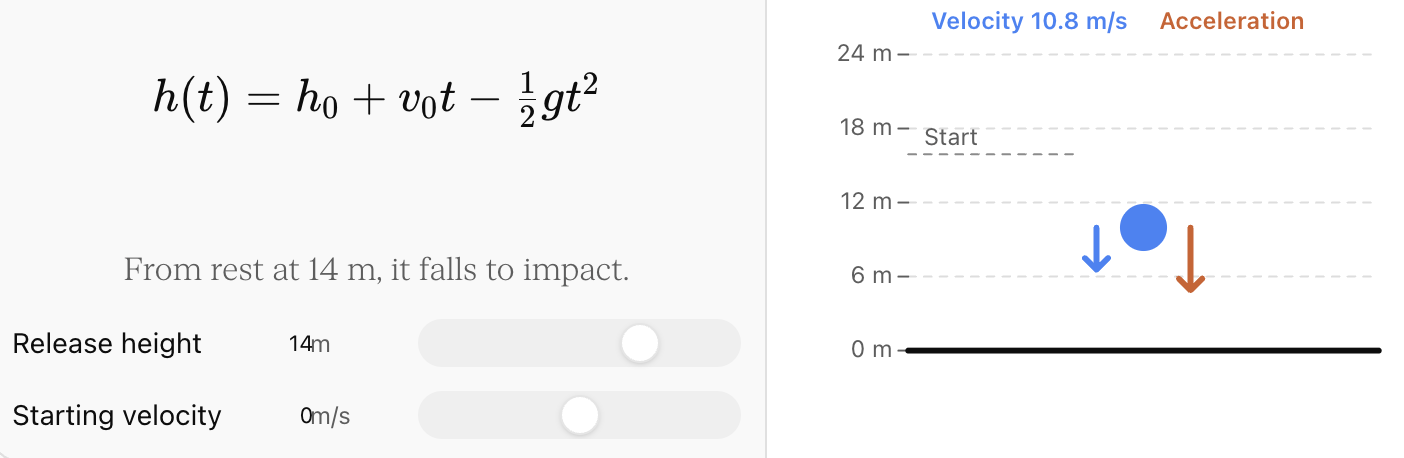
An object is in free fall when gravity is the only significant force acting on it.

Near Earth's surface, ignoring air resistance, a freely falling object accelerates downward at approximately:

9.8 m/s²

The object's velocity changes by approximately:

9.8 m/s every second

while the near-surface gravitational field can be treated as uniform.


Measuring g Using Free Fall

Suppose an object is released from rest.

For constant acceleration:

d = 1/2 gt²

where:

  • d = vertical distance fallen
  • g = acceleration due to gravity
  • t = fall time

Rearranging:

g = 2d/t²

Therefore, if distance and time are measured, g can be calculated.


Worked Example: Free-Fall Measurement

A ball is dropped from rest through a distance of:

1.80 m

The measured fall time is:

0.61 s

Calculate g.

g = 2d/t²

g = 2(1.80)/(0.61)²

g = 3.60/0.3721

g ≈ 9.67 m/s²

The experimental value is reasonably close to the accepted near-surface value of approximately:

9.8 m/s²


Why Experimental Values May Differ

A classroom experiment might produce:

9.4 m/s²

or:

10.1 m/s²

rather than exactly 9.8 m/s².

Possible reasons include:

  • timing uncertainty
  • inaccurate height measurement
  • air resistance
  • inconsistent release
  • limited precision of equipment
  • reaction time when using a stopwatch

A measured value does not need to exactly equal the accepted value to be useful.

Scientists evaluate the quality and uncertainty of measurements.


Improving a Free-Fall Experiment

A hand-operated stopwatch is not ideal because human reaction time may be significant compared with a short fall time.

Better methods could use:

  • light gates
  • motion sensors
  • electronic timers
  • high-speed video

Repeated trials can also improve reliability.


Using Several Measurements

Suppose five trials produce:

9.6 m/s²
9.9 m/s²
9.7 m/s²
10.0 m/s²
9.8 m/s²

The mean is:

(9.6 + 9.9 + 9.7 + 10.0 + 9.8)/5

= 49.0/5

= 9.8 m/s²

Repeating measurements helps reveal variation and reduces the influence of an unusual individual result when an appropriate average is used.


Measuring g with a Pendulum

A simple pendulum can also be used to estimate gravitational field strength.

For small oscillations:

T = 2π√(L/g)

where:

  • T = period in seconds
  • L = pendulum length in metres
  • g = gravitational field strength in m/s²

Rearranging:

g = 4π²L/T²

By measuring the pendulum's length and period, scientists can estimate the local value of g.


Improving Pendulum Measurements

Timing a single swing produces relatively large percentage uncertainty.

Instead, measure the time for many oscillations.

For example:

20 oscillations take:

36.0 s

Then:

T = 36.0/20

= 1.80 s

This provides a more reliable estimate of the period than trying to time one oscillation directly.


Calculating Fields Around Planets and Moons

Gravitational field strength outside a spherical mass can be calculated using:

g = GM/r²

where:

  • G = 6.67 × 10⁻¹¹ N·m²/kg²
  • M = mass of the planet or moon
  • r = distance from its centre

This equation allows gravitational field strength to be calculated even when direct measurement is difficult.


Surface Gravitational Field Strength

At the surface of a planet:

r = R

where R is the planet's radius.

Therefore:

g_surface = GM/R²

Surface gravitational field strength depends on both:

  • mass of the planet
  • radius of the planet

A more massive planet does not automatically have stronger surface gravity if it is also much larger.


Worked Example: Earth

Use approximate values:

Earth's mass:

M = 5.97 × 10²⁴ kg

Earth's radius:

R = 6.37 × 10⁶ m

Then:

g = GM/R²

g = (6.67 × 10⁻¹¹)(5.97 × 10²⁴)/(6.37 × 10⁶)²

g ≈ 9.8 N/kg

This agrees closely with measurements made near Earth's surface.


Worked Example: The Moon

Use approximate values:

Moon's mass:

M = 7.35 × 10²² kg

Moon's radius:

R = 1.74 × 10⁶ m

Then:

g = (6.67 × 10⁻¹¹)(7.35 × 10²²)/(1.74 × 10⁶)²

g ≈ 1.62 N/kg

The Moon's surface gravitational field is therefore much weaker than Earth's.


Comparing Earth and Moon

Using approximate surface values:

Location g (N/kg)
Earth 9.8
Moon 1.62

Ratio:

9.8/1.62 ≈ 6.05

Earth's surface gravitational field is therefore approximately:

6 times stronger

than the Moon's.

This explains why an astronaut weighs much less on the Moon.


Mass Does Not Change

Suppose an astronaut has a mass of:

72 kg

On Earth:

F = mg

= 72 × 9.8

= 705.6 N

On the Moon:

F = 72 × 1.62

≈ 116.6 N

The astronaut's:

mass remains 72 kg

but their:

weight changes

because gravitational field strength is different.


Calculating g Above a Planet

For an object above the surface:

r = R + h

where:

  • R = planetary radius
  • h = altitude

Then:

g = GM/(R + h)²

A common mistake is using h alone as the distance.

Gravitational calculations require distance from the centre of the planet.


Worked Example: Above Earth's Surface

Suppose a spacecraft is:

400 km

above Earth's surface.

Convert altitude:

400 km = 4.00 × 10⁵ m

Earth's radius is approximately:

6.37 × 10⁶ m

Therefore:

r = 6.37 × 10⁶ + 4.00 × 10⁵

r = 6.77 × 10⁶ m

Using:

g = GM/r²

g ≈ 8.7 N/kg

Gravity is weaker than at Earth's surface, but it is still substantial.


Astronauts in Orbit Are Still in a Strong Gravitational Field

A common misconception is that astronauts float because there is almost no gravity in orbit.

At an altitude of a few hundred kilometres, Earth's gravitational field is still quite strong.

Astronauts appear weightless because:

the spacecraft and astronauts are falling together around Earth.

They are in continuous free fall.

https://images.openai.com/static-rsc-4/LQzMisrv_oC-2oRZhcDpuYa_mxH7MiUWpBEywSQVhAZHvsGD3LihE3BiGJc4OzSuv-Ik_CxKOaFuJv3xh-PgLBEaruvazWkVzApeKvSzCM7mNpGxFut3ir3miAv6LK1xR0nVeqZys1bkBLNCQl0SpFw2LUYBV0Ze9sE-mz6R5KaTnPj7Rc_H0T8gHtFbgvdP?purpose=fullsize
 
https://images.openai.com/static-rsc-4/nJghwKAT5Qki41BQKpQHgZ92uivkl-JK5pAAxp_-z1AgO8oQeAlPHrHwMtQooKPB15geBri7FCXkZnOQwnaxOsJSZwJpvT1QNev8iIAD923g0j48SZIbAUXhV2we9Ei39lXsAGjgJVGameEqtiG3_EBbzbd84L0FzanD625wAZElGqYexIHF4nMy4O7PbdpT?purpose=fullsize
 
https://images.openai.com/static-rsc-4/fFqFl1b15zREEmZC6yAmQ_08-26nkhKHurRDJQf-IcWsDkwOxFdZoEvOhUr89wtA1zNkM2RDnVpuEEJOwlvk6zRTJHjavZyyBviQUYF53raXhjjE-ehMyqKymYOKRh6o1rS3dBBFH6saU98oqcJVhp3vfypdHcNfB1iiS_hv-fXmDMpK6Zg3d6YNDJfd7mBs?purpose=fullsize
 
6

Comparing Field Strengths Using Ratios

Sometimes the mass of the planet and G do not need to be used.

Since:

g ∝ 1/r²

for the same planet:

g₂/g₁ = r₁²/r₂²

This makes comparisons much quicker.


Worked Example: Twice the Distance

Suppose:

g = 12 N/kg

at distance r.

At distance:

2r

g₂ = 12 × (r/2r)²

= 12 × 1/4

= 3 N/kg

So doubling the distance from the centre reduces the field strength to one-quarter.


Worked Example: Three Times the Distance

Suppose:

g₁ = 18 N/kg

At:

r₂ = 3r₁

then:

g₂ = 18/3²

= 18/9

= 2 N/kg

The field strength has decreased by a factor of 9.


Comparing Different Planets

For two planets:

g₁ = GM₁/R₁²

and:

g₂ = GM₂/R₂²

Dividing gives:

g₂/g₁ = (M₂/M₁)(R₁/R₂)²

This allows planets to be compared using relative masses and radii.


Example: Twice the Mass, Same Radius

Planet B has:

2 times Earth's mass

and:

the same radius as Earth

Then:

gB/gEarth = 2

Therefore:

gB = 2gEarth

If:

gEarth = 9.8 N/kg

then:

gB = 19.6 N/kg


Example: Same Mass, Twice the Radius

Planet C has:

the same mass as Earth

but:

twice Earth's radius

Then:

gC/gEarth = 1/2²

= 1/4

Therefore:

gC = 9.8/4

= 2.45 N/kg

Doubling radius has a major effect because radius is squared.


Example: Four Times the Mass and Twice the Radius

Planet D has:

4 times Earth's mass

and:

2 times Earth's radius

Then:

gD/gEarth = 4/2²

= 4/4

= 1

Therefore:

gD = gEarth

The two planets would have the same surface gravitational field strength despite having very different masses and sizes.


Interpreting a Table of Gravitational Data

Consider this hypothetical data:

Location g (N/kg)
A 12.0
B 9.0
C 4.0
D 1.5

From the table we can conclude:

  • Location A has the strongest gravitational field.
  • Location D has the weakest.
  • A 1 kg object at A would experience 12 N of gravitational force.
  • A 1 kg object at D would experience 1.5 N.
  • An object would have greater weight at A than at D.

However, we cannot determine why the fields differ without additional information about the masses and distances involved.


Interpreting Force and Mass Data

Suppose measurements produce:

Mass (kg) Weight (N)
1.0 3.7
2.0 7.4
3.0 11.1
4.0 14.8

Calculate:

g = F/m

Using any row:

g = 3.7/1.0

= 3.7 N/kg

or:

g = 14.8/4.0

= 3.7 N/kg

The consistent ratio shows that the measurements were made in a field of approximately:

3.7 N/kg


Interpreting Free-Fall Data

Suppose an experiment measures the velocity of a falling object:

Time (s) Velocity (m/s)
0.0 0.0
0.5 4.9
1.0 9.8
1.5 14.7
2.0 19.6

Acceleration is:

a = Δv/Δt

Using:

Δv = 19.6 m/s

Δt = 2.0 s

a = 19.6/2.0

= 9.8 m/s²

Therefore:

g = 9.8 m/s² = 9.8 N/kg


Velocity-Time Graphs and g

For an object in free fall with negligible air resistance, the gradient of a velocity-time graph gives the acceleration.

Therefore:

gradient = g

if the chosen positive direction makes downward acceleration positive.

If upward is defined as positive, the gradient would instead be:

−g

The sign depends on the coordinate system.

The magnitude of the gravitational field strength remains positive.


Distance-Time Data

If an object is dropped from rest in an approximately uniform gravitational field:

d = 1/2 gt²

Therefore:

d ∝ t²

A graph of:

d against t²

should be approximately linear.

Its gradient is:

g/2

Therefore:

g = 2 × gradient

This provides another experimental method for determining gravitational field strength.


Field Strength Versus Distance

For a spherical mass:

g = GM/r²

Therefore, a graph of g against r is curved.

As r increases:

  • g decreases rapidly at first
  • the curve gradually becomes flatter
  • g approaches zero at very large distances

The field does not suddenly stop at a particular distance.


Linearizing Gravitational Data

Because:

g = GM/r²

we can write:

g = GM(1/r²)

Therefore, if we plot:

g against 1/r²

we expect a straight line for an ideal spherical source.

The gradient is:

GM

This is useful because a curved inverse-square relationship becomes a linear graph.

If G is known, the mass M can then be calculated from the gradient.


Using Data to Identify an Inverse-Square Relationship

Suppose measurements give:

r g
1 16
2 4
3 1.78
4 1

Notice:

At 2r:

16 → 4

The field becomes one-quarter.

At 4r:

16 → 1

The field becomes one-sixteenth.

This pattern strongly suggests:

g ∝ 1/r²


Percentage Comparison

Suppose Location A has:

gA = 9.8 N/kg

and Location B has:

gB = 3.7 N/kg

To express B as a percentage of A:

percentage = (3.7/9.8) × 100

≈ 37.8%

So Location B's gravitational field strength is approximately:

38% of Location A's

This can make comparisons easier to interpret.


Comparing Weight in Different Fields

Because:

F = mg

an object's weight is directly proportional to g.

Suppose:

gA = 10 N/kg

gB = 4 N/kg

Then:

FB/FA = 4/10

= 0.4

An object at B weighs only:

40% as much

as it does at A.

Its mass remains unchanged.


Field Strength Is Location-Dependent

Gravitational field strength is not a property of the test object.

It is a property of the gravitational field at a particular location.

At the same location:

  • a 1 kg object experiences the same g as a 10 kg object
  • their gravitational forces are different
  • their free-fall accelerations are the same if other forces are negligible

This distinction is fundamental when interpreting gravitational data.


Why g Varies Across Earth

The familiar:

g ≈ 9.8 N/kg

is an approximation.

The measured value varies slightly with location because of factors including:

  • altitude
  • latitude
  • Earth's rotation
  • Earth's slightly non-spherical shape
  • local variations in geological density

Highly sensitive instruments can detect these small differences.


Gravimeters

A gravimeter is an instrument designed to measure small variations in gravitational acceleration.

Gravimeters can be used in:

  • geophysical surveys
  • geological studies
  • monitoring volcanic regions
  • studying underground density variations
  • precision gravitational research

If the density beneath a location differs from its surroundings, extremely precise gravity measurements may reveal a small difference in the local field.


Comparing Measurement and Calculation

There are two broad approaches to determining gravitational field strength.

Measurement

Observe gravity's effect directly.

Examples:

  • measure weight of a known mass
  • measure free-fall acceleration
  • use a pendulum
  • use a gravimeter

Calculation

Use information about the source mass and distance:

g = GM/r²

Both approaches should produce compatible results when the assumptions and measurements are appropriate.


Evaluating Gravitational Field Data

When interpreting experimental data, ask:

Are the units correct?

g should normally be expressed in:

N/kg

or:

m/s²

Are the results consistent?

Repeated measurements should usually be reasonably close.

Are there outliers?

Investigate unusual measurements rather than automatically removing them.

Does the trend make physical sense?

Increasing distance from a planet should decrease g.

Does the pattern fit an inverse-square relationship?

Doubling distance from the centre should reduce g to approximately one-quarter for an isolated spherical source.

What uncertainties are present?

Consider measurement precision and experimental limitations.


Worked Data Analysis

Suppose a probe records:

Distance from Planet Centre g
R 20 N/kg
2R 5.0 N/kg
3R 2.2 N/kg
4R 1.25 N/kg

Check the inverse-square prediction.

At 2R:

20/2² = 5.0 N/kg

At 3R:

20/3² ≈ 2.22 N/kg

At 4R:

20/4² = 1.25 N/kg

The measurements closely match:

g ∝ 1/r²

Therefore, the data are consistent with an inverse-square gravitational field.


Choosing the Best Method

Different situations require different approaches.

Known mass and measured weight?

Use:

g = F/m

Free-fall data?

Use acceleration:

g = a

Known planetary mass and distance?

Use:

g = GM/r²

Comparing two distances from the same planet?

Use:

g₂/g₁ = r₁²/r₂²

Comparing planetary surfaces?

Use:

g = GM/R²

Selecting the appropriate relationship is often the most important first step.


Common Mistakes

Confusing g with gravitational force

g is field strength measured in N/kg or m/s².

Force is measured in N.

Thinking g depends on the test object's mass

At a particular location, gravitational field strength is independent of the test mass.

Confusing mass and weight

Mass is measured in kg.

Weight is measured in N.

Using altitude as r

For:

g = GM/r²

r is measured from the centre of the source mass.

Forgetting to square r

Gravity follows an inverse-square relationship.

Thinking astronauts in orbit experience zero gravity

Earth's gravitational field remains substantial at typical orbital altitudes.

Assuming every experimental value must equal exactly 9.8

Measurements contain uncertainty, and g also varies slightly with location.

Ignoring direction when acceleration data are signed

Depending on the coordinate system, gravitational acceleration may be written as +g or −g.

Assuming a larger planet must have stronger surface gravity

Both mass and radius determine surface gravitational field strength.


Key Terms

Gravitational field strength (g) — gravitational force per unit mass at a location.

Acceleration due to gravity — the acceleration experienced by a freely falling object when gravity is the only significant force.

Newton per kilogram (N/kg) — the SI unit of gravitational field strength.

Metre per second squared (m/s²) — the SI unit of acceleration, numerically equivalent to N/kg for gravitational field strength.

Free fall — motion in which gravity is the only significant force.

Weight — gravitational force acting on a mass.

Gravimeter — an instrument used to measure gravitational acceleration or small variations in gravitational field strength.

Pendulum — an oscillating system whose period can be used to estimate local gravitational field strength under appropriate conditions.

Inverse-square relationship — a relationship in which a quantity varies as 1/r².

Planetary radius (R) — distance from the centre of a planet to its surface.

Altitude Herz — height above a planetary surface.

Experimental uncertainty — the range of uncertainty associated with a measurement.

Gradient — rate of change represented by the slope of a graph.

Linearization — transforming variables so a non-linear relationship can be represented by a straight-line graph.


Key Takeaways

  • Gravitational field strength can be measured experimentally or calculated mathematically.
  • One direct method is g = F/m, using the measured weight of a known mass.
  • A graph of weight against mass has gradient equal to gravitational field strength.
  • Gravitational field strength is numerically equal to free-fall acceleration when gravity is the only significant force.
  • 1 N/kg = 1 m/s².
  • Near Earth's surface, g ≈ 9.8 N/kg = 9.8 m/s².
  • Free-fall measurements can be used to determine g.
  • Pendulum measurements can also be used to estimate local gravitational field strength.
  • Outside a spherical mass, g = GM/r².
  • At a planet's surface, g = GM/R².
  • Surface gravitational field strength depends on both planetary mass and radius.
  • The Moon's surface gravitational field is much weaker than Earth's.
  • An object's mass remains constant when it moves between gravitational fields, but its weight changes.
  • Gravitational field strength decreases according to an inverse-square relationship as distance from a spherical mass increases.
  • Data involving force, acceleration, distance, or planetary properties can all provide information about gravitational fields.
  • Measurements should be evaluated for uncertainty, consistency, trends, and possible experimental error.

Check Your Understanding

  1. Define gravitational field strength and state its two equivalent units.
  2. A 3.0 kg mass has a measured weight of 29.4 N. Calculate the gravitational field strength.
  3. A 12 kg object is placed where g = 4.5 N/kg. Calculate its weight.
  4. Explain why 1 N/kg is equivalent to 1 m/s².
  5. Explain why gravitational field strength is equal to free-fall acceleration when gravity is the only significant force.
  6. A ball is dropped from rest and falls 2.0 m in 0.64 s. Use g = 2d/t² to estimate the local gravitational field strength.
  7. Explain why using a light gate would generally produce a better measurement of g than using a handheld stopwatch.
  8. A graph of weight against mass has a gradient of 3.7 N/kg. What does this tell you about the gravitational field?
  9. A planet has mass 8.0 × 10²³ kg and radius 3.0 × 10⁶ m. Calculate its surface gravitational field strength using G = 6.67 × 10⁻¹¹ N·m²/kg².
  10. A planet produces a field strength of 32 N/kg at distance r. What is the field strength at 2r? What about 4r?
  11. A spacecraft is 600 km above a planet whose radius is 4,500 km. Determine the value of r that should be used in g = GM/r².
  12. Planet B has the same mass as Planet A but twice its radius. Compare their surface gravitational field strengths.
  13. Planet C has four times the mass and twice the radius of Planet A. Compare their surface gravitational field strengths.
  14. A probe measures gravitational field strengths of 16.0, 4.0, 1.78, and 1.0 N/kg at distances r, 2r, 3r, and 4r. Explain how these data provide evidence for an inverse-square relationship.
  15. Describe two different experimental methods for determining gravitational field strength and explain one important source of uncertainty for each method.