Gravitational Field Strength

1. Defining Gravitational Fields

Learning Outcomes
  • I can define a gravitational field.
  • I can explain the concept of gravitational field strength.
  • I can distinguish between gravitational force and field strength.
  • I can calculate gravitational field strength.
  • I can interpret field diagrams around massive objects.

Key Topics:
  • Field strength: \( g = \frac{F}{m} \)
  • Gravitational fields of point masses

Defining Gravitational Fields

Gravity is an attractive interaction between objects that have mass. We experience gravity every day when objects fall toward Earth, when we feel our own weight, and when the Moon remains in orbit around Earth.

A gravitational field is the region around a mass in which another mass experiences a gravitational force.

Earth therefore creates a gravitational field around itself. The field extends far beyond Earth's surface and becomes weaker as the distance from Earth increases.

https://images.openai.com/static-rsc-4/UIfOH40FbLVy88sBSuVtjX96xidMKIKz3vEFMY-aKZ7R6-yfLYC7tvRSX7c0TCl81IB-hBGG6xHlsN9ZC54jXTZq-gDyv5Pz2rEM4t_GnjZUdXV5cgA9PlfUnqExXgJA8468ayg41yiqNMD2JO-4h0P170UQRGFkxJHcXnpQ5zQ3pW5i0P5y-IevzQsEShHK?purpose=fullsize
 
https://images.openai.com/static-rsc-4/aXwaELT9XQVRT9w2AkZhI5o0aD4LMlLkW8nNE4depqO0oYPyrToyN4oT1kgYoqrBDEC67Cfue1nfPe-As-XFFX1pv-uZBsdsea9ibrSIdxxg1TgT68_I-wOU3-xHBDfjO5DRfeO9IbinM2Heok9hNB75AvKzTC2qvMKVJiYwcsJ1NtfOweTbvpl756tSxNnh?purpose=fullsize
 
https://images.openai.com/static-rsc-4/F3Ozd6bYAL9oCh5sVKqswh_tY9pjfRA48fkprZIgNswvqRefSixVIJatbC6VOh3P9Rwh4B6hY6NrNC74AQy2ZjttYY6k3M46QzfdEEL2bnDTSrC-uw0uYx_B-yKXaQN5SJsZ9lOxfnrYVSehB_hfyDg-u7AVr0UUj9_HJZQ5lNF2_kLgekIw7t_pFK8FUSwk?purpose=fullsize
 
6

The idea of a field allows us to describe gravity at a point in space even before we place another object there.


What Is a Gravitational Field?

Every object with mass produces a gravitational field.

This includes:

  • planets
  • stars
  • moons
  • asteroids
  • people
  • everyday objects

The gravitational fields produced by small everyday objects are extremely weak, so we normally do not notice them.

Massive astronomical objects produce much stronger effects.

For example, Earth creates a gravitational field that causes objects near its surface to accelerate toward Earth's centre.

The gravitational field exists whether or not another object is present to experience it.


Gravity Is Always Attractive

Gravitational forces between ordinary masses are attractive.

This means two masses pull toward one another.

Earth pulls an apple toward Earth.

At the same time, the apple pulls Earth toward the apple.

The forces are equal in magnitude and opposite in direction, although Earth's enormous mass means its acceleration is extremely small compared with the apple's.
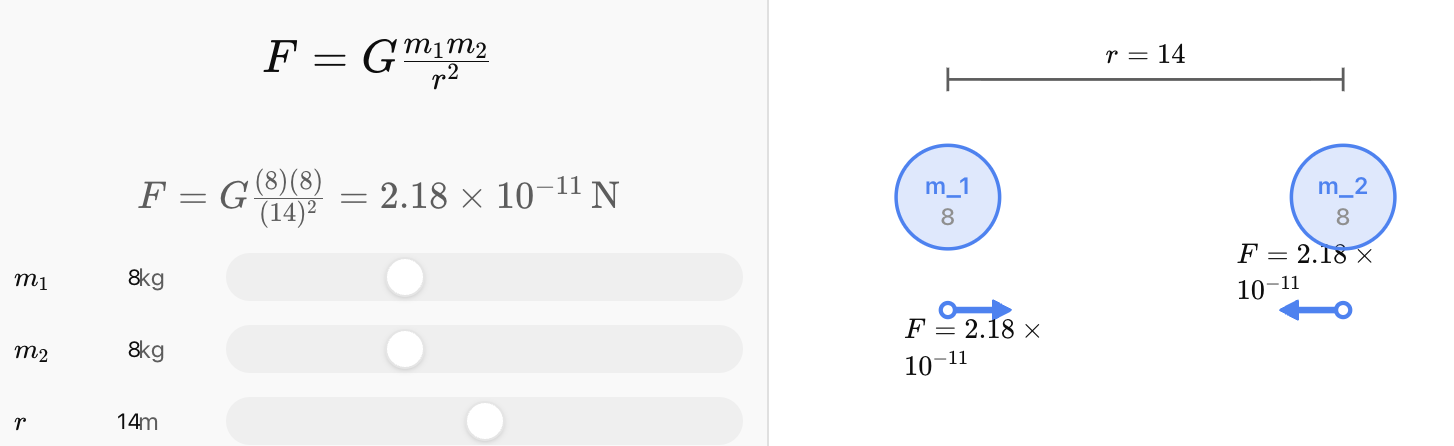
This mutual attraction is described by Newton's law of universal gravitation.


Gravitational Field Strength

The gravitational field strength, g, tells us how much gravitational force would act on each kilogram of mass placed at a particular point.

It is defined by:

g = F/m

where:

  • g = gravitational field strength in N/kg
  • F = gravitational force in newtons (N)
  • m = mass placed in the field in kilograms (kg)

The unit of gravitational field strength is:

N/kg

This means:

newtons of gravitational force per kilogram of mass.


Interpreting N/kg

Suppose the gravitational field strength at a location is:

g = 9.8 N/kg

This means that each kilogram of mass experiences approximately:

9.8 N of gravitational force.

Therefore:

1 kg → 9.8 N
2 kg → 19.6 N
5 kg → 49 N
10 kg → 98 N

Near Earth's surface:

g ≈ 9.8 N/kg

For many introductory calculations, this may be rounded to:

g ≈ 10 N/kg

unless greater precision is required.


Gravitational Force and Field Strength

Gravitational force and gravitational field strength are closely related, but they are not the same quantity.

Quantity Gravitational Force Gravitational Field Strength
Symbol F or Fg g
Meaning Force acting on an object Force per kilogram at a location
Unit N N/kg
Depends on test object's mass? Yes No
Vector quantity? Yes Yes

A gravitational field describes the gravitational conditions at a location.

A gravitational force describes what happens to a particular mass placed at that location.


Example: Same Field, Different Forces

Suppose two objects are near Earth's surface.

Object A:

m = 2 kg

Object B:

m = 8 kg

Both are in approximately the same gravitational field:

g = 9.8 N/kg

For Object A:

F = mg

= 2 × 9.8

= 19.6 N

For Object B:

F = mg

= 8 × 9.8

= 78.4 N

The gravitational forces are different because the masses are different.

However, both objects experience the same gravitational field strength:

9.8 N/kg

This distinction is fundamental.


Weight Is a Gravitational Force

The weight of an object is the gravitational force acting on it.

Near a planet:

weight = mass × gravitational field strength
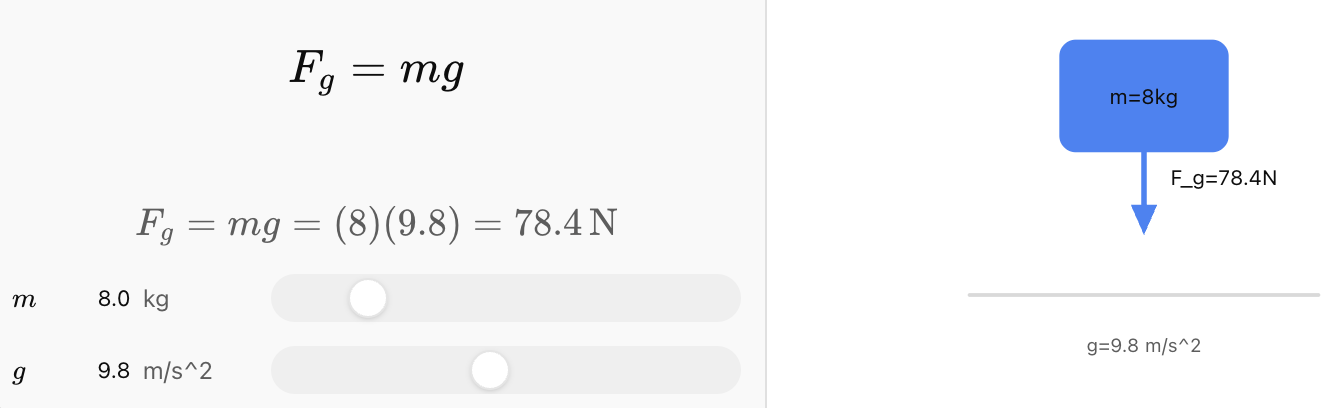
For example, a 60 kg person near Earth's surface has a weight of approximately:

F = 60 × 9.8

= 588 N

The person's:

mass = 60 kg

while their:

weight = 588 N

Mass and weight are therefore different quantities.


Calculating Gravitational Field Strength from Force

The equation:

g = F/m

can be used when gravitational force and mass are known.

Worked Example

A 4 kg object experiences a gravitational force of 39.2 N.

Calculate the gravitational field strength.

g = F/m

g = 39.2/4

g = 9.8 N/kg

The object is therefore in a gravitational field with strength 9.8 N/kg.


Another Example

A spacecraft has a mass of 500 kg.

At a particular location, the gravitational force acting on it is 800 N.

Calculate the gravitational field strength.

g = F/m

g = 800/500

g = 1.6 N/kg

The field at this location is much weaker than the field near Earth's surface.


Rearranging the Equation

Starting with:

g = F/m

we can rearrange to calculate gravitational force:

F = mg

or mass:

m = F/g

Always identify which quantities are known before selecting the appropriate form.


Worked Example: Finding Mass

An object experiences a gravitational force of 147 N in a field of strength 9.8 N/kg.

Find its mass.

m = F/g

m = 147/9.8

m = 15 kg


Gravitational Field Strength Around a Spherical Mass

For a spherical object such as a planet or star, the gravitational field strength outside the object can be calculated using:

g = GM/r²

where:

  • g = gravitational field strength in N/kg
  • G = gravitational constant
  • M = mass of the object creating the field
  • r = distance from the centre of that object

The gravitational constant is approximately:

G = 6.67 × 10⁻¹¹ N·m²/kg²

Notice that r is measured from the centre of the mass, not from its surface.

https://images.openai.com/static-rsc-4/2ZrIZ9s_6QfmO4UaW7K9KFdCzEAY9TcLCVcXlk_sAwSJvS9-1eOCE1xBeZjnsoS-Np0IlglbROUeis7ZxgUZkva7sPKHkITiC1h46W8GSPsYEHGdUrmF9xTIS98hL-zTruhY1iQPOBE9QI4vZPaKmijLe_zEMa0QPcdNGBUbYWnWp7jJ4L9tAUAWBAF0ftiZ?purpose=fullsize
 
https://images.openai.com/static-rsc-4/xwxKXzw-lnSjq6bt0RyOz-fCGXuLa-dSfRaFCyMuxSKKchL8mU_X-hrNIgVx8bQm7b9VZvCPLLpCjWeaZeGn7goU99XOQiDp1iRWiYGD6ZUpsH-CAxlx2LsickecBIXQD3C_4N7Ez2Q9RMSQmWN18JjrKhWrwSYL_IV9vV3oC9oPlIyQr9vNZGjlDYExymWH?purpose=fullsize
 
https://images.openai.com/static-rsc-4/eex1fYslsWi2NjNSpq6MU1K1zvJ5438AmjQXhJbs2o4GDtNb0MlFbX7IP1sN3LPmfMxW8PwLg-W_mr618od0dv0rngHaq5NtGFUah5paGJ1kaP9r3wgOdsaAj2L9h2402QltbPPdhFQVixXaVEJ14TnfD0w-ef7zeFVgcBPZN519yo0LbJQjxijgXr3UhOFd?purpose=fullsize
 
6

Why the Test Mass Disappears

Newton's law of universal gravitation gives the force between two masses:

F = GMm/r²

Field strength is:

g = F/m

Substituting the gravitational force:

g = (GMm/r²)/m

The test mass cancels:

g = GM/r²

This demonstrates an important idea:

The gravitational field strength at a point does not depend on the mass of the object used to test the field.

A 1 kg object and a 100 kg object at the same location experience the same value of g, even though the 100 kg object experiences 100 times as much gravitational force.


Worked Example: Field Strength Around a Planet

Suppose a planet has:

M = 6.0 × 10²⁴ kg

and we want the gravitational field strength at:

r = 6.4 × 10⁶ m

from its centre.

Use:

g = GM/r²

Substitute:

g = (6.67 × 10⁻¹¹)(6.0 × 10²⁴)/(6.4 × 10⁶)²

First calculate the denominator:

(6.4 × 10⁶)² = 4.096 × 10¹³

Then:

g ≈ 4.002 × 10¹⁴ / 4.096 × 10¹³

g ≈ 9.77 N/kg

This is close to the familiar gravitational field strength near Earth's surface.


Distance from the Centre Matters

A very common mistake is measuring r from the surface of a planet.

Suppose a spacecraft is:

1,000 km above Earth's surface.

The value of r is not 1,000 km.

Instead:

r = Earth's radius + altitude

If Earth's radius is approximately 6,370 km:

r = 6,370 + 1,000

= 7,370 km

Then convert to metres if required:

r = 7.37 × 10⁶ m

This centre-to-centre distance is used in gravitational calculations.


Gravity Follows an Inverse-Square Relationship

The equation:

g = GM/r²

shows that gravitational field strength follows an inverse-square relationship with distance.

This means:

g ∝ 1/r²

If distance from the centre doubles:

g becomes 1/4 as large.

If distance triples:

g becomes 1/9 as large.

If distance becomes four times greater:

g becomes 1/16 as large.

Distance Relative Field Strength
r g
2r g/4
3r g/9
4r g/16

The field weakens rapidly with increasing distance.

https://images.openai.com/static-rsc-4/pkMZIN-BbOVKPJ6PJmIC3kuz2Y_m90u7XImHbf1L5xeGNKhZH9IajNuhBxfNzQg1XHoUvsmZlyzrjvwrBk_fZugbSthMjA4Dwin29xASnNJffmZC3tDuGWih5yel_k8WV7TtqkuOYt39RaIW56NCo0vIDmaijoM3x-1xmOuFgjU9UdSaSHyLlQWsSwzkmASE?purpose=fullsize
 
https://images.openai.com/static-rsc-4/NENkws50n4hRtgpg1ppznAfwmFFkDNtLjcK87qrDnHt9JmNZJKBsQ7FMldEMECw4P9L_vwBydKaPnOsIzM3-8zsl0xPDttjDBjshYRVh8EFXl-k6bFy2BOkp1pXwo9Vx2nIieeT8z7sUpOFVV9n5jCHhDszJw40vyMsx4TP0sS75kiFFqo1lApDtfN8u1Lo9?purpose=fullsize
 
https://images.openai.com/static-rsc-4/oMw51rpy7CTQD8Yo7oRing_6hy-r6ihK12w_IAykNUHp7uv9AEIoPrDM2-pf9S9E4Adwsh6O1f99QEmUJ6ZL_mGMVLC4rUvJ_JekQb0N3hyZMrSA365A7LH4DpzuvZxTEgY41NexATlgu_hqqWq_ISOXExVXFzrDH77pkK-kPlfi0xKbZ_lVKeMBDpFmDQsV?purpose=fullsize
 
5

Example: Doubling the Distance

Suppose the gravitational field strength at distance r is:

16 N/kg

At distance 2r:

g₂ = 16/2²

= 16/4

= 4 N/kg

At distance 4r:

g₄ = 16/4²

= 16/16

= 1 N/kg

Distance has a powerful effect on gravitational field strength.


Increasing the Source Mass

From:

g = GM/r²

we can also see:

g ∝ M

At the same distance, doubling the mass producing the field doubles the gravitational field strength.

For example:

Planet A has mass M.

Planet B has mass 2M.

At the same distance from their centres:

gB = 2gA

A more massive object produces a stronger gravitational field at the same distance.


Mass and Distance Together

Suppose Planet B has:

  • twice the mass of Planet A
  • twice the radius of Planet A

At the surfaces:

For Planet A:

gA = GM/R²

For Planet B:

gB = G(2M)/(2R)²

= 2GM/4R²

= 1/2(GM/R²)

Therefore:

gB = 1/2 gA

Even though Planet B is more massive, its surface gravitational field is weaker because its larger radius has an even greater effect.

This shows why we cannot determine surface gravity from mass alone.


Gravitational Fields Are Vector Fields

Gravitational field strength has both:

  • magnitude
  • direction

Therefore, gravitational field strength is a vector quantity.

The direction of the field at a point is the direction in which a small test mass would accelerate if placed there.

Around an isolated spherical mass, this direction is:

toward the centre of the mass.


Gravitational Field Lines

Gravitational fields can be represented using field lines.

The arrows on the lines show the direction of the gravitational field.

Around a spherical mass:

  • lines point inward
  • lines are radial
  • lines are directed toward the centre
  • the pattern is symmetric for an isolated spherical mass

The inward arrows are important because gravity is attractive.


Interpreting Field-Line Density

Field diagrams can also indicate relative field strength.

Where field lines are represented as more closely spaced:

the field is stronger.

Where they are represented as farther apart:

the field is weaker.

Around a planet, the lines appear denser close to the planet and more widely spaced farther away.

This corresponds to:

g ∝ 1/r²

Field-line density is a visual representation; the lines themselves are not physical objects.


Field Lines Are Models

A gravitational field does not literally contain drawn lines.

Field lines are a model that helps us visualize:

  • field direction
  • relative strength
  • symmetry
  • interactions between fields

We could draw more or fewer lines without changing the actual gravitational field.

What matters is the pattern and relative density of the lines.


Field Direction at a Point

Imagine a field line passing through a point.

The gravitational field direction at that point is tangent to the field line and follows the arrow.

For a spherical planet, this means a test mass at any location outside the planet would initially accelerate toward the planet's centre.


Uniform Gravitational Fields

Very close to Earth's surface, over relatively small distances, the gravitational field can often be approximated as uniform.

A uniform field is represented by:

  • parallel field lines
  • equally spaced field lines
  • arrows pointing in the same direction

Near Earth's surface, the arrows point approximately downward.

This approximation works because the distances involved in everyday situations are tiny compared with Earth's radius.


Radial Versus Uniform Fields

There are two common gravitational field diagrams.

Radial Field

Used when considering a planet, star, or spherical mass over large distances.

The lines:

  • point toward the centre
  • spread apart with distance
  • show decreasing field strength

Uniform Field

Used as an approximation over a small region near a planetary surface.

The lines:

  • are parallel
  • are equally spaced
  • point downward
  • represent nearly constant field strength

Both models can describe Earth's gravity, but at different scales.


Fields Around Two Masses

When more than one mass is present, each produces its own gravitational field.

The total field at a point is found by combining the individual gravitational field vectors.

This is called superposition.

For two masses, the total field is:

g_net = g₁ + g₂

Remember that gravitational field strength is a vector, so direction matters.

https://images.openai.com/static-rsc-4/NEJFO4qbVNA7JEj2o_Ynh9J1bh0z7hsvQ6rLUZk1ZAwF5DLPI8oiUCm5Trs6d2iqAMH7EZrjOsY5N0d3HT_N15n2UbDaLDKe47pxdZuk6CJlHmV3IJvuzHFd0qGljF7tSM8Dc8KeqrHY45ijVqtZYvDY8X5G2DjO1O1QT3CbW_DKuoeC1AKcB7cUwP5YFB3g?purpose=fullsize
 
https://images.openai.com/static-rsc-4/2EFggZzvTk2BnDmucN7fhGjDfJqY0cqzHQozLMz1JXLgB983gZaCsniR7sblABXBCJXImTPLSlcIucHri5TgytHpGluRivDg53CNmNdp20yWhSoDIbdrihp4zld_UcZ-8OXvesIgNnjOXQ1rWS7iUT8_7hjiD-cd_L9EGZtNvPEYkHIRgvRZHbGV5EM3v8xE?purpose=fullsize
 
https://images.openai.com/static-rsc-4/k9TYDiXuH577dNoCotH_dk-_vqqBEDZyUSjuTBTffu3-MpaO_b5g5TgnPZOWn_vBPoo37TVQAT01N7GhqO6Fz8VFdGEYMIKXTn_ZUnide2Tao-PW8ji6pJp7Paf6cybE8ZhuxcDeCD7mRynY0mODqGBT9jP29NSddevW2J--7gWbdNRK-JxtWLbD3t1913c7?purpose=fullsize
 
6

Between Two Equal Masses

Consider two identical masses separated by some distance.

At the exact midpoint:

  • the first mass produces a field toward itself
  • the second mass produces an equally strong field in the opposite direction

Therefore:

g_net = 0

This point is sometimes called a neutral point.

Importantly, each individual gravitational field is not zero.

The net field is zero because the two fields cancel.


Between Unequal Masses

If the two masses are unequal, the neutral point will not normally be halfway between them.

The larger mass produces the stronger field at the same distance.

To balance the fields, the neutral point must therefore be closer to the smaller mass.

At that point:

g₁ = g₂

in magnitude, while the directions are opposite.


Gravitational Field and Acceleration

Gravitational field strength is numerically equivalent to the acceleration a freely falling object experiences when gravity is the only significant force.

Therefore:

1 N/kg = 1 m/s²

Near Earth's surface:

g ≈ 9.8 N/kg

and the free-fall acceleration is:

a ≈ 9.8 m/s² downward

The units describe different interpretations of the same gravitational quantity:

N/kg emphasizes force per unit mass.

m/s² emphasizes acceleration.


Why Different Masses Fall at the Same Acceleration

Consider two objects of different mass.

The heavier object experiences a larger gravitational force:

F = mg

But Newton's second law gives:

a = F/m

Substituting:

a = mg/m

The mass cancels:

a = g

Therefore, in the absence of significant air resistance, objects at the same location experience the same gravitational acceleration regardless of their mass.

This is why a heavy object does not inherently fall faster than a light object in a vacuum.


Gravitational Fields Around Different Worlds

Different astronomical bodies have different gravitational field strengths because they have different:

  • masses
  • radii

A massive compact object can produce a very strong surface gravitational field.

A smaller or less massive body generally produces a weaker field.

This means an astronaut's mass remains the same when travelling from one world to another, but their weight changes because the gravitational field strength changes.

https://images.openai.com/static-rsc-4/xSfTXMvh3gePXaPVfjuk3QPLSpel2zrx44bi0rV5aUhuInAanWpF5CBTCDzGgVeOEwaKnEpShKp4RAESubqyMbTsE-wf0LHGdoehnVl4fBAWHEAQp68ew9d0yu_0jQcPYf6fNU2aGdnnty272gyhtpKPQJLARuCLtB7q6q4e_TjuTbrNm4blhi3qTk2Wd1qc?purpose=fullsize
 
https://images.openai.com/static-rsc-4/1ecHHHt9D5ZFo6Az64CCcpL-H-fo2vDF0Iz2aQ2Vew4Kgp1QEeiBg7Qn6MeHkJs8VjWjrJPb3haPG2IibTv1AjahCOJHXb1BJWMK1H3wFkZ9UJc87XbiuoHJ6lPFiXwlzeb4twcK1tLIL_nOzTXwQMT7a9GeIp2AiB-Pjsi2jefWnclh4s43LrzmDSoLz6l3?purpose=fullsize
 
https://images.openai.com/static-rsc-4/MpkhCTppbRVGWAlSyDxALFITrFFJuTEFoVRQgq2zHKv3heTJB6s5Qoze3I2lDEOhkOx_D494YsPwG-7Qew3WELsaO_XxwB17RpUpWzhKVjlhLwZgSnh5m4e6Hhrc6iaH6c8RXO2Arwc6qQFMlfmCmjQ9RuHd7av-jNp3yQXa6oVvcgc-pd3vdgO8DTLiRMVL?purpose=fullsize
 
6

Example: Weight in Different Fields

An astronaut has mass:

75 kg

On Earth, using:

g = 9.8 N/kg

weight = 75 × 9.8

= 735 N

Suppose the astronaut travels to a location where:

g = 1.6 N/kg

weight = 75 × 1.6

= 120 N

The astronaut's mass remains:

75 kg

but their weight decreases from 735 N to 120 N.


Gravitational Fields and Orbits

A spacecraft orbiting Earth is still inside Earth's gravitational field.

Gravity provides the force that continually changes the spacecraft's direction and keeps it moving along its orbit.

Astronauts in orbit are therefore not beyond Earth's gravity.

They appear weightless because the spacecraft and everything inside it are falling together around Earth.

https://images.openai.com/static-rsc-4/cAZJPp_p01RqH7IIDRO-k9FLSiNPS0dFqDrDcDVYfl3xK2HrOJhgPpMkoGeCWM8z7jKsAy5JitqCm7cY-nQEDSJOwB8txPGxB_ywvJayFUrFhDQsPCLnGkL8cvou6gF95scHviEnKrRzWUg7lRVO_d2yGLLKa-OiqA5RwDpiGm7X2ltWH9fe-6pEiSldTP1Z?purpose=fullsize
 
https://images.openai.com/static-rsc-4/6paG_cnwkcVs8MlLc2WR8t-fsvzlY3HlbdqUftTiG4ovPZoFZ18-i9Z1VuCCPjotKOTYbVn0eGU7VnZZglbN4h6acLHZncgchzO7nrrXG1TsirOZApO6iWxxBdIxEi7zJMu0Jw4sHFCeGjW6f7ZYoxOrPBWnabPh3y-mh3NHRWM7O3DhenvNG-RjSiFNCE06?purpose=fullsize
 
https://images.openai.com/static-rsc-4/9x6khoppk-SRgSkXpybo5Ika-rTiA_1U05RFZMSdadkmsvK6GO5DcUCAOPC8nKnDZ3diqhTnDUG_EUKeRNLA9GxuWO7ss1YdRl2VJaq7lnerwiEeRo2tI0unIna0EBWgYw5ZYeUqk6Qgvxh8Znp1K0BsPb_aRQcMldEPZoKQ6-zhMMn8P2x5oEsfTtJc9ZiU?purpose=fullsize
 
7

Earth's gravitational field extends indefinitely in the Newtonian model, becoming progressively weaker with distance rather than suddenly stopping.


Reading a Gravitational Field Diagram

When interpreting a gravitational field diagram, ask:

Which way do the arrows point?

This gives the field direction.

Where are the lines closest together?

This indicates stronger regions of the field in conventional field-line diagrams.

Is the field radial or approximately uniform?

This tells you about the geometry of the situation.

Are several masses present?

If so, the total field results from the combination of their fields.

Is there a point where fields cancel?

That may indicate a neutral point.

A field diagram contains information about both direction and relative strength.


A Useful Problem-Solving Strategy

For gravitational field calculations:

Identify the source mass.

Determine which object is creating the field.

Identify the location.

Find the distance from the centre of the source mass.

Choose the equation.

If force on a test mass is known:

g = F/m

If source mass and distance are known:

g = GM/r²

Check units.

Use:

  • kg for mass
  • m for distance
  • N for force
  • N/kg for field strength

Calculate carefully.

Remember that r is squared.

Include direction when appropriate.

Gravitational field strength is a vector.

Check whether the answer makes physical sense.

Greater distance should generally mean a weaker field.

Greater source mass at the same distance should mean a stronger field.


Common Mistakes

Confusing gravitational force with gravitational field strength

Force is measured in N.

Field strength is measured in N/kg.

Confusing mass with weight

Mass is measured in kg.

Weight is a gravitational force measured in N.

Thinking heavier objects experience a larger value of g

At the same location, different test masses experience the same gravitational field strength.

Measuring r from the surface

In g = GM/r², r is measured from the centre of the spherical source mass.

Forgetting to square the distance

Doubling r makes the field one-quarter as strong, not one-half.

Drawing gravitational arrows away from a planet

Gravitational field lines point toward ordinary masses because gravity is attractive.

Thinking field lines are physical objects

They are visual models representing the field.

Assuming Earth's gravitational field stops above the atmosphere

The field continues far into space, becoming weaker with distance.

Thinking astronauts in orbit experience no gravity

Orbiting spacecraft and astronauts are continuously falling under gravity.

Assuming a zero net field means no gravitational fields exist

At a neutral point, individual fields may be present but cancel vectorially.


Key Terms

Gravity — the attractive interaction between objects with mass.

Gravitational field — a region in which a mass experiences a gravitational force.

Gravitational field strength (g) — gravitational force per unit mass at a particular location.

Gravitational force (F) — the attractive force acting between masses.

Mass (m) — a measure of the amount of matter/inertia of an object, measured in kilograms.

Weight — the gravitational force acting on an object.

Newton per kilogram (N/kg) — the SI unit of gravitational field strength.

Gravitational constant (G) — the universal constant in Newton's gravitational law, approximately 6.67 × 10⁻¹¹ N·m²/kg².

Radial field — a field whose lines radiate toward or away from a central point; gravitational radial fields point inward toward the mass.

Uniform field — a field with approximately constant magnitude and direction throughout the region considered.

Field line — an imaginary line used to represent the direction and relative strength of a field.

Inverse-square relationship — a relationship in which a quantity is proportional to 1/r².

Test mass — a small mass imagined or used to determine the gravitational field at a point.

Superposition — the principle that the total gravitational field is the vector sum of the fields produced by individual masses.

Neutral point — a point where gravitational fields from different masses cancel to produce zero net gravitational field.

Free fall — motion in which gravity is the only significant force acting on an object.


Key Takeaways

  • Every object with mass produces a gravitational field.
  • A gravitational field is a region in which another mass experiences gravitational force.
  • Gravitational field strength tells us the gravitational force acting per kilogram of test mass.
  • Field strength is calculated using g = F/m.
  • Gravitational force and gravitational field strength are different quantities.
  • Force is measured in N, while field strength is measured in N/kg.
  • Weight is gravitational force and can be calculated using F = mg.
  • Around a spherical mass, gravitational field strength depends on the source mass and distance from its centre.
  • The relationship g ∝ 1/r² means gravitational fields weaken rapidly with distance.
  • Gravitational field strength is a vector quantity.
  • Field lines around an isolated spherical mass point inward toward its centre.
  • Closely spaced field lines conventionally represent a stronger field.
  • Near Earth's surface, gravity can often be approximated as a uniform field.
  • Multiple gravitational fields combine according to vector superposition.
  • A zero net gravitational field can occur when opposing fields cancel.
  • Gravitational field strength and free-fall acceleration are numerically equivalent, so 1 N/kg = 1 m/s².
  • Mass remains constant when moving between planets, but weight changes with gravitational field strength.

Check Your Understanding

  1. Define a gravitational field in your own words.
  2. Explain what it means if the gravitational field strength at a location is 6 N/kg.
  3. Distinguish between gravitational force and gravitational field strength, including their units.
  4. A 5 kg object experiences a gravitational force of 49 N. Calculate the gravitational field strength.
  5. A 12 kg object is placed in a gravitational field of 4 N/kg. Calculate the gravitational force acting on it.
  6. An object experiences a gravitational force of 180 N in a field of strength 6 N/kg. Calculate its mass.
  7. Two objects of masses 2 kg and 10 kg are placed at exactly the same location near Earth. Compare the gravitational field strength experienced by each and the gravitational force acting on each.
  8. Explain why the gravitational field strength around a spherical planet decreases as distance from the planet increases.
  9. A gravitational field has strength 36 N/kg at distance r from the centre of a mass. What will its strength be at distance 2r?
  10. The gravitational field strength is 45 N/kg at distance r. Calculate its field strength at distance 3r.
  11. Explain why the distance in g = GM/r² must be measured from the centre of a spherical planet rather than from its surface.
  12. Describe the field-line pattern around an isolated spherical planet, including both the direction of the arrows and how the spacing changes with distance.
  13. Explain why a gravitational field near Earth's surface can often be represented by parallel, equally spaced lines even though Earth's complete gravitational field is radial.
  14. Two identical planets are positioned near each other. Explain why the net gravitational field can be zero at the midpoint between them even though both planets produce gravitational fields there.
  15. An astronaut travels from Earth to a world with a much weaker gravitational field. Explain what happens to the astronaut's mass, weight, gravitational force, and gravitational field strength experienced at the new location.