Rotational Dynamics and Torque
1. Torque
Learning outcomes
- I can define torque.
- I can calculate torque using force and lever arm distance.
- I can identify factors that affect torque.
- I can determine the direction of torque.
- I can apply torque concepts to real-world systems.
Torque
Torque is the turning effect produced by a force acting around a pivot or axis.
When you:
- open a door
- turn a wrench
- use a screwdriver
- pedal a bicycle
- turn a steering wheel
- balance on a seesaw
you are using torque.
Torque tells us how effective a force is at causing rotation.


What Is Torque?
A force can cause an object to move in a straight line, but if the force acts away from a pivot, it can also cause the object to rotate.
This rotational effect is called: Torque
Torque is sometimes also called the moment of a force.
For example, pushing on the handle of a door produces torque around the door's hinges.
The hinges act as the pivot.
Calculating Torque
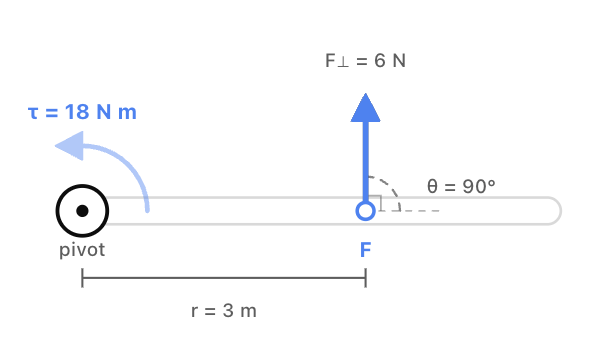
For a force acting perpendicular to a lever:
τ = Fr
where:
- τ = torque
- F = force
- r = perpendicular distance from the pivot to the line of action of the force
The SI unit of torque is: Nm or newton metre.
Force and Lever Arm
The distance between the pivot and the point where the force effectively acts is called the lever arm or moment arm.
For a perpendicular force:
Larger force → Larger torque
and:
Larger lever arm → Larger torque
This explains why applying the same force farther from the pivot produces a greater turning effect.
Worked Example 1
A force of: 20 N acts perpendicular to a wrench at a distance of 0.30 m from the pivot.
Calculate the torque.
τ = Fr = (20)(0.30) = 6.0 Nm
Why Does a Longer Wrench Help?
Suppose you apply the same 100 N force using two different wrenches.
Short Wrench
r = 0.15 m
τ = (100)(0.15) = 15 Nm
Long Wrench
r = 0.40 m
τ = (100)(0.40) = 40 Nm
The longer wrench produces much greater torque.
This is why long-handled tools make it easier to loosen tight bolts.


Factors That Affect Torque
Three main factors determine torque:
- size of the force
- distance from the pivot
- angle at which the force is applied
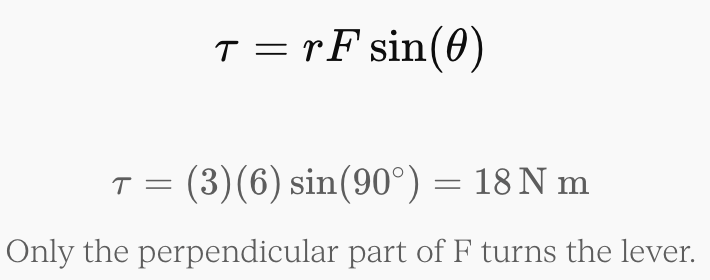
The full equation is: τ = rFsinθ
where θ is the angle between the lever arm and the force.
The Effect of Force
If the lever arm stays the same:
More force → More torque
For example:
A force of 10 N applied 0.5 m from a pivot gives:
τ = (10)(0.5) = 5 Nm
If the force doubles:
τ = (20)(0.5) = 10 Nm
The torque also doubles.
The Effect of Distance
If the force stays the same:
Greater distance from pivot → Greater torque
Imagine opening a door.
It is easiest to push:
far from the hinges
It is much harder to push:
close to the hinges


The force may be identical, but the larger lever arm creates greater torque.
The Effect of Angle
Torque is greatest when the force is applied perpendicular to the lever arm.
At:
θ = 90o
sin90 = 1
so:
τ = rF
If the force is applied at a smaller angle, less of the force contributes to rotation.
At:
θ = 90o
sin0 = 0
so:
τ = 0
A force directed straight toward or away from the pivot produces no turning effect.
Worked Example 2: Force at an Angle
A force of 50 N is applied to a 0.40 m wrench at an angle of 60o
Calculate the torque.
Use:
τ = rFsinθ
τ = (0.40)(50)sin60 = 20(0.866) = 17.3 Nm
If the same force had been applied at 90o , the torque would have been 20 Nm
So the angled force is slightly less effective.
Direction of Torque
Torque has a direction of rotation.
It can produce:
- clockwise rotation
- counterclockwise rotation


In many introductory problems, we use a sign convention such as:
Counterclockwise torque = positive
Clockwise torque = negative
However, the opposite convention can also be used as long as it is applied consistently.
Example: Clockwise Torque
Suppose a downward force is applied to the right side of a horizontal bar.
The right side moves downward.
The bar rotates: clockwise
Therefore, using the usual convention, the torque is negative.
Example: Counterclockwise Torque
Now suppose the same downward force is applied to the left side of the bar.
The left side moves downward.
The bar rotates: counterclockwise
The torque is positive using the usual convention.
Torque on a Seesaw
A seesaw is an excellent example of torque.
The pivot is located near the centre.
A person's weight produces torque: τ = Fr
where:
- F is the person's weight
- r is the distance from the pivot


A heavier person can balance a lighter person if the lighter person sits farther from the pivot.
Balanced Torque
An object is in rotational equilibrium when the total clockwise torque equals the total counterclockwise torque.
Therefore:
Στ = 0
or, in simple cases:
Clockwise torque = Counterclockwise torque
This means the object has no angular acceleration.
It may remain stationary or continue rotating at constant angular velocity.
Worked Example: Balanced Seesaw
A child weighing 400 N sits 1.5 m from the pivot.
Their torque is:
τ = (400)(1.5) = 600 Nm
A second child weighs 300 N
How far from the pivot should they sit to balance the seesaw?
For balance:
300r = 600
\( r = \frac{600}{300} = 2.0 m \)
The lighter child must sit farther from the pivot.
Torque and Doors
A door rotates around its hinges.
To open the door most easily:
- push far from the hinges
- push approximately perpendicular to the door
This maximizes the torque.
Pushing directly toward the hinges produces very little or no useful torque.

This is why door handles are usually installed on the side opposite the hinges.
Torque in Tools
Many tools are designed to increase torque.
Examples include:
- wrenches
- socket handles
- crowbars
- screwdrivers
- breaker bars
A long handle increases the lever arm, allowing a smaller force to produce a larger torque.
This is an example of using physics to make work easier.
Torque in Bicycles
When a cyclist pushes on a pedal, the force produces torque around the centre of the crank.
The greater the torque, the greater the tendency for the crank and bicycle wheel system to rotate.


Applying the force when the pedal is positioned so that the force is nearly perpendicular to the crank produces greater torque.
Torque in Cars
Torque is an important measure of engine and motor performance.
An engine produces torque that rotates the drivetrain and wheels.
Greater torque can help a vehicle:
- accelerate
- move heavy loads
- climb hills
- tow objects
This is why vehicle specifications often list both:
- power
- torque
They describe related but different aspects of vehicle performance.
Torque in the Human Body
The human body also uses torque.
Muscles pull on bones across joints.
The joint acts as the pivot, while the muscle provides the force.
For example, when lifting an object with your forearm:
- elbow = pivot
- biceps = force
- forearm = lever


Muscles often attach quite close to joints, meaning they must produce relatively large forces to create the required torque.
Torque and Centre of Mass
Gravity can also create torque.
If the line of action of an object's weight does not pass through its support point, gravity can cause the object to rotate or tip.
For example, a tall object becomes more likely to tip if its centre of mass moves beyond its base of support.
This idea is important in:
- vehicle stability
- construction
- sports
- robotics
- human balance
Worked Example: Opening a Door
A student pushes a door with a force of 30 N
The force is perpendicular to the door and applied 0.80 m from the hinges.
Calculate the torque.
τ = Fr
τ = = (30)(0.80) = 24 Nm
Now suppose the student applies the same force only 0.20 m from the hinges.
τ = = (30)(0.20) = 6 Nm
The original position produces four times as much torque.
Worked Example: Direction
A horizontal beam pivots at its centre.
A downward force of 40 N is applied 0.50 m to the right of the pivot.
Magnitude:
τ = (40)(0.50) = 20 Nm
The force causes a clockwise rotation.
Using counterclockwise as positive:
τ = = -20 Nm
Solving Torque Problems
A useful strategy is:
Step 1 – Identify the Pivot
Determine the point or axis around which rotation occurs.
Step 2 – Identify the Force
Find the magnitude and direction of the applied force.
Step 3 – Determine the Lever Arm
Find the perpendicular distance between the pivot and the force's line of action.
Step 4 – Calculate
For a perpendicular force:
τ = Fr
For a force at an angle:
τ = rFsinθ
Step 5 – Determine Direction
Is the rotation:
- clockwise
- counterclockwise?
Step 6 – Include Units
Torque is measured in: Nm
Don't Confuse Torque with Force
Force and torque are related but different.
Force
Can cause linear acceleration.
Unit: N
Torque
Can cause angular acceleration.
Unit: Nm
A large force does not necessarily produce a large torque.
If the force acts very close to the pivot, the torque may be small.
Torque and Angular Acceleration
Torque plays a rotational role similar to the role force plays in linear motion.
For linear motion:
Net force → linear acceleration
For rotational motion:
Net torque → angular acceleration
Therefore, an unbalanced torque causes an object's rotational motion to change.
Common Misconceptions
Torque is not just force.
Torque depends on both force and lever arm distance.
A force does not always produce torque.
If its line of action passes directly through the pivot:
r⊥ = 0
and therefore:
τ = 0
The longest distance is not always the correct lever arm.
The lever arm is the perpendicular distance from the pivot to the line of action of the force.
Balanced torque does not necessarily mean no forces are acting.
Several forces may act while their torques cancel.
Did You Know?
Professional mechanics sometimes use a torque wrench when tightening bolts.
A bolt may need to be tightened to a specific torque—for example:
120 Nm
Too little torque may leave the connection loose.
Too much torque may damage the bolt or the components being joined.


Torque is therefore not just a classroom calculation. It is an important measurement in engineering, mechanics, construction, and manufacturing.
Key Terms
Torque (τ) – The turning effect of a force around a pivot or axis.
Pivot – The point or axis around which an object rotates.
Lever arm – The perpendicular distance between the pivot and the force's line of action.
Clockwise torque – Torque tending to rotate an object clockwise.
Counterclockwise torque – Torque tending to rotate an object counterclockwise.
Rotational equilibrium – A condition in which the net torque is zero.
Line of action – The imaginary line extending through the direction of a force.
Angular acceleration – The rate of change of angular velocity.
Key Takeaways
- Torque is the turning effect of a force.
- Torque is measured in: Nm
- For a perpendicular force: τ = Fr
- More generally: τ = rFsinθ
- Torque increases when the force increases.
- Torque increases when the lever arm increases.
- Torque is greatest when the force acts perpendicular to the lever arm.
- A force directed through the pivot produces zero torque.
- Torque can act clockwise or counterclockwise.
- Rotational equilibrium occurs when the total clockwise and counterclockwise torques balance.
- Long handles on tools increase torque by increasing the lever arm.
- Torque is important in doors, wrenches, bicycles, seesaws, engines, human joints, machines, and many other rotating systems.
- Net torque causes angular acceleration, just as net force causes linear acceleration.