Gas Laws and Kinetic Theory
4. Ideal Gas Law and Molar Volume
Learning outcomes
- I can identify the variables in the Ideal Gas Law.
- I can calculate pressure, volume, temperature, or amount of gas using the Ideal Gas Law.
- I can explain the concept of molar volume.
- I can use molar volume to determine the volume or amount of a gas at standard conditions.
- I can compare calculations using the Ideal Gas Law and molar volume.
Ideal Gas Law and Molar Volume
Bringing the Gas Variables Together
The basic gas laws describe relationships between pressure, volume and temperature. The Ideal Gas Law combines these relationships and also includes the amount of gas present.
The four important variables are:
- pressure (P)
- volume (V)
- amount of gas
- absolute temperature (T)
This makes the Ideal Gas Law useful when the amount of gas is known or needs to be calculated.


The Ideal Gas Law
The relationship between the variables is:
PV = nRT
where:
- P = pressure
- V = volume
- n = amount of gas in moles
- R = ideal gas constant
- T = absolute temperature in kelvin
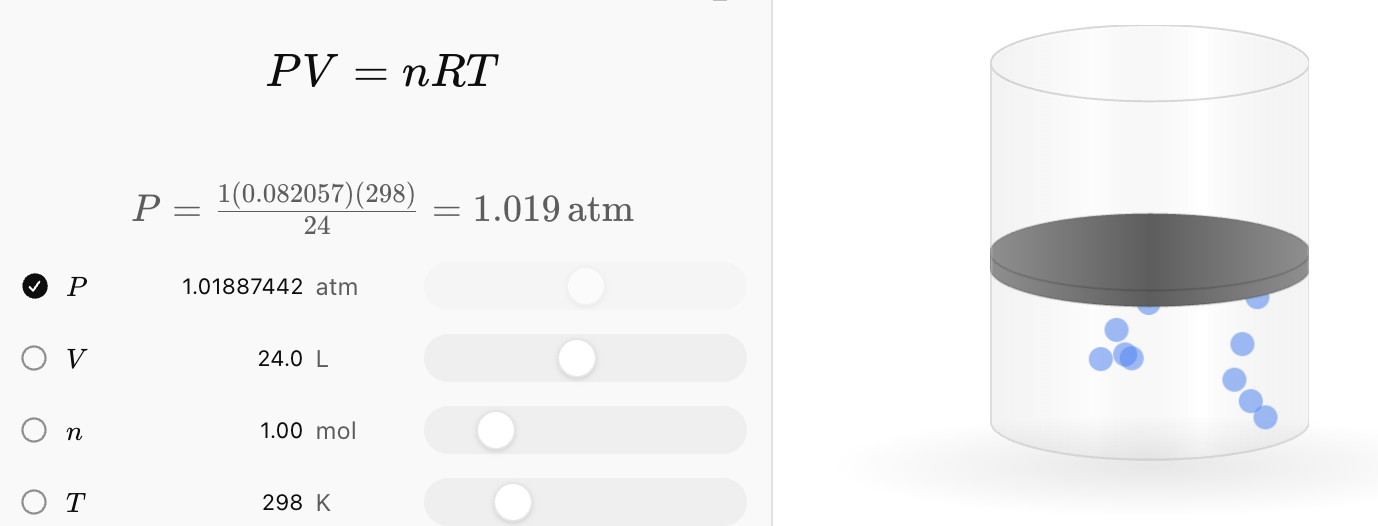
The Ideal Gas Law describes the behavior of an ideal gas and provides a good approximation for many real gases under ordinary conditions.
Understanding the Variables
Pressure
Pressure results from gas particles colliding with the walls of their container.
Common units include:
- Pa
- kPa
- atm
Volume
Volume is the space occupied by the gas.
Common units include:
- m³
- L
- mL
Amount of Gas
The amount of gas is measured in moles.
Symbol:
n
One mole contains approximately:
6.022 × 10²³ particles
This number is called the Avogadro constant.
Temperature
Temperature must be measured in kelvin.
Convert using:
T(K) = T(°C) + 273.15
The Gas Constant
The value of R depends on the units used for pressure and volume.
Two commonly used forms are:
R = 8.31 J/(mol·K)
when using SI units:
- pressure in Pa
- volume in m³
or:
R = 8.31 kPa·L/(mol·K)
when using:
- pressure in kPa
- volume in L
These work because:
1 kPa·L = 1 J
Another common chemistry form is:
R = 0.0821 L·atm/(mol·K)
when pressure is measured in atmospheres.
The important rule is:
choose an R value that matches your units.
Rearranging the Ideal Gas Law
Starting with:
PV = nRT
To calculate pressure:
P = nRT/V
To calculate volume:
V = nRT/P
To calculate amount of gas:
n = PV/RT
To calculate temperature:
T = PV/nR
These four forms allow us to solve many gas problems.
Solving an Ideal Gas Problem
A reliable strategy is:
- Identify P, V, n and T.
- Convert temperature to kelvin.
- Check that pressure and volume units match R.
- Rearrange PV = nRT for the unknown.
- Substitute the values.
- Include the correct unit.
- Check whether the answer is physically reasonable.
Worked Example: Finding Volume
Calculate the volume occupied by 2.00 mol of an ideal gas at:
T = 300 K
P = 100 kPa
Use:
V = nRT/P
Using:
R = 8.31 kPa·L/(mol·K)
Substitute:
V = (2.00 × 8.31 × 300)/100
V = 49.86 L
V ≈ 49.9 L
Worked Example: Finding Pressure
A 10.0 L container contains 0.50 mol of gas at 300 K.
Calculate the pressure.
Use:
P = nRT/V
P = (0.50 × 8.31 × 300)/10.0
P = 124.65 kPa
P ≈ 125 kPa
Worked Example: Finding the Amount of Gas
A 12.0 L container holds gas at:
P = 200 kPa
T = 300 K
Calculate the amount of gas.
Use:
n = PV/RT
n = (200 × 12.0)/(8.31 × 300)
n = 2400/2493
n ≈ 0.963 mol
Worked Example: Finding Temperature
A 5.0 L container holds 0.20 mol of gas at a pressure of 150 kPa.
Find the temperature.
Use:
T = PV/nR
T = (150 × 5.0)/(0.20 × 8.31)
T ≈ 451 K
T ≈ 451 K
In Celsius:
451 − 273 ≈ 178°C
Why Temperature Must Be in Kelvin
The Ideal Gas Law uses absolute temperature.
Suppose a gas is at:
27°C
Convert:
T = 27 + 273
T ≈ 300 K
Using 27 directly in PV = nRT would give a completely incorrect result.
This is because 0°C does not represent zero molecular kinetic energy.
The kelvin scale begins at absolute zero.
Unit Consistency
One of the most common sources of errors is mixing incompatible units.
For example, if:
R = 8.31 kPa·L/(mol·K)
then use:
- P in kPa
- V in L
- n in mol
- T in K
If:
R = 8.31 Pa·m³/(mol·K)
then use:
- P in Pa
- V in m³
A useful conversion is:
1 L = 0.001 m³
and:
1 kPa = 1000 Pa
Connecting the Ideal Gas Law to Particle Theory
The Ideal Gas Law can also be understood using kinetic molecular theory.


If more particles are placed into the same volume:
n ↑ → more wall collisions → P ↑
If temperature increases:
T ↑ → average kinetic energy ↑ → P tends to ↑
If volume increases:
V ↑ → wall collisions become less frequent per unit area → P tends to ↓
The mathematical relationships in PV = nRT therefore reflect microscopic particle behavior.
What Is a Mole?
Gas samples contain enormous numbers of particles.
Instead of counting individual atoms or molecules, chemists use the mole.
One mole contains:
6.022 × 10²³ particles
Therefore:
2 mol contains approximately:
1.204 × 10²⁴ particles
and:
0.5 mol contains approximately:
3.011 × 10²³ particles
The mole allows microscopic particle numbers to be connected to measurable quantities of gas.
What Is Molar Volume?
Molar volume is the volume occupied by one mole of a substance under specified conditions.
For gases:
molar volume = volume/amount
or:
V_m = V/n
where:
- V_m = molar volume
- V = gas volume
- n = amount of gas
Typical units are:
L/mol
or:
m³/mol
Why Conditions Matter
A gas does not have one fixed molar volume under all conditions.
Gas volume depends strongly on:
- temperature
- pressure
Therefore, a molar volume must always be associated with specified conditions.
For example, one mole of gas occupies a larger volume at:
- higher temperature
- lower pressure
and a smaller volume at:
- lower temperature
- higher pressure
Standard Temperature and Pressure
A commonly used reference condition is standard temperature and pressure, or STP.
A widely used chemistry definition is:
T = 273.15 K (0°C)
P = 100 kPa
At these conditions, one mole of an ideal gas occupies approximately:
22.7 L/mol
However, some textbooks use the older convention:
T = 273.15 K
P = 1 atm = 101.325 kPa
Under those conditions:
molar volume ≈ 22.4 L/mol
This difference is small but important.
Always check which definition your course or question uses.
Why You May See 22.4 L and 22.7 L
Both values can be correct because they refer to slightly different standard pressures.
| Conditions | Molar Volume |
|---|---|
| 0°C and 100 kPa | ≈ 22.7 L/mol |
| 0°C and 1 atm | ≈ 22.4 L/mol |
For calculations, use the convention specified in the question.
If none is given, state which standard you are using.
Using Molar Volume
If molar volume is known:
V = nV_m
where:
- V = gas volume
- n = amount in moles
- V_m = molar volume
To find moles:
n = V/V_m
This can make calculations at standard conditions much quicker than using the complete Ideal Gas Law.
Worked Example: Volume from Moles
Using:
V_m = 22.7 L/mol
calculate the volume of 3.0 mol of ideal gas at 0°C and 100 kPa.
Use:
V = nV_m
V = 3.0 × 22.7
V = 68.1 L
Worked Example: Moles from Volume
A gas occupies 45.4 L at 0°C and 100 kPa.
Calculate the amount of gas.
Use:
n = V/V_m
n = 45.4/22.7
n = 2.00 mol
Worked Example: A Smaller Gas Sample
What volume would 0.25 mol of ideal gas occupy at 0°C and 100 kPa?
V = nV_m
V = 0.25 × 22.7
V = 5.68 L
Why Different Gases Have Similar Molar Volumes
At the same temperature and pressure, equal amounts of ideal gases occupy equal volumes.
This is related to Avogadro's law.
For example, at the same temperature and pressure:
1 mol helium
1 mol oxygen
1 mol nitrogen
1 mol hydrogen
all occupy approximately the same volume if they behave ideally.


The particles themselves may have very different masses, but the relationship between particle number, pressure, temperature and volume produces the same ideal-gas molar volume.
Molar Volume Does Not Mean Equal Mass
Suppose we have:
1 mol He
and:
1 mol O₂
At the same temperature and pressure, they occupy approximately the same volume.
But their masses are very different.
Approximately:
1 mol He ≈ 4 g
1 mol O₂ ≈ 32 g
Therefore:
equal molar volume does not mean equal mass.
It means equal amounts in moles occupy equal volumes at the same temperature and pressure.
Finding Molar Volume from the Ideal Gas Law
The molar volume relationship can actually be derived from the Ideal Gas Law.
Start with:
PV = nRT
Rearrange:
V/n = RT/P
But:
V/n = V_m
Therefore:
V_m = RT/P
This shows clearly that molar volume depends on:
- temperature
- pressure
Calculating Molar Volume at 100 kPa
At:
T = 273.15 K
P = 100 kPa
Use:
V_m = RT/P
V_m = (8.31 × 273.15)/100
V_m ≈ 22.7 L/mol
So one mole occupies approximately:
22.7 L
at 0°C and 100 kPa.
Molar Volume at Room Temperature
Suppose the temperature is approximately:
25°C = 298 K
and pressure is:
100 kPa
Calculate the molar volume.
V_m = RT/P
V_m = (8.31 × 298)/100
V_m ≈ 24.8 L/mol
Therefore, at approximately room temperature and 100 kPa:
1 mol ideal gas occupies about 24.8 L
This is larger than its volume at 0°C because the temperature is higher.
STP vs Room Conditions
This comparison is useful:
| Conditions | Approximate Molar Volume |
|---|---|
| 0°C, 100 kPa | 22.7 L/mol |
| 25°C, 100 kPa | 24.8 L/mol |
Heating the gas while keeping pressure constant causes it to expand.
This agrees with Charles' Law.
Using the Ideal Gas Law or Molar Volume?
Both methods can solve some of the same problems.
Use molar volume when:
- conditions match a known standard
- the molar volume is given
- only volume and moles are needed
Use the Ideal Gas Law when:
- temperature is not a standard value
- pressure is not a standard value
- pressure must be calculated
- temperature must be calculated
- conditions are changing
- a more general solution is needed
Comparing the Two Methods
Suppose 2.0 mol of gas is at:
0°C and 100 kPa.
Molar Volume Method
V = nV_m
V = 2.0 × 22.7
V = 45.4 L
Ideal Gas Law Method
V = nRT/P
V = (2.0 × 8.31 × 273.15)/100
V ≈ 45.4 L
Both methods give approximately the same answer.
The molar-volume method is simply faster when the appropriate standard conditions apply.
Molar Volume and Particle Number
Since one mole contains:
6.022 × 10²³ particles
approximately 22.7 L of an ideal gas at 0°C and 100 kPa contains:
6.022 × 10²³ particles
This is true whether the gas is:
- helium
- hydrogen
- nitrogen
- oxygen
provided ideal behavior is a reasonable approximation.
Connecting Mass, Moles and Gas Volume
Gas problems may also provide mass instead of moles.
Use:
n = m/M
where:
- n = amount in mol
- m = mass
- M = molar mass
Once moles are known, use either:
PV = nRT
or:
V = nV_m
depending on the conditions.
Worked Example: Mass to Gas Volume
What volume would 32 g of oxygen gas occupy at 0°C and 100 kPa?
O₂ has molar mass:
M = 32 g/mol
First calculate moles:
n = m/M
n = 32/32
n = 1.00 mol
Now use molar volume:
V = nV_m
V = 1.00 × 22.7
V = 22.7 L
Worked Example: Gas Volume to Mass
A sample of oxygen occupies 11.35 L at 0°C and 100 kPa.
First find moles:
n = V/V_m
n = 11.35/22.7
n = 0.500 mol
O₂ has molar mass:
32 g/mol
Therefore:
m = nM
m = 0.500 × 32
m = 16.0 g
Gas Density
The Ideal Gas Law can also help explain gas density.
Density is:
ρ = m/V
For one mole:
m = M
and:
V = V_m
Therefore:
ρ = M/V_m
A gas with a larger molar mass generally has a greater density under the same temperature and pressure conditions.
For example, oxygen gas is denser than helium at the same temperature and pressure.
Ideal Gases and Real Gases
The Ideal Gas Law assumes ideal behavior.
Real gases are made of particles that:
- have finite volume
- experience intermolecular forces
Real gases behave most like ideal gases when:
- pressure is relatively low
- temperature is relatively high


At high pressures, particles are crowded closer together and their actual volume becomes important.
At low temperatures, attractive forces between particles become more significant.
Why the Ideal Gas Law Is Useful
Even though no real gas is perfectly ideal, PV = nRT provides a very useful approximation for:
- laboratory gases
- atmospheric calculations
- balloons
- gas storage
- chemistry calculations
- engineering
- environmental science
It provides a bridge between microscopic particle behavior and measurable macroscopic quantities.
Common Mistakes
Mistake: "Temperature can be entered in Celsius."
The Ideal Gas Law requires kelvin.
Mistake: "R is always 8.31 regardless of units."
The numerical value and units of R must match the pressure and volume units being used.
Mistake: "One mole of gas always occupies 22.4 L."
Molar volume depends on temperature and pressure.
Mistake: "22.4 L/mol and 22.7 L/mol cannot both be correct."
They correspond to different standard-pressure conventions.
Mistake: "All gases have the same density because they have the same molar volume."
Different gases have different molar masses.
Mistake: "Molar volume can be used at any temperature and pressure."
A quoted molar volume applies only to its specified conditions.
Mistake: "Moles and molecules are the same thing."
A mole is an amount containing 6.022 × 10²³ particles.
Key Terms
Ideal Gas Law — relationship connecting pressure, volume, amount of gas and absolute temperature.
Ideal gas — theoretical gas whose particles follow the assumptions of the ideal-gas model.
Pressure (P) — force per unit area produced by gas-particle collisions.
Volume (V) — amount of space occupied by a gas.
Amount of gas — quantity of gas measured in moles.
Absolute temperature (T) — temperature measured using the kelvin scale.
Ideal gas constant (R) — proportionality constant connecting P, V, n and T.
Mole — amount of substance containing approximately 6.022 × 10²³ particles.
Avogadro constant — number of particles per mole, approximately 6.022 × 10²³ mol⁻¹.
Molar volume (V_m) — volume occupied by one mole of a substance under specified conditions.
Standard temperature and pressure (STP) — defined reference conditions used for gas calculations; the exact pressure convention should always be checked.
Avogadro's law — equal amounts of ideal gases occupy equal volumes at the same temperature and pressure.
Molar mass (M) — mass of one mole of a substance.
Key Takeaways
- The Ideal Gas Law combines pressure, volume, amount of gas and temperature.
- The equation is PV = nRT.
- P represents pressure, V volume, n moles and T absolute temperature.
- Temperature must always be expressed in kelvin when using the Ideal Gas Law.
- The units used for pressure and volume must match the chosen value of R.
- The Ideal Gas Law can be rearranged to calculate P, V, n or T.
- One mole contains approximately 6.022 × 10²³ particles.
- Molar volume is the volume occupied by one mole at specified temperature and pressure.
- Molar volume is calculated using V_m = V/n.
- At 0°C and 100 kPa, an ideal gas has a molar volume of approximately 22.7 L/mol.
- At 0°C and 1 atm, the corresponding value is approximately 22.4 L/mol.
- At about 25°C and 100 kPa, the ideal-gas molar volume is approximately 24.8 L/mol.
- Molar volume changes when temperature or pressure changes.
- Different ideal gases have approximately the same molar volume when measured at the same temperature and pressure.
- Equal molar volumes do not mean equal masses.
- Molar volume is convenient when conditions match a known reference value.
- The Ideal Gas Law is more general and can be used at many different temperatures and pressures.
- Molar-volume calculations and Ideal Gas Law calculations should agree when the same conditions are used.
Check Your Understanding
- Write the Ideal Gas Law.
- What does each symbol in PV = nRT represent?
- Why must temperature be expressed in kelvin?
- Calculate the volume of 1.5 mol of ideal gas at 300 K and 100 kPa.
- A 20.0 L container holds 0.80 mol of gas at 300 K. Calculate its pressure.
- A gas occupies 15.0 L at 150 kPa and 300 K. Calculate the number of moles present.
- Define molar volume.
- What is the approximate molar volume of an ideal gas at 0°C and 100 kPa?
- Why might a textbook give 22.4 L/mol instead of 22.7 L/mol?
- Calculate the volume occupied by 2.5 mol of ideal gas at 0°C and 100 kPa using molar volume.
- A gas occupies 56.75 L at 0°C and 100 kPa. Calculate the number of moles.
- Explain why one mole of helium and one mole of oxygen occupy approximately the same volume at the same temperature and pressure.
- Explain why those two samples do not have the same mass.
- When is using molar volume easier than using PV = nRT?
- When would the Ideal Gas Law be preferable to using a standard molar volume?
- Calculate the molar volume of an ideal gas at 298 K and 100 kPa and compare it with the molar volume at 273 K.