Gas Laws and Kinetic Theory

3. Gas Laws

Learning outcomes
  • I can describe Boyle's Law, Charles' Law, and Gay-Lussac's Law.
  • I can identify which variables remain constant in each gas law.
  • I can predict how pressure, volume, and temperature change in different situations.
  • I can solve problems involving the basic gas laws.
  • I can explain gas laws using the kinetic molecular theory.

Gas Laws

Describing the Behavior of Gases

The gas laws describe relationships between three important properties of a gas:

  • pressure (P)
  • volume (V)
  • temperature (T)

For a fixed amount of gas, changing one of these variables often causes another to change.

Three fundamental gas laws are:

  • Boyle's Law — pressure and volume
  • Charles' Law — volume and temperature
  • Gay-Lussac's Law — pressure and temperature
https://images.openai.com/static-rsc-4/Ptq75in4JHGJOc5K4H_xFFlo--tebf94rEbv3S_JuN2n3kb3JA0NTuHNayoV6de2MqCvagdWPy2vLYts0U1xlhubJ3-4e3UWr47V58HCZtGLFUD2jdtngBEGG49Zk6CQSNenPGQDCcOMtZkEGXo3hEv9IFvHusO_M0SU2uKVc2AmAAXM6yCn70iT3vHn7DPA?purpose=fullsize
 
https://images.openai.com/static-rsc-4/l_xTMuYaUp5POIaSHODDUM5xJdGJmi85VkKmLb0wq8OXkXVp5NtAIZKETiO1-dLQNv8orqph-5PBN1LcUbXPmF0CCSm6Zt1aBpo2Euhv3PxzdBpdaJGDG3N8ETRz54VfbkBIdggfhbytDt7BpFTkHScH3rNOhQdgicJ2FRCSKpKE8Fr64A5HTEgy-R6OTqVU?purpose=fullsize
 
https://images.openai.com/static-rsc-4/gqJ5erlHaJ9tw9Kmlhe7LQtdJv_91EdM9JJQbnmoe8PrRWu0uPoQkZWvZ5kU05pL7CuY8jinm4ooxhRBzR6aWtVHLtwl3izO0SIa0nFHvfRrv23MajeYdpUq7FFp16-h4z4vNLvkwT0YXB7OHXDsuZNa16CcZgV0WDXZGqHdACFhD75ON-WiKq_n0-N0dyiV?purpose=fullsize
 
6

Each law keeps one important variable constant.

Gas Law Variables Compared Held Constant Relationship
Boyle's Law P and V Temperature Inverse
Charles' Law V and T Pressure Direct
Gay-Lussac's Law P and T Volume Direct

The amount of gas is also assumed to remain constant.


Pressure, Volume and Temperature

Before examining the laws, it is useful to review the three variables.

Pressure

Gas pressure results from particles colliding with the walls of their container.

Common pressure units include:

  • pascal (Pa)
  • kilopascal (kPa)
  • atmosphere (atm)

Volume

Volume is the amount of space occupied by the gas.

Common units include:

  • litres (L)
  • millilitres (mL)
  • cubic metres (m³)

Temperature

Temperature is related to the average translational kinetic energy of gas particles.

For gas-law calculations involving temperature ratios, temperature must be measured in:

kelvin (K)

Convert using:

T(K) = T(°C) + 273.15


Boyle's Law

Boyle's Law describes the relationship between pressure and volume when:

  • temperature remains constant
  • amount of gas remains constant

The relationship is:

pressure ∝ 1/volume

Therefore:

volume decreases → pressure increases

and:

volume increases → pressure decreases

This is an inverse relationship.
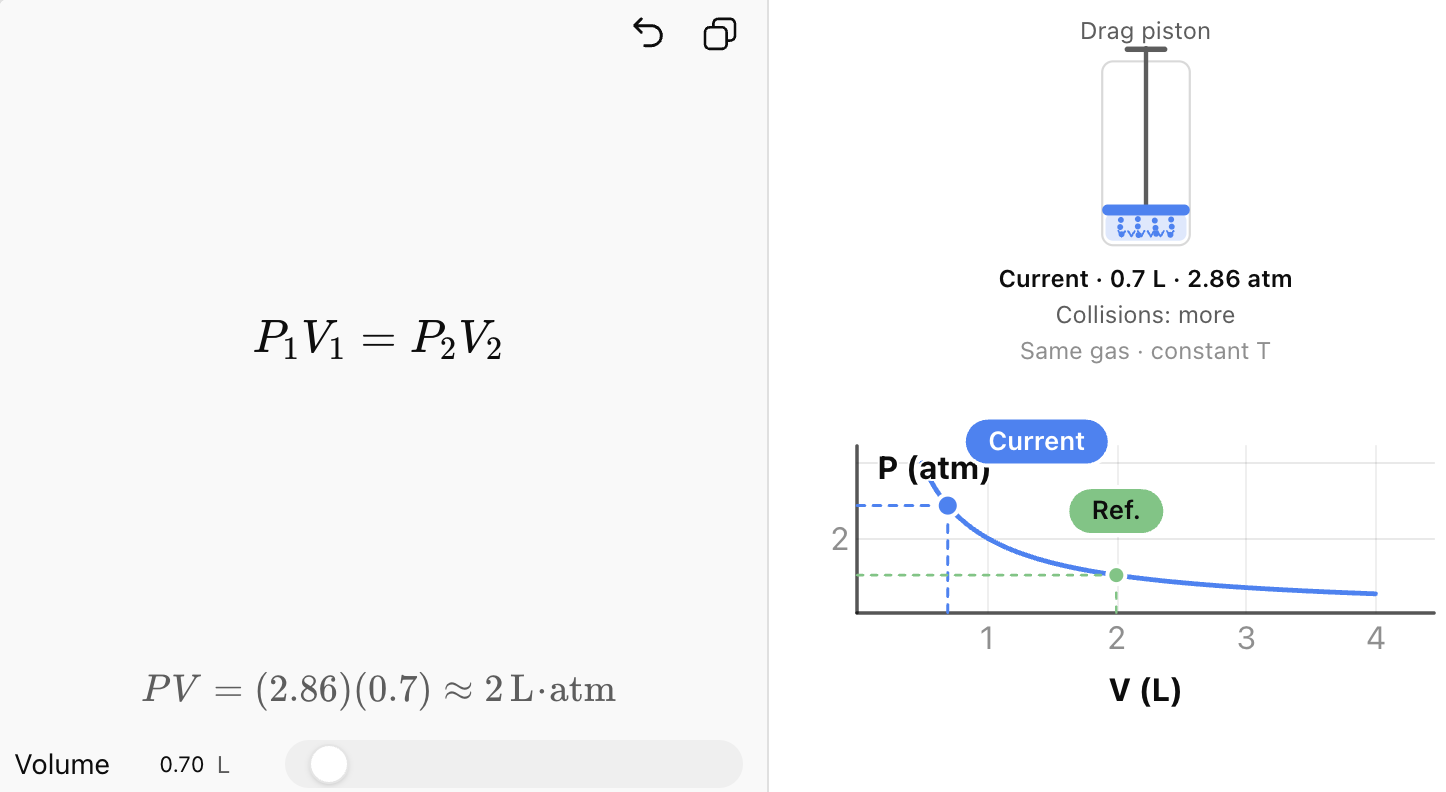
Boyle's Law Equation

For two states of the same gas:

P₁V₁ = P₂V₂

where:

  • P₁ = initial pressure
  • V₁ = initial volume
  • P₂ = final pressure
  • V₂ = final volume

Temperature must remain constant.


Boyle's Law and Particle Theory

Imagine gas trapped inside a sealed syringe.

When the plunger is pushed inward:

  • volume decreases
  • particles have less space
  • particles travel shorter distances between wall collisions
  • collisions with the walls occur more frequently

Therefore:

pressure increases

https://images.openai.com/static-rsc-4/Fi6DJbINoANpwAOEPrardyeKjoK9THkr2vwXcm_HzUwz2W4Fusv5mlug-fUE9vyd9YiBpD4qXnmKvcXTloaVgk3pENIFwWLOpXaOiMyP-OUpewirXTqslGu-dhNcFecOvg5oQhYf0AGgCl6lXtMS-VteFLh6pB2yWRNzkXb0BiGFoNGVQLEmBzcwmTYhuMpO?purpose=fullsize
 
https://images.openai.com/static-rsc-4/G8ASNVXG-Xa3aX86mmjguHQTcdsmUQZbZZqworCsG_AIYcjzX-LEZMbtGPA1-M8nqMhVLjGEuGY69tkpZg0KrrNjJepw25x0HzI0eVibylY8joWjorU0aGfXKdNmqBdee4BBfsPn_3lsaHxMZloaka8UKSWyilRhS8B8vuOcLJYblsrhe1ek78UYgRLt-mh2?purpose=fullsize
 
https://images.openai.com/static-rsc-4/PJVsQQSGVQLINLX7JfTr9COs2AujDpjXJ5YbTJkeGFsiQed-AdKB6WgBYO-ugw6lwbfc27lT6G3Of-fc6IXhwb4jZe8n_n0gJdNDwzUlk0PtFVVoCpFqWnHYNHH2iP17XTmKdG-O8Tt9XgrWyuAG1knaYGOf-67-qhuhcLUe-Wxds6xFkjo3XbFmtd5jZ_GE?purpose=fullsize
 
6

The particles themselves do not become smaller.

The space between the particles decreases.


Boyle's Law Prediction

Suppose a gas occupies:

4.0 L at 100 kPa

If the volume is reduced to:

2.0 L

at constant temperature, the volume has been halved.

Therefore, the pressure doubles:

100 kPa → 200 kPa

So:

V ÷ 2 → P × 2


Boyle's Law Worked Example

A gas occupies 6.0 L at a pressure of 120 kPa. It is compressed to 4.0 L at constant temperature.

Find the new pressure.

Use:

P₁V₁ = P₂V₂

Substitute:

120 × 6.0 = P₂ × 4.0

720 = 4.0P₂

P₂ = 180 kPa

Answer: 180 kPa

The answer makes sense because volume decreased, so pressure should increase.


Boyle's Law Graph

If pressure is plotted against volume, the graph is a curve.

https://images.openai.com/static-rsc-4/HDtw8adzdSFgEHzhJ-5HuyM56QweE8tL0-W9nn0HnBOTFfh42HyLGgQGBxTcwCbi_kLIp7L74GRKi4N8kO3d9-K0MY094rCMSgJkadIc-6nlWH3S_czli_RTHo3VZSWgyFbHRXe0Q---pev2TSJ7ziNkXyeI1QANiHUihzIPU3Z6SdsaUNmpBRrG6a8Mf7ws?purpose=fullsize
 
https://images.openai.com/static-rsc-4/ZXpCct4vN0lvJ3xxJsBwc63N1y8rCwuc5VRql-DEKEX7v7iNqFRh13Y3j9Olpf0bQm09IIGnZDlynwbscPa3sHEEPJmFmnV6_pss8rUD-osg7aVADTZIfScSHzZj4x-6OcdEWVlKRkFw74zAaMrMBlbLSDZLfpv1cyRimu_jQkYzpNQOtPMBlu3_Asbt6Ctk?purpose=fullsize
 
https://images.openai.com/static-rsc-4/Cp3MnIT1-XSgAiLTjGGlHVsJkj3SuTrgo7VpGy9ipJyKuLVWBoL67kDmSZoUHiikKZ8vsmtZfGTUG8CInFPsmG98vJ-k2rW4mRYpITdlhC1AolkRx2ZMiGfyLw3H1PQBt51w7HqIH8RS-_mu12jRVn1fvSmfaIOIC72ATA7FKnrxhoQ8shNKkgMAOateViMw?purpose=fullsize
 
6

As volume increases, pressure decreases.

The graph is not a straight line because:

P ∝ 1/V

However, a graph of pressure against 1/V would be linear for an ideal gas at constant temperature.


Boyle's Law in Everyday Life

Breathing

During inhalation, the chest cavity expands.

The volume available to the lungs increases, reducing the pressure inside relative to atmospheric pressure.

Air then moves into the lungs.

During exhalation, the volume decreases and pressure increases, helping push air outward.

Syringes

Pulling a syringe plunger outward increases volume and lowers pressure inside.

Pushing it inward decreases volume and raises pressure.

Bicycle Pumps

Compressing air inside a bicycle pump decreases its volume and increases its pressure.


Charles' Law

Charles' Law describes the relationship between volume and temperature when:

  • pressure remains constant
  • amount of gas remains constant

The relationship is:

volume ∝ absolute temperature

Therefore:

temperature increases → volume increases

and:

temperature decreases → volume decreases

This is a direct relationship.
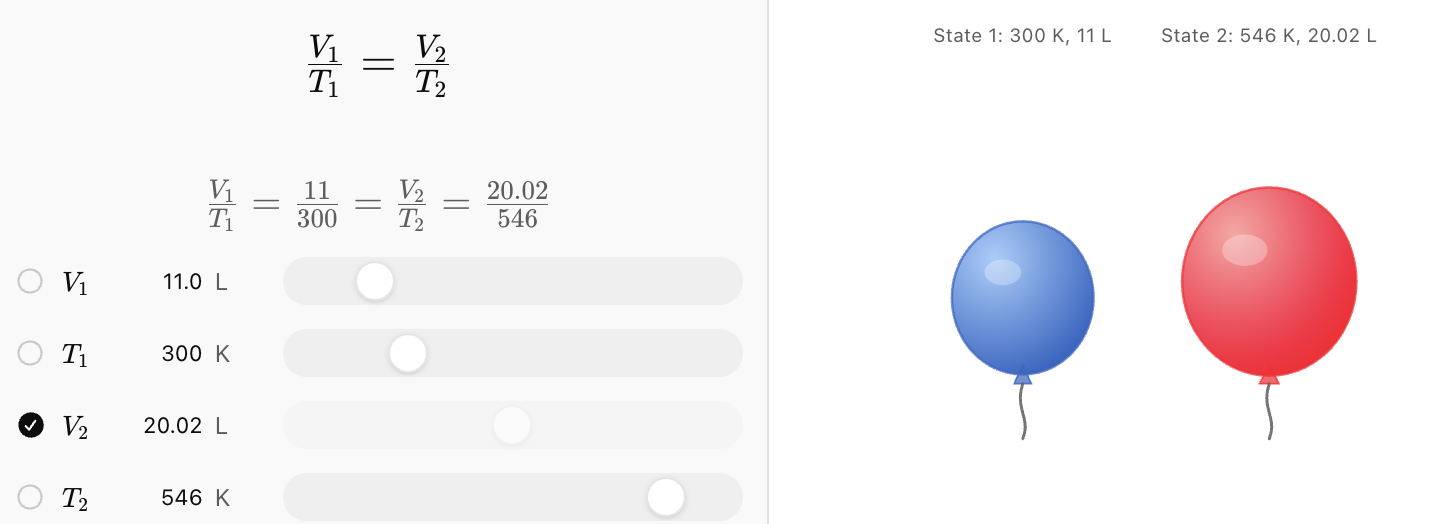
Charles' Law Equation

For two states:

V₁/T₁ = V₂/T₂

where:

  • V₁ = initial volume
  • T₁ = initial temperature
  • V₂ = final volume
  • T₂ = final temperature

Temperatures must be in kelvin.


Charles' Law and Particle Theory

Suppose gas is trapped beneath a movable piston.

When the gas is heated:

  • temperature increases
  • average kinetic energy increases
  • particles move faster
  • collisions with the piston become more energetic

The piston moves outward.

The gas expands until its internal pressure again balances the external pressure.

Therefore:

temperature increases → volume increases

when pressure remains constant.

https://images.openai.com/static-rsc-4/N-LqdGg5jsKS7DfRxohQA68j-ggN1F8KuK6SYFts6SEEQtUztrhoP62J1HFC-uO9rSUXnYbgD6L_PWJePfo-Ia_xxenHrLBvqhkz0_b5s6M5pQOt1UN1JoKCcmeJbTS903_U9Hhz9CN-kSEsDmNRh4APxhiSZbZ8asVTjYxyGUM0yLoFURT5J6mdU57dlKup?purpose=fullsize
 
https://images.openai.com/static-rsc-4/PLldSCeMWAgW7sxa8h27Df1bKAYqQdJQsoIWsxtucyayOhfsgprs5sW4_wOv3V_eP1tKpCa0rfvzQbxNUCtaUnjej-vNBujs1jtJtVD1_GqXoZwH_cAFlDj9OhZr4OrwJXLyXs-Sc-5_as0yKAn46JUAlqwIimjbU9KB4-b2iD5s77hwukNYypDS0vnjz0du?purpose=fullsize
 
https://images.openai.com/static-rsc-4/yCFKj02caCXdu8_HyakZGZ2wN14DKDPylogTdKaOLFzMCS564uah6t-RI9S4s0IMgi3Vz8bvNU08b-FKwm4CCzB-0mVpQWHLsgOgAEmPdApe7IubIRHIB_i1C1ppe1twcE7mzzfQQlby9kaFymfOUg1eXZBwyJpEN_huMDcAmv53rtJci6TzzR89BrCkPnX0?purpose=fullsize
 
7

Charles' Law Prediction

Suppose a gas has:

V₁ = 2.0 L

at:

T₁ = 300 K

If the temperature increases to:

T₂ = 600 K

the absolute temperature doubles.

At constant pressure:

volume also doubles

Therefore:

V₂ = 4.0 L


Charles' Law Worked Example

A balloon has a volume of 3.0 L at 300 K.

It is heated to 400 K while pressure remains approximately constant.

Find its new volume.

Use:

V₁/T₁ = V₂/T₂

Substitute:

3.0/300 = V₂/400

V₂ = (3.0 × 400)/300

V₂ = 4.0 L

Answer: 4.0 L

The answer makes sense because temperature increased, so volume increased.


Why Celsius Cannot Be Used

Suppose a gas is heated from:

20°C to 40°C

It would be incorrect to say the temperature doubled.

Convert to kelvin:

20°C = 293 K

40°C = 313 K

The absolute temperature only increased slightly.

Therefore, the gas volume would increase only slightly at constant pressure.

Gas laws involving temperature ratios require kelvin.


Charles' Law Graph

A graph of volume against absolute temperature is approximately a straight line for an ideal gas.

https://images.openai.com/static-rsc-4/zG2Bs3rka92ot70z13XSnd9s42KUhXR1oChrfdtkcUBBKgjVP24oLkN7kcRm_6etISeYjjmbOnfomKGTHcBIU6_qRLq4BRCQIJtwvWj94yNcCf5qH9CnM0yrYA0gE8iRNc2OYXLNLhrG-XaZlMH_K3FkoJ2zucLdis-uBILWq0PVxY-h-NAoEvutu192Jrx3?purpose=fullsize
 
https://images.openai.com/static-rsc-4/lTvARUasUxNAbNppMPMvEcX5VCotYDArRrOByrXBCCEYuKnaSNqQf_bAW6RaUHJ0abcbx96-q9TtevMsStHYmY4huOEcD5ki5Y18hAMCnfev40WaGUZQkHMsd8pdrphbrlOtDtv4a_0FvOqjqyhjsr82wHObh_PJHLULisCzZqmj6cXXqB6lFMDqNeUiXtRJ?purpose=fullsize
 
https://images.openai.com/static-rsc-4/Nd1mYtEyyyL3Sc9zSsVSi7kWhDwCoFfmBruGrMpYDjEnFpOZ5_EJzPedsVY7o8eBvI22vxxL5zyGK-BUOdcxy5P53LXBmfYVOJQ3OHt1oheQHg0Emg10pRlTKw7NzuxcnywaUX7HKf4JVnzJmmpVtaRGKPTOtW460r1UvEJHu2ghhJuNud-vYp-gXChHiaoL?purpose=fullsize
 
6

Since:

V ∝ T

doubling absolute temperature doubles volume if pressure remains constant.

An idealized line extrapolates toward zero volume at:

T = 0 K

This historical relationship helped scientists develop the concept of absolute zero.


Charles' Law in Everyday Life

Balloons

A balloon placed in a cold environment may shrink.

Cooling reduces the particles' average kinetic energy, and the flexible balloon contracts until its internal and external pressures rebalance.

Hot-Air Balloons

Heating the air causes it to expand.

The expanded air has lower density than the surrounding cooler air, helping produce buoyancy.

Sports Balls

Flexible balls can change slightly in size when their temperature changes, although pressure may also change.


Gay-Lussac's Law

Gay-Lussac's Law describes the relationship between pressure and temperature when:

  • volume remains constant
  • amount of gas remains constant

The relationship is:

pressure ∝ absolute temperature

Therefore:

temperature increases → pressure increases

and:

temperature decreases → pressure decreases

This is another direct relationship.
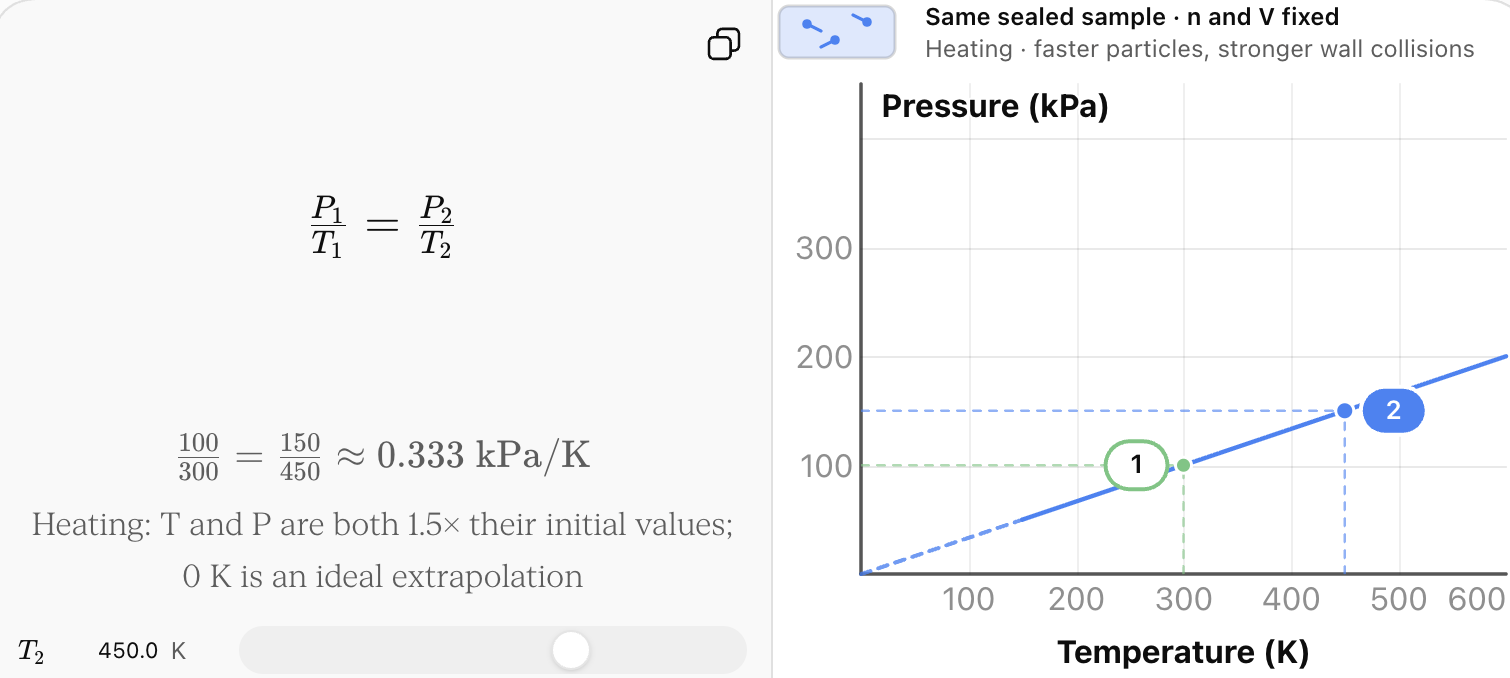
Gay-Lussac's Law Equation

For two states:

P₁/T₁ = P₂/T₂

where:

  • P₁ = initial pressure
  • T₁ = initial temperature
  • P₂ = final pressure
  • T₂ = final temperature

Again:

temperature must be measured in kelvin.


Gay-Lussac's Law and Particle Theory

Imagine gas trapped in a rigid sealed container.

The volume cannot change.

When the gas is heated:

  • temperature increases
  • average kinetic energy increases
  • particles move faster
  • particles strike the walls more frequently
  • collisions involve greater momentum changes

Therefore:

pressure increases

https://images.openai.com/static-rsc-4/VO7G23JNgz5mtY-PMcG7jg5kcXvXJEj6jqCI1L5mHAkVy4PoLMgUmgVYY79O3aANPbCWGgkkt3L04xYfCDRd5JeIf_fTB89sic0tBH2DaJR-id72zU6XeEgxQ4d558_cCjo25xbKVQuJS1rDo1V784PWqph40f8YB5GOSn2n3RoOreqA9umwM04gDX91iAw8?purpose=fullsize
 
https://images.openai.com/static-rsc-4/4CdlMXkilsOUPCioBLdSHuON2xExDuX4vKqAKuan2IDER5ES_QSjfXkiaGhyuAasw3-yhY3qZy4nAswUOKV2gZp2rzpgnVqPZounoSlMwvKgcKt9wJ2SsyEc_JMJrBaQBcWOGqCzYDMa6gaL6LX_xR5ydM90_S0D9Vmh6JQarC7Rga_DwzRVGHAbm2EDNjma?purpose=fullsize
 
https://images.openai.com/static-rsc-4/O5lqcw716zVfIzy1NcwRoGHc6ift-x8CtjpXBfjZC1L1BieVC2k1J0OcZ3_4Alio1LJrjpJXwcnTQcLhPImI4_phC_xQGI1eSPn_IOrpfdVscL_O-d-NkkyEPUhom0RcYM8Qp_dr3Ze2aBx-ZMf6Mk21FTpmNxRuZMkEFUPH_5RXuXqzdiTPjQdZB6ZZPGwF?purpose=fullsize
 
7

Because the container is rigid, the gas cannot expand enough to relieve the increased pressure.


Gay-Lussac's Law Prediction

Suppose gas in a rigid container is at:

300 K and 100 kPa

The temperature is increased to:

600 K

Absolute temperature doubles.

Therefore, at constant volume:

pressure doubles

So:

P₂ = 200 kPa


Gay-Lussac's Law Worked Example

A sealed rigid container contains gas at:

P₁ = 150 kPa

T₁ = 300 K

The gas is heated to:

T₂ = 400 K

Find the final pressure.

Use:

P₁/T₁ = P₂/T₂

Substitute:

150/300 = P₂/400

P₂ = (150 × 400)/300

P₂ = 200 kPa

Answer: 200 kPa

The answer makes sense because the temperature increased while volume remained constant.


Gay-Lussac's Law in Everyday Life

Tire Pressure

When a tire becomes warmer, the air particles move faster.

If the tire volume changes relatively little:

temperature increases → pressure increases

This is why tire pressure can vary with temperature.

Pressurized Containers

Heating a sealed pressurized container can increase its internal pressure.

This is why pressurized cans should not be exposed to excessive heat.

Pressure Cookers

Heating gases and vapor in a mostly sealed container increases pressure, although pressure-cooker behavior also involves boiling and phase changes and is therefore more complicated than a simple ideal-gas example.


Comparing the Three Gas Laws

The easiest way to distinguish the laws is to identify what stays constant.

Law Constant Relationship Equation
Boyle's Temperature P ↑ when V ↓ P₁V₁ = P₂V₂
Charles' Pressure V ↑ when T ↑ V₁/T₁ = V₂/T₂
Gay-Lussac's Volume P ↑ when T ↑ P₁/T₁ = P₂/T₂

A useful memory pattern is:

Boyle: P–V

Charles: V–T

Gay-Lussac: P–T


Direct and Inverse Relationships

Direct Relationships

Charles' Law:

V ∝ T

Gay-Lussac's Law:

P ∝ T

If one variable increases, the other increases.

If one decreases, the other decreases.

Inverse Relationship

Boyle's Law:

P ∝ 1/V

If pressure increases, volume decreases.

If pressure decreases, volume increases.


Predict Before Calculating

Before solving a gas-law problem, predict the direction of change.

For example:

Gas is compressed at constant temperature

Volume ↓

Therefore:

Pressure ↑

Gas is heated at constant pressure

Temperature ↑

Therefore:

Volume ↑

Gas is cooled in a rigid container

Temperature ↓

Therefore:

Pressure ↓

Making a prediction first is a powerful way to check whether a calculated answer is reasonable.


Choosing the Correct Gas Law

Ask:

Which variable stays constant?

If temperature stays constant:

Boyle's Law

If pressure stays constant:

Charles' Law

If volume stays constant:

Gay-Lussac's Law

Then identify the initial and final values before substituting numbers.


Problem-Solving Strategy

For most gas-law calculations:

Identify the variables

Write down:

P₁, V₁, T₁

P₂, V₂, T₂

Identify the constant

Which variable does not change?

Select the correct law

Choose Boyle, Charles or Gay-Lussac.

Convert temperature

If temperature is involved:

°C → K

Rearrange if necessary

Solve the equation for the unknown.

Substitute values

Keep units consistent.

Check your answer

Ask whether the direction of change makes physical sense.


Worked Example: Identifying the Law

A sealed syringe contains 50 mL of air.

The plunger is pushed inward until the volume becomes 25 mL. Temperature remains constant.

Which gas law applies?

Temperature is constant.

Therefore:

Boyle's Law

Volume decreased by half.

Therefore, pressure should:

double


Worked Example: Temperature in Celsius

A balloon occupies 5.0 L at 27°C.

It is heated to 127°C at constant pressure.

Find the new volume.

First convert temperatures:

T₁ = 27 + 273 = 300 K

T₂ = 127 + 273 = 400 K

Use Charles' Law:

V₁/T₁ = V₂/T₂

5.0/300 = V₂/400

V₂ = 6.67 L

Answer: approximately 6.7 L

Notice that 127°C is not used directly.


Worked Example: Cooling a Rigid Container

Gas in a rigid tank has:

P₁ = 240 kPa

T₁ = 360 K

It cools to:

T₂ = 270 K

Find P₂.

Volume is constant, so use Gay-Lussac's Law:

P₁/T₁ = P₂/T₂

240/360 = P₂/270

P₂ = 180 kPa

Answer: 180 kPa

The pressure decreased because the gas cooled.


Gas Laws and Kinetic Molecular Theory

The gas laws are not simply mathematical rules.

They can be explained using particle behavior.

https://images.openai.com/static-rsc-4/y-lws_aMxcnUMMK_XtuqsPnrT2zSshH5jI_OYIKTMLCLduWHMyZ9cg1RCt1JNOzpOQsHW_8Mv5jpy3NqHKPTJ5PhYHgY5haRysAdaksEuVghThjQKFDMtgTjIS_3H0Nc8-lPh75wTkGD9Bei2pR42pR_yJSSRB9Ke_9-mm8yxbV7qEVhlZ3TLuMULXfhw1ig?purpose=fullsize
 
https://images.openai.com/static-rsc-4/OBLAR9JZUdfRhXXO9G5Z58OiF9FPW-ytVoppEDcIL5OgcdwDrlqoUV6XodcM6k_hlVWqu7osVVirckCdkJdSdLNGXkThqAL7m6qmQZa0B5L2rX3FAbP9QBjoyWQd6-0aMTDKHAtTjZDWcgf1QEzFQ2ZfzGFwp1WnPj1hdJxBwYYQ-4fGj4dX80szqAzXNd3G?purpose=fullsize
 
https://images.openai.com/static-rsc-4/oehLn3HNN9qo2Bp3DPLNb6bhF9pS-PQTEpooqDEcs-qMBXi7hMG1GwrtN6OYKdjaq3KtVQmW5rQr64CdbDYgf4OvztBmQLsqnRML7SgpWg7uvE0UaQv4jLpaPtMXH1vuB2p9xw9TkAnpV1RbONGWo97OT2gflWdPTGkF-ggHLOgN_4qJBr0ebIMcZ_aiB37Z?purpose=fullsize
 
7

Boyle's Law

Compression reduces the distance particles travel between wall collisions.

V ↓ → collision frequency ↑ → P ↑

Charles' Law

Heating increases particle kinetic energy. If pressure is kept constant, the gas expands until collision effects per unit area rebalance.

T ↑ → particle speed ↑ → V ↑

Gay-Lussac's Law

Heating increases particle kinetic energy while volume remains fixed.

T ↑ → faster particles → stronger/more frequent wall collisions → P ↑

The same particle model therefore explains all three laws.


What If Nothing Is Held Constant?

Real situations often involve changes in pressure, volume and temperature simultaneously.

For a fixed amount of gas, these relationships can be combined into the combined gas law:

P₁V₁/T₁ = P₂V₂/T₂

This equation combines Boyle's, Charles' and Gay-Lussac's relationships.

For the current topic, the three individual gas laws are the main focus, but recognizing the combined relationship helps show how they fit together.


The Ideal Gas Law

A broader relationship is the ideal gas law:

PV = nRT

where:

  • P = pressure
  • V = volume
  • n = amount of gas in moles
  • R = gas constant
  • T = absolute temperature

The three basic gas laws can be understood as special cases of this relationship when certain variables remain constant.


Real Gases

The gas laws describe ideal gases most accurately.

Real gases behave approximately ideally under many ordinary conditions.

However, differences become more important at:

  • very high pressures
  • very low temperatures

Under these conditions:

  • particle volume becomes more significant
  • intermolecular attractions become more important

The simple gas laws are nevertheless excellent models for many everyday and scientific situations.


Common Mistakes

Mistake: "Boyle's Law says pressure and volume increase together."
They have an inverse relationship. If one increases, the other decreases at constant temperature.

Mistake: "Charles' Law keeps temperature constant."
Charles' Law keeps pressure constant and compares volume with temperature.

Mistake: "Gay-Lussac's Law keeps pressure constant."
Gay-Lussac's Law keeps volume constant and compares pressure with temperature.

Mistake: "Celsius can be used in temperature ratios."
Gas-law calculations involving temperature ratios require kelvin.

Mistake: "Gas particles get larger when a gas expands."
The particles themselves remain essentially the same size. Their average separation increases.

Mistake: "Heating always increases gas pressure."
If volume is fixed, pressure increases. If the gas can expand at constant pressure, volume increases instead.

Mistake: "You need to memorize a formula before deciding what is happening."
First identify what remains constant and predict the physical change.


Key Terms

Gas law — mathematical relationship describing the behavior of gases under specified conditions.

Pressure — force per unit area resulting from particle collisions with surfaces.

Volume — amount of space occupied by a gas.

Absolute temperature — temperature measured from absolute zero using kelvin.

Boyle's Law — inverse relationship between pressure and volume at constant temperature.

Charles' Law — direct relationship between volume and absolute temperature at constant pressure.

Gay-Lussac's Law — direct relationship between pressure and absolute temperature at constant volume.

Direct relationship — relationship in which both variables increase or decrease together.

Inverse relationship — relationship in which one variable increases while the other decreases.

Kelvin — SI unit of thermodynamic temperature.

Kinetic molecular theory — particle model explaining gas behavior through particle motion and collisions.

Combined gas law — equation connecting pressure, volume and temperature changes for a fixed amount of gas.

Ideal gas — theoretical gas that follows the assumptions of kinetic molecular theory and gas-law relationships exactly.


Key Takeaways

  • Gas behavior can be described using pressure, volume and temperature.
  • Boyle's Law relates pressure and volume while temperature remains constant.
  • Boyle's Law is an inverse relationship.
  • Boyle's Law can be written as P₁V₁ = P₂V₂.
  • Charles' Law relates volume and absolute temperature while pressure remains constant.
  • Charles' Law is a direct relationship.
  • Charles' Law can be written as V₁/T₁ = V₂/T₂.
  • Gay-Lussac's Law relates pressure and absolute temperature while volume remains constant.
  • Gay-Lussac's Law is a direct relationship.
  • Gay-Lussac's Law can be written as P₁/T₁ = P₂/T₂.
  • Temperature must be measured in kelvin for gas-law temperature ratios.
  • Boyle's Law can be explained by changes in the frequency of particle collisions as volume changes.
  • Charles' Law can be explained by increased particle kinetic energy causing expansion when pressure remains constant.
  • Gay-Lussac's Law can be explained by faster particles producing greater pressure when volume remains constant.
  • Predicting whether a variable should increase or decrease is an important way to check calculations.
  • The three basic gas laws can be connected through the combined gas law and ideal gas law.

Check Your Understanding

  1. What three variables are described by the basic gas laws?
  2. Which variable remains constant in Boyle's Law?
  3. Describe the relationship between pressure and volume in Boyle's Law.
  4. A gas's volume is halved at constant temperature. Predict what happens to its pressure.
  5. A gas occupies 4.0 L at 100 kPa and is compressed to 2.0 L at constant temperature. Calculate its new pressure.
  6. Which variable remains constant in Charles' Law?
  7. A gas is heated from 300 K to 450 K at constant pressure. Predict what happens to its volume.
  8. A gas occupies 2.0 L at 250 K. Calculate its volume at 500 K if pressure remains constant.
  9. Why must Celsius temperatures be converted to kelvin in gas-law calculations?
  10. Which variable remains constant in Gay-Lussac's Law?
  11. A rigid container is heated from 300 K to 600 K. What happens to its gas pressure?
  12. A gas has a pressure of 120 kPa at 300 K. Calculate its pressure at 450 K if volume remains constant.
  13. Use kinetic molecular theory to explain Boyle's Law.
  14. Use kinetic molecular theory to explain why pressure increases when a gas is heated in a rigid container.
  15. A balloon becomes smaller when placed in a cold environment. Which gas law best explains this behavior?
  16. Explain how you would decide which of the three basic gas laws to use in a calculation.