Power and Efficiency
4. Efficiency
Learning outcomes
- I can explain why no real system is 100% efficient.
- I can distinguish between useful and wasted energy transfers.
- I can calculate efficiency using energy or power values.
- I can analyze the causes of energy dissipation in mechanical and electrical systems.
- I can compare the efficiencies of different devices and processes.
Efficiency
Efficiency describes how much of the energy transferred into a system becomes a useful energy output.
Whenever a machine or device operates, energy is transferred. However, not all of the input energy is transferred in the form we actually want.
For example:
- a motor transfers electrical energy into useful mechanical energy, but also becomes warm
- a lamp transfers electrical energy into light, but also transfers thermal energy to its surroundings
- a car engine transfers chemical energy into mechanical energy, but large amounts are transferred as thermal energy and sound
- a generator transfers mechanical energy into electrical energy, but some energy is dissipated through friction and heating
Real systems are therefore less than 100% efficient.


Useful and Wasted Energy Transfers
When analyzing efficiency, energy transfers can be divided into two broad categories.
Useful Energy
Useful energy is energy transferred in the form required for the intended purpose of the device.
Examples:
- mechanical energy from a motor
- light from a lamp
- thermal energy from a heater
- electrical energy from a generator
- kinetic energy from a vehicle engine
Wasted Energy
Wasted energy is energy transferred in forms that are not useful for the intended purpose.
Common examples include:
- unwanted thermal energy
- sound
- vibration
- deformation
"Wasted" does not mean that the energy has disappeared.
Energy is always conserved.
A better physical description is that the energy has been dissipated or transferred into less useful stores.
Energy Is Conserved
Consider a motor receiving:
1000 J
of electrical energy.
Suppose it produces:
800 J useful mechanical energy
and transfers:
200 J into thermal energy and sound
The energy balance is:
1000 J input = 800 J useful + 200 J wasted
Nothing has disappeared.
The total energy remains:
1000 J
Energy conservation still applies even though the motor is not 100% efficient.
Calculating Efficiency
Efficiency compares the useful output with the total input.
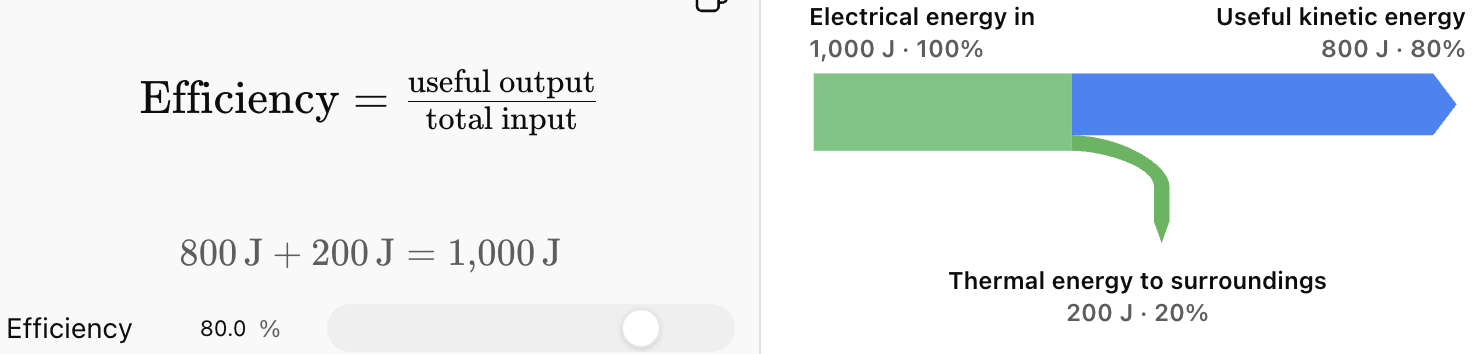
Efficiency can be written as a decimal or percentage.
For example:
efficiency = 0.80
is the same as:
efficiency = 80%
Worked Example: Electric Motor
A motor receives:
500 J
of electrical energy.
It produces:
400 J
of useful mechanical energy.
Efficiency:
efficiency = 400/500
efficiency = 0.80
As a percentage:
0.80 × 100 = 80%
The motor is 80% efficient.
Finding Wasted Energy
Because energy is conserved:
input energy = useful energy + wasted energy
Therefore:
wasted energy = input energy − useful energy
For the previous motor:
wasted energy = 500 − 400
wasted energy = 100 J
So:
500 J input → 400 J useful + 100 J wasted
Worked Example: Lamp
A lamp receives:
200 J
of electrical energy.
It transfers:
60 J
as useful light.
Efficiency:
efficiency = 60/200 × 100
efficiency = 30%
Wasted energy:
200 − 60 = 140 J
Therefore:
200 J electrical → 60 J useful light + 140 J thermal energy
The lamp is 30% efficient at producing the desired light output.
Efficiency Using Power
Efficiency can also be calculated using power.
When input and output are measured over the same time interval:
efficiency = useful output power / total input power
As a percentage:
efficiency (%) = useful output power / total input power × 100
This is especially useful for machines operating continuously.
Worked Example: Motor Power
An electric motor receives:
2500 W
of electrical power.
It provides:
2000 W
of useful mechanical power.
Efficiency:
efficiency = 2000/2500 × 100
efficiency = 80%
Power dissipated:
2500 − 2000 = 500 W
This means energy is being dissipated at a rate of:
500 J/s
Why Energy and Power Give the Same Efficiency
Suppose the motor operates for 10 s.
Input energy:
E = Pt
E = 2500 × 10
E = 25,000 J
Useful output energy:
E = 2000 × 10
E = 20,000 J
Efficiency:
efficiency = 20,000/25,000
efficiency = 0.80
or:
80%
The same result is obtained using either energy or power.
Rearranging the Efficiency Equation
If efficiency and input energy are known:
useful output = efficiency × input
Remember to convert a percentage to a decimal.
For example:
75% = 0.75
Therefore:
useful output = 0.75 × input
If useful output and efficiency are known:
input = useful output / efficiency
Worked Example: Finding Useful Energy
A machine receives:
2400 J
and is:
75% efficient
Convert:
75% = 0.75
Useful energy:
useful output = 0.75 × 2400
useful output = 1800 J
Wasted energy:
2400 − 1800 = 600 J
Worked Example: Finding Input Energy
A machine must produce:
3600 J
of useful energy.
It is:
80% efficient
Convert:
80% = 0.80
Input energy:
input = 3600/0.80
input = 4500 J
Therefore:
900 J
is transferred into unwanted forms.
Worked Example: Finding Useful Power
A motor receives:
10 kW
of electrical power.
It is:
85% efficient
Useful mechanical power:
Puseful = 0.85 × 10
Puseful = 8.5 kW
Wasted power:
10 − 8.5 = 1.5 kW
Why Real Systems Are Not 100% Efficient
In real systems, interactions between components cause some energy to be transferred into unwanted forms.
Common causes include:
- friction
- electrical resistance
- air resistance
- sound
- vibration
- deformation
- turbulence
- heating of components
These processes transfer energy into the surroundings.
Because these transfers cannot normally be eliminated completely:
real systems are not 100% efficient
Friction
Friction is one of the most common causes of energy dissipation in mechanical systems.
When surfaces move against one another, mechanical energy is transferred into thermal energy.
Examples include:
- gears
- bearings
- tyres
- engine components
- conveyor systems
- bicycle chains
You may notice machinery becoming warm during operation because of these transfers.


Reducing Friction
Engineers can reduce friction using:
- lubricants
- ball bearings
- smoother surfaces
- appropriate materials
- improved alignment
Reducing friction means less mechanical energy is transferred into unwanted thermal energy.
This can increase efficiency.
Electrical Resistance
Electrical devices also dissipate energy because conductors have resistance.
When current passes through resistance:
electrical energy → thermal energy
This is useful in devices designed for heating.
Examples include:
- kettles
- heaters
- toasters
But it is usually unwanted in:
- motors
- power cables
- computers
- transformers
- generators
Electrical components becoming warm is evidence that some energy is being transferred thermally.
Useful or Wasted Depends on Purpose
An important point is that whether an energy transfer is considered useful depends on the purpose of the device.
Consider an electric heater.
Electrical energy becoming thermal energy is:
useful
But in an electric motor, excessive heating is:
wasted
Similarly, light from a lamp is useful, while light from a heating element may not be.
Efficiency must therefore always be considered in relation to the intended output.
Sound and Vibration
Machines often produce sound and vibration.
These transfers usually represent energy that is not contributing to the intended output.
Examples include:
- noisy engines
- vibrating motors
- rattling machinery
- tyre noise
- electrical transformers
Reducing unwanted vibration and sound can improve efficiency as well as make machinery quieter and more reliable.
Air Resistance
Moving objects transfer energy to the surrounding air.
This is particularly important for:
- cars
- trains
- aircraft
- bicycles
Air resistance generally increases as speed increases.
Therefore, high-speed vehicles may transfer large amounts of energy into the surrounding air.
Streamlining can reduce these unwanted energy transfers.


Improving Mechanical Efficiency
Mechanical systems can often be made more efficient by:
- reducing friction
- using lubrication
- using bearings
- reducing unnecessary mass
- improving aerodynamics
- reducing vibration
- improving gear design
- using suitable materials
However, completely eliminating unwanted transfers is usually impossible.
Improving Electrical Efficiency
Electrical systems can be improved through:
- lower-resistance conductors
- efficient motors
- improved insulation
- better electronic control systems
- reduced standby consumption
- efficient lighting
- improved cooling systems
- appropriate operating voltages
The goal is to increase the fraction of input energy transferred into the intended output.
Comparing Devices
Suppose three motors receive the same input energy:
1000 J
| Motor | Useful Output | Wasted Energy | Efficiency |
|---|---|---|---|
| A | 600 J | 400 J | 60% |
| B | 750 J | 250 J | 75% |
| C | 900 J | 100 J | 90% |
Motor C is the most efficient because the greatest fraction of its input energy becomes useful output.
It also dissipates the least energy.
Comparing Devices with Different Inputs
Efficiency is a ratio, so devices can be compared even when their input energies are different.
Device A
Input = 500 J
Useful = 400 J
efficiency = 400/500 × 100 = 80%
Device B
Input = 2000 J
Useful = 1500 J
efficiency = 1500/2000 × 100 = 75%
Device B produces more useful energy overall, but Device A is more efficient.
This is an important distinction.
Efficiency Does Not Mean Power
A device can be highly efficient but have low power.
Another device can be less efficient but have much greater power.
For example:
Device A:
input power = 100 W
useful power = 90 W
Efficiency:
90%
Device B:
input power = 2000 W
useful power = 1600 W
Efficiency:
80%
Device B provides much more useful power, but Device A is more efficient.
Sankey Diagrams
A Sankey diagram visually represents energy transfers.
The width of each arrow represents the amount of energy being transferred.
For example:
100 J input
might divide into:
70 J useful
and:
30 J wasted
Because:
70 + 30 = 100
the total width of the output arrows equals the width of the input arrow.
Sankey diagrams make it easy to compare the useful and wasted energy transfers in different systems.
Reading a Sankey Diagram
Suppose a motor receives:
500 J
The diagram shows:
350 J useful mechanical energy
and:
150 J thermal and sound energy
Efficiency:
efficiency = 350/500 × 100
efficiency = 70%
The wasted fraction is:
150/500 × 100
= 30%
Therefore:
70% useful + 30% wasted = 100%
Light Bulbs
Different lighting technologies can provide the same useful function while transferring different amounts of energy into unwanted thermal energy.
An efficient lamp transfers a greater proportion of its electrical input into useful light and a smaller proportion into unwanted heating.
This means less electrical energy is required to produce a particular useful light output.


Worked Comparison: Lamps
Suppose two lamps each receive:
100 J
of electrical energy.
Lamp A produces:
15 J useful light
Lamp B produces:
80 J useful light
Lamp A:
efficiency = 15/100 × 100
efficiency = 15%
Lamp B:
efficiency = 80/100 × 100
efficiency = 80%
Lamp B converts a much greater fraction of the electrical input into the desired output.
Electric Motors
Electric motors convert:
electrical energy → mechanical energy
Some energy is also transferred through:
- heating of wires
- friction in bearings
- sound
- vibration
A more efficient motor provides more mechanical output for the same electrical input.
This can reduce:
- electricity consumption
- operating costs
- unwanted heating
- environmental impacts associated with energy production
Vehicle Engines
Vehicle engines and motors convert stored energy into mechanical energy.
In combustion engines, significant energy can be transferred into:
- hot exhaust gases
- cooling systems
- friction
- sound
Only part of the input energy becomes useful mechanical output.
Electric motors generally have different energy-loss pathways, including electrical resistance, magnetic losses, friction, and heating.


Worked Example: Vehicle
An engine receives:
50 MJ
of chemical energy.
It transfers:
18 MJ
into useful mechanical energy.
Efficiency:
efficiency = 18/50 × 100
efficiency = 36%
Energy dissipated:
50 − 18 = 32 MJ
The remaining energy has been transferred mainly into thermal energy and other unwanted outputs.
Power Station Efficiency
Efficiency is also important in electricity generation.
Suppose a power station receives:
1000 MW
of energy per second from its fuel source and produces:
400 MW
of electrical power.
Efficiency:
efficiency = 400/1000 × 100
efficiency = 40%
The remaining:
600 MW
is transferred into other forms, especially thermal energy.
Efficiency Through Several Stages
Many real systems involve several energy conversions.
For example:
fuel → electricity → motor → motion
Suppose:
Power station efficiency = 40%
Motor efficiency = 80%
Start with:
100 J
After the power station:
100 × 0.40 = 40 J
After the motor:
40 × 0.80 = 32 J
Overall useful output:
32 J
Therefore:
overall efficiency = 32%
For several stages, the overall efficiency can be found by multiplying the decimal efficiencies:
overall efficiency = efficiency₁ × efficiency₂ × efficiency₃ ...
Worked Example: Multi-Stage System
A system contains:
Generator efficiency = 90%
Motor efficiency = 80%
Machine efficiency = 75%
Convert to decimals:
0.90 × 0.80 × 0.75
= 0.54
Therefore:
overall efficiency = 54%
Only 54% of the original input reaches the final useful output.
This demonstrates how losses at several stages can significantly reduce overall efficiency.
Efficiency and Sustainability
Improving efficiency can reduce the amount of energy required to perform a task.
This can lead to:
- lower energy consumption
- lower operating costs
- reduced fuel use
- reduced waste heat
- lower demand for energy resources
- reduced environmental impacts
For example, if two motors perform the same useful task but one is more efficient, the more efficient motor requires less input energy.
Worked Example: Energy Savings
Machine A is 60% efficient.
Machine B is 80% efficient.
Both must provide:
2400 J
of useful energy.
Machine A
input = 2400/0.60
input = 4000 J
Machine B
input = 2400/0.80
input = 3000 J
Machine B requires:
1000 J less input energy
to perform the same useful task.
Can Efficiency Be 100%?
In an idealized model, we sometimes assume:
efficiency = 100%
This simplifies calculations.
Real machines, however, always have some unwanted energy transfers.
For example:
- wires have resistance
- surfaces experience friction
- objects interact with air
- machines vibrate
- components become warm
Therefore, real energy-transfer systems do not achieve perfect efficiency.
Can Efficiency Be Greater Than 100%?
No.
An efficiency greater than 100% would mean:
useful output energy > input energy
That would require energy to be created.
This violates conservation of energy.
Therefore:
0% ≤ efficiency ≤ 100%
for a correctly defined system.
If a calculation gives more than 100%, check:
- the data
- the units
- which quantity is input
- which quantity is useful output
Efficiency Versus Energy Conservation
These ideas should not be confused.
Conservation of Energy
Total energy is always conserved.
input energy = total output energy
Efficiency
Efficiency asks what fraction of that output is useful.
For example:
100 J input → 70 J useful + 30 J thermal
Energy conservation:
100 J = 70 J + 30 J
Efficiency:
70%
The system is only 70% efficient, but 100% of the energy still exists.
Practical Example: Electric Elevator
An elevator motor receives:
50 kW
of electrical power.
The elevator receives:
42 kW
of useful mechanical power.
Efficiency:
efficiency = 42/50 × 100
efficiency = 84%
Power dissipated:
50 − 42 = 8 kW
This means:
8000 J
is transferred into other forms every second.
Practical Example: Pump
A water pump receives:
3000 W
of electrical power.
It transfers:
2250 W
usefully to the water.
Efficiency:
efficiency = 2250/3000 × 100
efficiency = 75%
Wasted power:
3000 − 2250 = 750 W
Improving Efficiency
Engineers try to increase efficiency by reducing unwanted energy transfers.
Possible approaches include:
Mechanical Systems
- lubrication
- bearings
- aerodynamic design
- reducing unnecessary vibration
- improving alignment
- reducing friction
Electrical Systems
- low-resistance conductors
- efficient motors
- improved electronic components
- appropriate cooling
- improved circuit design
Buildings
- insulation
- efficient lighting
- improved heating and cooling systems
- reducing unwanted air leakage
Transportation
- aerodynamic shapes
- lightweight materials
- efficient motors
- regenerative braking
- reduced rolling resistance
Efficiency improvements often involve engineering trade-offs involving cost, reliability, safety, materials, and performance.
Common Mistakes
Saying Energy Is "Used Up"
Energy is not destroyed.
It is transferred or dissipated.
Saying Wasted Energy Disappears
Wasted energy still exists.
It has been transferred into forms that are less useful for the intended purpose.
Dividing Input by Output
The correct relationship is:
useful output ÷ total input
not the other way around.
Forgetting to Multiply by 100
If the question asks for percentage efficiency:
0.75 = 75%
Using 80 Instead of 0.80
When using an efficiency in another calculation:
80% = 0.80
not 80.
Assuming the Largest Output Means the Highest Efficiency
Efficiency is a ratio.
A machine producing more useful energy may still be less efficient if it requires much more input energy.
Confusing Power with Energy
Efficiency can be calculated using either energy or power, but the quantities must be compared appropriately.
Use:
useful energy / input energy
or:
useful power / input power
Assuming Thermal Energy Is Always Wasted
Thermal energy from a heater is useful.
Thermal energy from a motor is generally unwanted.
The intended purpose of the device determines what counts as useful.
Assuming 100% Efficiency Is Realistic
Idealized calculations may assume 100%, but real systems experience energy dissipation.
Check Your Understanding
- Define efficiency.
- Explain the difference between useful and wasted energy transfers.
- Why is the term dissipated energy often more scientifically useful than saying energy is "lost"?
- A machine receives 500 J and produces 400 J of useful energy. Calculate its efficiency.
- How much energy is wasted in Question 4?
- A motor receives 2000 J and produces 1500 J of useful mechanical energy. Calculate its efficiency.
- A lamp receives 100 J and transfers 25 J as useful light. Calculate its efficiency.
- A device receives 500 W and provides 400 W of useful output power. Calculate its efficiency.
- How much power is dissipated in Question 8?
- A motor is 80% efficient and receives 5000 J. Calculate its useful output.
- Calculate the wasted energy in Question 10.
- A machine produces 3000 J of useful output and is 75% efficient. Calculate its required input energy.
- A motor receives 10 kW and is 85% efficient. Calculate its useful mechanical power.
- Explain why friction reduces mechanical efficiency.
- Explain why electrical resistance can reduce the efficiency of a motor.
- Give three examples of unwanted energy transfers in machines.
- Why can thermal energy be useful in one device but wasted in another?
- Machine A receives 1000 J and produces 700 J usefully. Machine B receives 500 J and produces 400 J usefully. Which is more efficient?
- Explain why the device producing the greatest useful output is not necessarily the most efficient.
- A power station is 40% efficient and receives 2000 MW. Calculate its electrical output power.
- A 90%-efficient motor receives 5 kW. Calculate its useful output power.
- A system contains two stages with efficiencies of 80% and 75%. Calculate the overall efficiency.
- A system contains three stages with efficiencies of 90%, 80%, and 70%. Calculate the overall efficiency.
- Explain why several efficient devices connected together can have a noticeably lower overall efficiency.
- Describe three ways engineers can improve the efficiency of a mechanical system.
- Describe two ways engineers can reduce unwanted electrical energy transfers.
- Explain why improving efficiency can reduce environmental impacts.
- A machine must produce 6000 J of useful output. Compare the required input energy if it is 60% efficient and if it is 80% efficient.
- Explain why an efficiency of 120% is impossible.
- Explain how a system can be only 60% efficient while still obeying the law of conservation of energy.
Key Terms
Efficiency — Fraction of the total input energy or power transferred into the intended useful output.
Useful energy — Energy transferred in the form required for the intended purpose.
Wasted energy — Energy transferred in forms that are not useful for the intended purpose.
Energy dissipation — Transfer and spreading of energy into less useful stores, often thermal energy in the surroundings.
Input energy — Total energy supplied to a system.
Output energy — Energy transferred from a system.
Useful output — Portion of the output that performs the intended function.
Input power — Rate at which energy is supplied to a system.
Useful output power — Rate at which useful energy is transferred.
Watt (W) — Unit of power equal to one joule per second.
Friction — Force opposing motion that can transfer mechanical energy into thermal energy.
Electrical resistance — Opposition to electric current that causes electrical energy to be transferred thermally.
Air resistance — Resistive force caused by motion through air.
Sankey diagram — Diagram showing energy transfers using arrows whose widths represent energy quantities.
Overall efficiency — Efficiency of a system containing several energy-transfer stages.
Conservation of energy — Principle stating that energy cannot be created or destroyed.
Key Takeaways
- Efficiency measures the fraction of input energy transferred into the desired useful output.
- Efficiency can be expressed as a decimal or percentage.
- Efficiency can be calculated using either energy values or power values.
- Useful output is determined by the intended purpose of the device.
- Wasted energy has not disappeared; it has been transferred into less useful forms.
- Total energy is always conserved.
- Real systems are less than 100% efficient because some energy is dissipated.
- Common causes of energy dissipation include friction, electrical resistance, air resistance, sound, vibration, and deformation.
- Mechanical efficiency can often be improved by reducing friction and resistance.
- Electrical efficiency can often be improved by reducing unwanted heating and resistance.
- A more efficient device requires less input energy to produce the same useful output.
- A device with a greater useful output is not necessarily more efficient.
- Efficiency and power are different quantities.
- Several energy conversions can reduce the overall efficiency of a system.
- For multi-stage systems, decimal efficiencies can be multiplied to determine overall efficiency.
- Sankey diagrams show how input energy divides into useful and wasted outputs.
- Improving efficiency can reduce energy consumption, operating costs, resource use, and environmental impacts.
- An efficiency greater than 100% is impossible because it would violate conservation of energy.
The central idea is:
Energy is never destroyed — but not all transferred energy remains useful.
A more efficient system transfers a greater fraction of its input energy into the output we actually want.