Two-Dimensional Motion
3. Free Fall
Learning outcomes
- I can define free fall as motion influenced only by gravity.
- I can identify the acceleration due to gravity near Earth's surface.
- I can apply kinematic equations to free-fall situations.
- I can distinguish between upward and downward motion in free-fall problems.
- I can solve quantitative problems involving falling objects.
What is free fall?
An object is in free fall when gravity is the only force acting on it.
A freely falling object may be:
- Moving downwards after being dropped.
- Moving downwards after falling from rest.
- Moving upwards after being thrown.
- Momentarily stationary at the highest point of its motion.
- Moving downwards after reaching its highest point.
Free fall does not mean that an object must be moving downwards. An object thrown upwards is in free fall as soon as it leaves the thrower’s hand, provided air resistance is ignored.
During its entire flight, gravity accelerates the object downwards.


In a stroboscopic image, the growing gaps between successive positions of a falling object show that its speed is increasing.
Acceleration due to gravity
Near Earth’s surface, all freely falling objects have approximately the same downward acceleration:
g = 9.81 m/s²
For many calculations, this is rounded to:
g = 9.8 m/s²
Some introductory problems use:
g = 10 m/s²
This means that an object’s downward velocity changes by approximately 9.8 m/s every second.
| Time after being dropped (s) | Downward velocity (m/s) |
|---|---|
| 0 | 0 |
| 1 | 9.8 |
| 2 | 19.6 |
| 3 | 29.4 |
| 4 | 39.2 |
This table assumes that the object begins from rest and air resistance is negligible.
The value of g varies slightly with altitude and location, but 9.8 m/s² is a useful approximation near Earth’s surface.
Mass and free-fall acceleration
In the absence of air resistance, objects of different masses fall with the same acceleration.
A heavy object experiences a larger gravitational force than a light object, but it also has more inertia. These effects balance so that both objects have the same gravitational acceleration.
A bowling ball and a small metal ball dropped together in a vacuum reach the floor at the same time.


On the Moon, where there is almost no atmosphere, an astronaut demonstrated that a hammer and feather fall together. Near the Moon’s surface, the gravitational acceleration is about 1.62 m/s².
Free fall and air resistance
A real object falling through air usually experiences:
- Weight acting downwards.
- Air resistance acting opposite to its motion.
If air resistance is significant, gravity is not the only force acting and the object is not in ideal free fall.
Air resistance depends on factors including:
- Speed.
- Shape.
- Cross-sectional area.
- Air density.
A crumpled piece of paper falls faster than a flat sheet because it experiences less drag relative to its weight.
The constant-acceleration equations using a = g are most accurate when air resistance is negligible.
Choosing a positive direction
Free-fall calculations require a clear sign convention.
Upwards chosen as positive
If upwards is positive:
- Upward displacement is positive.
- Downward displacement is negative.
- Upward velocity is positive.
- Downward velocity is negative.
- Acceleration due to gravity is a = −9.8 m/s².
Downwards chosen as positive
If downwards is positive:
- Downward displacement is positive.
- Downward velocity is positive.
- Acceleration due to gravity is a = +9.8 m/s².
Either convention works. The important requirement is to use one convention consistently throughout the problem.
Upward and downward motion
Consider a ball thrown vertically upwards.
While rising
- Velocity points upwards.
- Acceleration points downwards.
- Velocity and acceleration act in opposite directions.
- The ball slows down.
At the highest point
- Instantaneous velocity is zero.
- Acceleration is still g downwards.
- The ball is about to change direction.
While falling
- Velocity points downwards.
- Acceleration points downwards.
- Velocity and acceleration act in the same direction.
- The ball speeds up.
Gravity does not change direction when the object reaches its highest point.
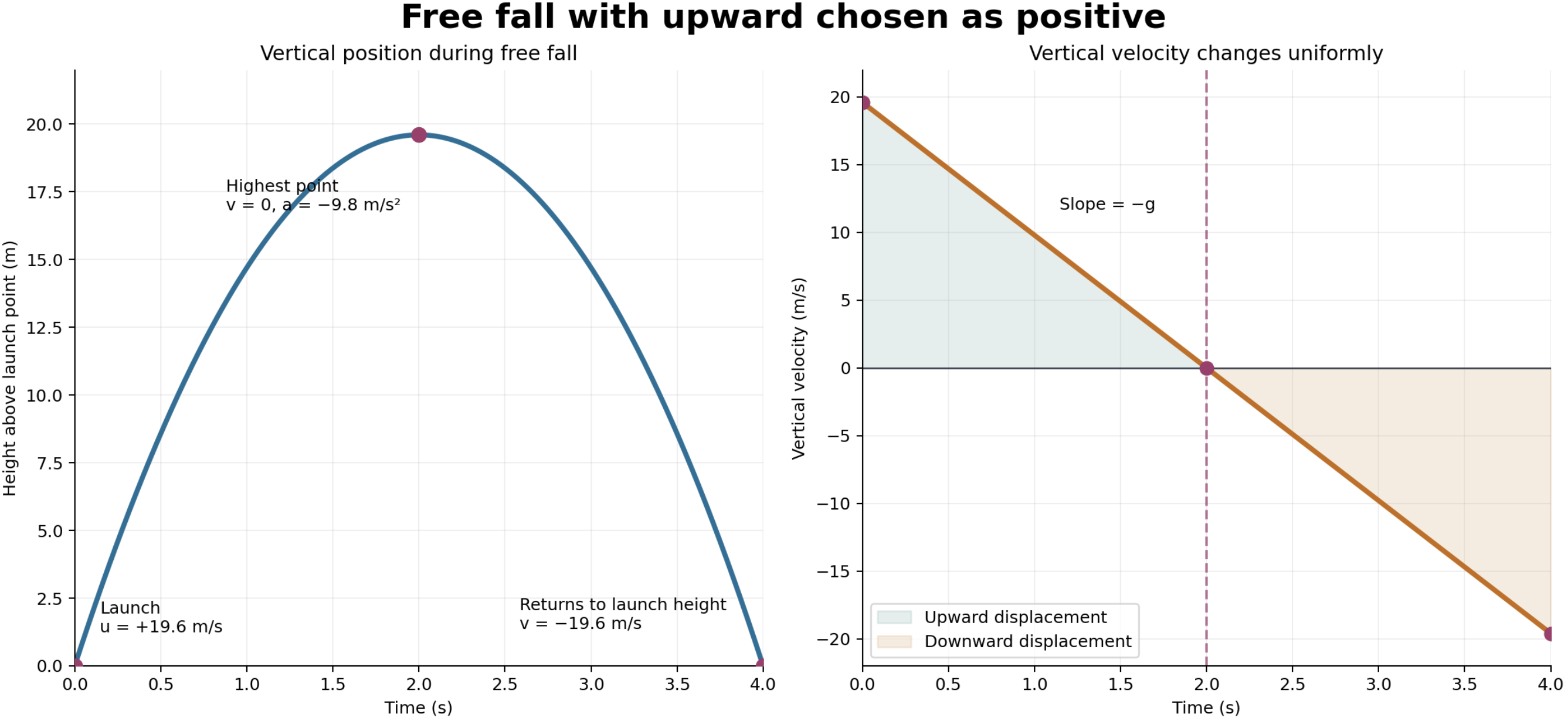
The position graph reaches its maximum at 2 seconds. The velocity graph has a constant gradient of −g and crosses zero at the same time.
Equations for free fall
Free fall is uniformly accelerated motion, so the standard kinematic equations apply:
v = u + at
s = ½(u + v)t
s = ut + ½at²
v² = u² + 2as
s = vt − ½at²
When upwards is positive, substitute:
a = −g
This gives:
v = u − gt
s = ut − ½gt²
v² = u² − 2gs
The symbols represent:
- s: Vertical displacement.
- u: Initial vertical velocity.
- v: Final vertical velocity.
- a: Vertical acceleration.
- g: Magnitude of gravitational acceleration.
- t: Time.
Use displacement rather than total distance in the vector equations.
Objects that are dropped
The word dropped means that the object begins from rest:
u = 0
It does not mean that acceleration is zero.
For an object dropped from rest:
v = gt
s = ½gt²
when downward is chosen as positive.
Worked example: object dropped from rest
A stone is dropped from a bridge and falls for 3.0 seconds. Ignore air resistance and use g = 9.8 m/s². Calculate its final velocity and displacement.
Choose downwards as positive.
Known:
u = 0 m/s
a = +9.8 m/s²
t = 3.0 s
Final velocity
v = u + at
v = 0 + 9.8(3.0)
v = 29.4 m/s downwards
Displacement
s = ut + ½at²
s = 0 + ½(9.8)(3.0²)
s = 4.9(9.0)
s = 44.1 m downwards
The stone travels farther during each successive second because its velocity is increasing.
Finding fall time from height
Worked example
A ball is dropped from a height of 19.6 m. Calculate the time required to reach the ground. Ignore air resistance.
Choose downwards as positive.
Known:
u = 0 m/s
s = 19.6 m
a = 9.8 m/s²
t = ?
Use:
s = ut + ½at²
19.6 = 0 + ½(9.8)t²
19.6 = 4.9t²
t² = 4
t = ±2
The physical solution is:
t = 2.0 s
The negative solution lies before the selected starting time and does not describe the fall after release.
Finding impact velocity without time
Worked example
A stone is dropped from a height of 45 m. Calculate its impact velocity. Use g = 10 m/s² and ignore air resistance.
Choose downwards as positive.
Known:
u = 0 m/s
s = 45 m
a = 10 m/s²
v = ?
Time is not given, so use:
v² = u² + 2as
v² = 0² + 2(10)(45)
v² = 900
v = 30 m/s
The impact velocity is:
30 m/s downwards
The negative square-root solution is not appropriate for an object falling downwards under this sign convention.
Objects thrown downwards
An object thrown downwards has a non-zero initial downward velocity.
Worked example
A ball is thrown downwards from a building at 5.0 m/s. Find its velocity after 2.0 seconds. Use g = 9.8 m/s².
Choose downwards as positive.
Known:
u = +5.0 m/s
a = +9.8 m/s²
t = 2.0 s
Use:
v = u + at
v = 5.0 + 9.8(2.0)
v = 24.6 m/s downwards
A common mistake is to set u = 0. The phrase “thrown downwards” means the ball already has an initial velocity.
Objects thrown upwards
When an object is thrown upwards, gravity reduces its upward velocity until it reaches zero. The object then begins moving downwards.
Choose upwards as positive:
a = −9.8 m/s²
Worked example: time to maximum height
A ball is thrown upwards at 19.6 m/s. Find the time taken to reach its highest point.
Known:
u = +19.6 m/s
v = 0 m/s
a = −9.8 m/s²
t = ?
Use:
v = u + at
0 = 19.6 − 9.8t
9.8t = 19.6
t = 2.0 s
At the highest point, velocity is zero but acceleration remains −9.8 m/s².
Finding maximum height
Using the same ball:
u = +19.6 m/s
v = 0 m/s
a = −9.8 m/s²
s = ?
Time is not required, so use:
v² = u² + 2as
0² = 19.6² + 2(−9.8)s
0 = 384.16 − 19.6s
19.6s = 384.16
s = 19.6 m
The ball rises 19.6 m above its release point.
Returning to the launch height
If air resistance is ignored and an object returns to the height from which it was launched:
- Time rising equals time falling.
- Speed on returning equals launch speed.
- Return velocity has the opposite direction.
- Total displacement is zero.
- Total distance is twice the maximum height.
For the ball launched upwards at 19.6 m/s:
- Time to rise = 2.0 s.
- Total flight time = 4.0 s.
- Maximum height = 19.6 m.
- Return velocity = −19.6 m/s when upwards is positive.
- Total distance = 39.2 m.
- Displacement = 0 m.
This symmetry applies only when launch and landing heights are equal and air resistance is ignored.
Worked example: launch and landing at the same height
A ball is thrown upwards at 14.7 m/s and returns to its release point. Calculate its total flight time. Ignore air resistance.
Choose upwards as positive.
First find the time to maximum height:
v = u + at
0 = 14.7 − 9.8t
t = 14.7/9.8
t = 1.5 s
The downward journey takes the same amount of time:
Total flight time = 2(1.5)
Total flight time = 3.0 s
Launching from an elevated position
If an object is thrown upwards from a building, its landing position is below its release point. The upward and downward parts are not symmetrical around the release point.
A displacement equation may produce two mathematical times. Interpret each result carefully.
Worked example
A ball is thrown vertically upwards at 15 m/s from a platform 20 m above the ground. Calculate when it reaches the ground. Use g = 10 m/s².
Choose the release point as s = 0 and upwards as positive.
The ground is 20 m below the release point:
s = −20 m
Known:
u = +15 m/s
a = −10 m/s²
s = −20 m
Use:
s = ut + ½at²
−20 = 15t − 5t²
Rearrange:
5t² − 15t − 20 = 0
Divide by 5:
t² − 3t − 4 = 0
Factorize:
(t − 4)(t + 1) = 0
Therefore:
t = 4 s or t = −1 s
The physical solution after release is:
t = 4.0 s
The negative value refers to the mathematical extension of the motion before t = 0.
Determining impact velocity
Continue the platform example:
u = +15 m/s
a = −10 m/s²
t = 4 s
Use:
v = u + at
v = 15 − 10(4)
v = −25 m/s
The impact velocity is:
25 m/s downwards
The negative sign indicates that the velocity points opposite to the chosen positive direction.
Free fall on motion graphs
Position–time graph
For an object thrown upwards, the position–time graph is a downward-opening parabola.
- Positive gradient: moving upwards.
- Zero gradient: at maximum height.
- Negative gradient: moving downwards.
- Increasingly steep negative gradient: downward speed is increasing.
Velocity–time graph
The velocity–time graph is a straight line with gradient −g when upwards is positive.
- Above the axis: upward velocity.
- On the axis: momentarily at rest.
- Below the axis: downward velocity.
- Area under the graph: displacement.
Acceleration–time graph
Acceleration remains constant at −g, so the graph is a horizontal line below the time axis.
Gravity does not become zero at maximum height.
Distance fallen during successive seconds
A dropped object travels increasingly large distances during equal time intervals.
For an object dropped from rest using g = 9.8 m/s²:
| Time (s) | Total displacement (m) | Distance during that second (m) |
|---|---|---|
| 0 | 0 | — |
| 1 | 4.9 | 4.9 |
| 2 | 19.6 | 14.7 |
| 3 | 44.1 | 24.5 |
| 4 | 78.4 | 34.3 |
The velocity increases by equal amounts each second, while the distance travelled during each second increases.
This occurs because displacement depends on time squared:
s = ½gt²
Reaction time and falling objects
A simple classroom demonstration can estimate reaction time using a falling ruler.
If a ruler falls a measured distance s before being caught:
s = ½gt²
Rearrange:
t = √(2s/g)
Worked example
A ruler falls 0.20 m before being caught.
t = √[2(0.20)/9.8]
t = √0.0408
t ≈ 0.20 s
The estimated reaction time is approximately 0.20 seconds.


The estimate assumes that the ruler begins from rest and falls freely before being caught.
Terminal velocity is not free fall
As an object’s speed through air increases, air resistance usually increases.
Eventually, air resistance may equal the object’s weight:
- Resultant force becomes zero.
- Acceleration becomes zero.
- Velocity becomes constant.
This constant falling speed is called terminal velocity.
An object at terminal velocity is not in ideal free fall because both gravity and air resistance act on it.


A skydiver may be described casually as being in “free fall,” but the ideal physics definition applies only when gravity is the sole force.
A reliable method for free-fall problems
- Draw a simple vertical diagram.
- Choose upwards or downwards as positive.
- List s, u, v, a and t.
- Give all vector quantities appropriate signs.
- Replace a with +g or −g according to the sign convention.
- Select a kinematic equation.
- Substitute and calculate.
- State the answer with units and direction.
- Interpret multiple or negative solutions.
- Check whether ignoring air resistance is reasonable.
Common misconceptions
- “Free fall means moving downwards.” An upward-moving object can be in free fall.
- “Heavier objects fall faster.” Without air resistance, all objects have the same gravitational acceleration.
- “Acceleration becomes zero at maximum height.” Velocity is zero there; acceleration remains downward.
- “An object that is dropped has zero acceleration.” It has zero initial velocity.
- “Gravity is positive 9.8 m/s² in every problem.” Its sign depends on the chosen positive direction.
- “A negative velocity means an object is slowing down.” It indicates direction.
- “The flight is always symmetrical.” This requires equal launch and landing heights and negligible air resistance.
- “Terminal velocity is free fall.” Air resistance acts at terminal velocity.
- “Every mathematical time is physically meaningful.” Check whether the result lies within the interval being studied.
Did you know?
Astronauts in orbit appear weightless because they and their spacecraft are falling together around Earth.
Gravity is still strong at the altitude of the International Space Station. The astronauts experience apparent weightlessness because no supporting surface pushes against them in the usual way.
Key terms
- Free fall: Motion in which gravity is the only force acting.
- Gravitational acceleration: The acceleration produced by gravity.
- g: The magnitude of gravitational acceleration, approximately 9.8 m/s² near Earth’s surface.
- Initial velocity: Velocity at the beginning of an interval.
- Final velocity: Velocity at the end of an interval.
- Maximum height: The greatest vertical position reached.
- Impact velocity: Velocity immediately before striking a surface.
- Sign convention: A chosen system for representing opposite directions.
- Air resistance: A drag force opposing motion through air.
- Terminal velocity: Constant falling velocity reached when drag balances weight.
- Weight: The gravitational force acting on an object.
- Vacuum: A region containing little or no matter.
Key takeaways
- Free fall occurs when gravity is the only force acting.
- Near Earth’s surface, g is approximately 9.8 m/s² downwards.
- Free fall is uniformly accelerated motion when g is treated as constant.
- A dropped object has u = 0, not a = 0.
- At maximum height, velocity is zero but acceleration remains downward.
- Upward and downward motion require consistent vector signs.
- The standard kinematic equations apply to ideal free fall.
- Equal launch and landing heights produce symmetrical motion when air resistance is ignored.
- Interpret answers using their signs, units and physical context.