Work and Energy
2. Work Done
Learning outcomes
- I can explain work done as the transfer of energy by a force acting through a displacement.
- I can describe the relationship between work done, energy transferred, and the principle of conservation of energy.
- I can determine when work is done on an object and identify situations in which no mechanical work is done.
- I can apply the equations and to calculate the work done by a constant force.
- I can analyze energy transfers in mechanical and electrical systems using the concept of work done.
What Is Work Done?
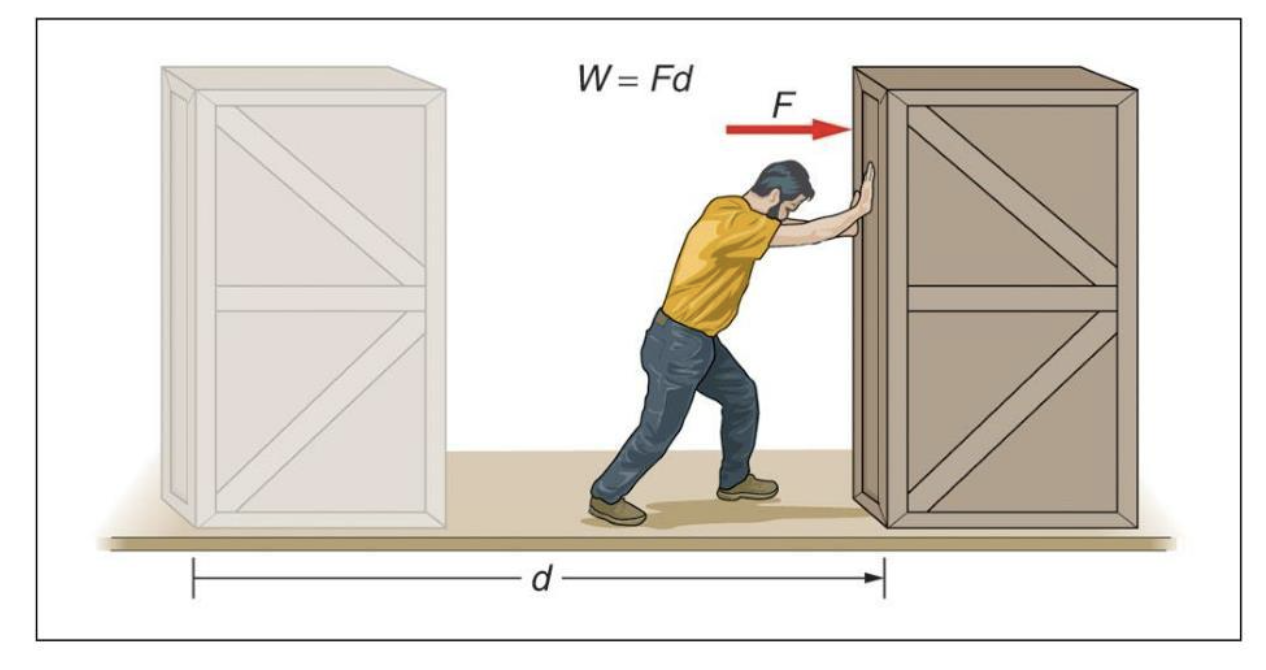
In physics, work is done when a force causes an object to move through a displacement.
Work is not simply about how hard something feels. A force must act through a distance for mechanical work to be done.
The simplest equation is:
\[ \boxed{W=Fd} \]
where:
- \(W\) = work done, measured in joules (J)
- \(F\) = force, measured in newtons (N)
- \(d\) = displacement in the direction of the force, measured in metres (m)
This equation applies when the force and displacement act in the same direction.
Work Is an Energy Transfer
Work done is closely connected to energy.
When a force does work on an object, energy is transferred.
For example, suppose you push a box across the floor.
Chemical energy stored in your body is transferred into:
- kinetic energy of the box
- thermal energy due to friction
- thermal energy in your muscles and surroundings
The amount of work done represents the amount of energy transferred by the force.
Therefore:
\[ \boxed{1\text{ J of work}=1\text{ J of energy transferred}} \]
This is one of the most important ideas in mechanics.
The Joule
The SI unit of work is the joule (J).
One joule of work is done when a force of 1 newton moves an object 1 metre in the direction of the force.
\[ \boxed{1\text{ J}=1\text{ N}\cdot\text{m}} \]
For example:
\[ W=Fd \]
If:
\[ F=1\text{ N} \]
and:
\[ d=1\text{ m} \]
then:
\[ W=1\times1 \]\[ \boxed{W=1\text{ J}} \]
Worked Example: Pushing a Box
A person pushes a box with a constant force of 50 N over a distance of 4 m.
Calculate the work done.
Use:
\[ W=Fd \]
Substitute:
\[ W=50\times4 \]\[ \boxed{W=200\text{ J}} \]
Therefore, 200 J of energy has been transferred by the force.
When Is Mechanical Work Done?
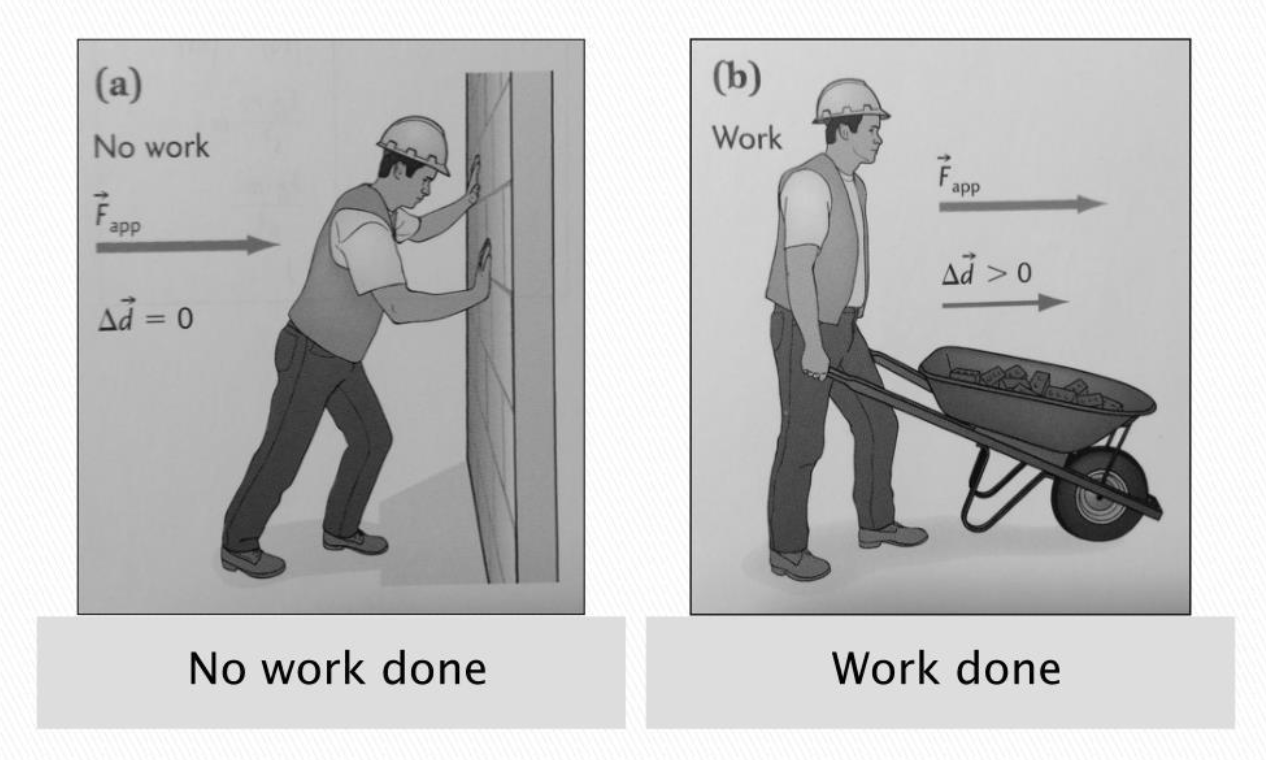
Mechanical work is done when:
- a force acts on an object
- the object moves through a displacement
- at least part of the force acts in the direction of the displacement
If any of these conditions is missing, mechanical work may be zero.
Example: Lifting an Object
Suppose you lift a 10 N object vertically upward by 2 m.
The force you apply is upward.
The displacement is also upward.
So work is done.
\[ W=Fd \]\[ W=10\times2 \]\[ \boxed{W=20\text{ J}} \]
The work done transfers energy to the object.
In this case, the object's gravitational potential energy increases.
Example: Pushing a Wall
Imagine pushing against a solid wall with a force of 200 N.
You may become tired, but the wall does not move.
Therefore:
\[ d=0 \]
Using:
\[ W=Fd \]\[ W=200\times0 \]\[ \boxed{W=0\text{ J}} \]
No mechanical work is done on the wall because there is no displacement.
Your body still transfers chemical energy internally, but that is different from mechanical work being done on the wall.
Example: Holding a Heavy Object
Suppose you hold a heavy box stationary for 30 seconds.
You exert an upward force on the box, but the box does not move.
Therefore:
\[ d=0 \]
and:
\[ \boxed{W=0} \]
No mechanical work is done on the box.
Even though your muscles become tired, the box has no displacement.
This is a common example showing that the everyday meaning of "work" is different from the physics definition.
Force at an Angle
The force does not always act in exactly the same direction as the displacement.
For example, imagine pulling a suitcase using a handle angled upward.
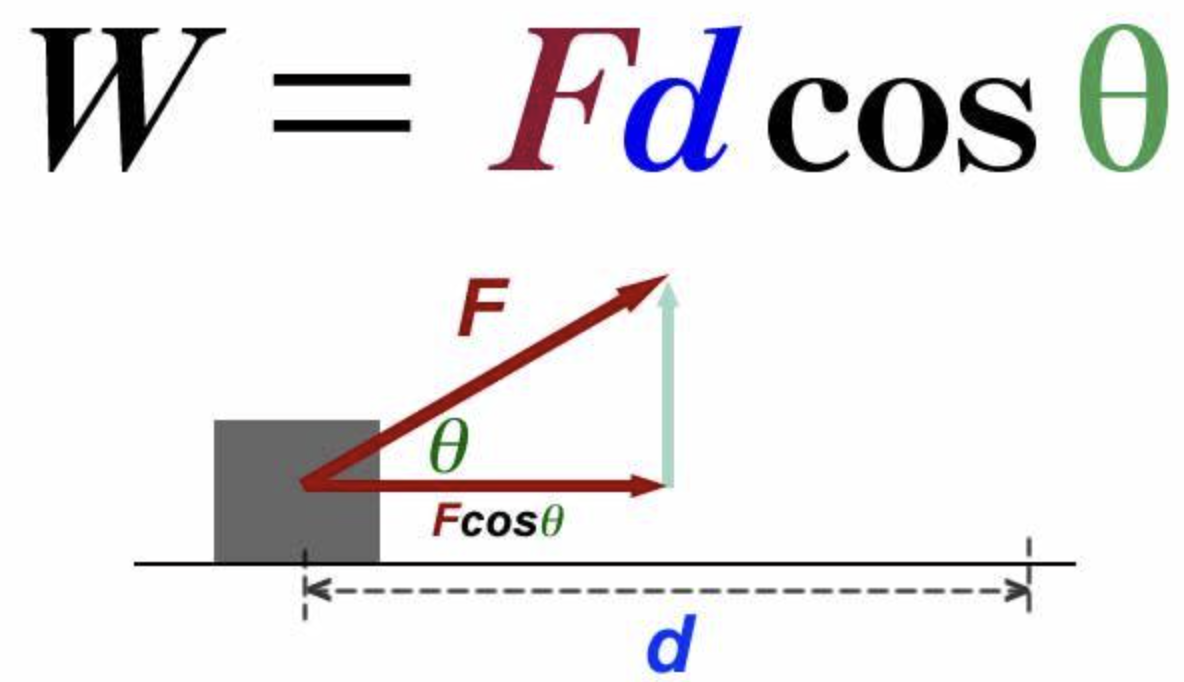
Only the component of the force parallel to the displacement does work.
The more general equation is:
\[ \boxed{W=Fd\cos\theta} \]
where:
- \(W\) = work done
- \(F\) = force
- \(d\) = displacement
- \(\theta\) = angle between the force and displacement
Understanding the Angle
The value of \(\theta\) is the angle between the force vector and the displacement vector.
This gives several important situations.
Force in the Same Direction
\[ \theta=0^\circ \]
Since:
\[ \cos0^\circ=1 \]
then:
\[ W=Fd \]
The force does the maximum possible positive work.
Force Perpendicular to the Motion
\[ \theta=90^\circ \]
Since:
\[ \cos90^\circ=0 \]
then:
\[ W=0 \]
The force does no work.
Force Opposite the Motion
\[ \theta=180^\circ \]
Since:
\[ \cos180^\circ=-1 \]
then:
\[ W=-Fd \]
The force does negative work.
Worked Example: Pulling at an Angle
A person pulls a suitcase with a force of 80 N at an angle of \(30^\circ\) above the horizontal.
The suitcase moves 5 m horizontally.
Calculate the work done by the pulling force.
Use:
\[ W=Fd\cos\theta \]
Substitute:
\[ W=(80)(5)\cos30^\circ \]\[ W=400(0.866) \]\[ \boxed{W\approx346\text{ J}} \]
Only the horizontal component of the pulling force contributes to the work done on the suitcase.
Positive Work
A force does positive work when it acts at least partly in the same direction as the object's displacement.
For example:
- pushing a trolley forward
- gravity pulling a falling object downward
- a motor accelerating a vehicle
Positive work generally transfers energy to the object or system.
For example, if a force increases an object's speed, its kinetic energy increases.
Negative Work
A force does negative work when it acts in the opposite direction to the displacement.
Friction commonly does negative work.
Imagine a sliding box.
The box moves to the right while friction acts to the left.
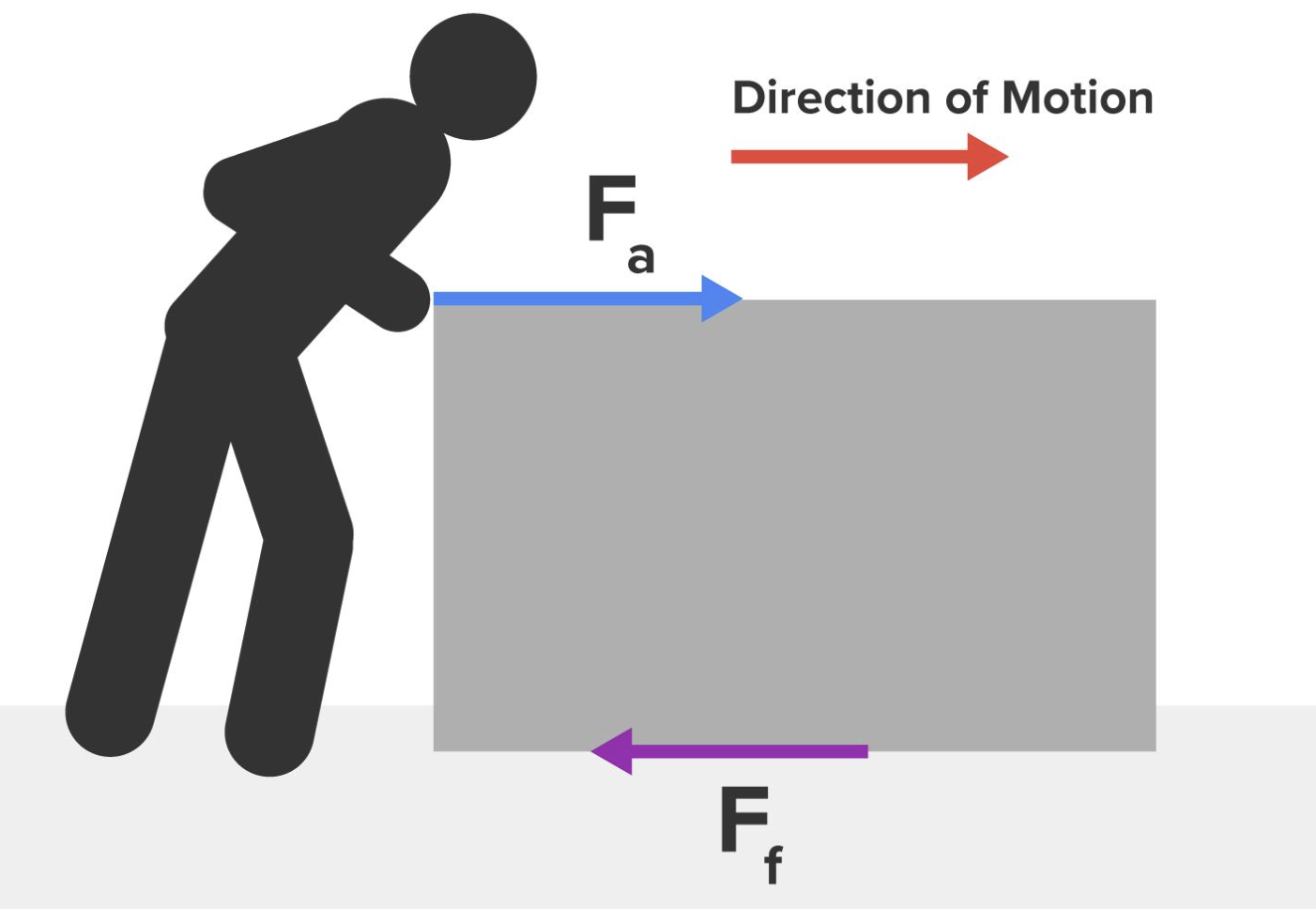
The angle between force and displacement is:
\[ 180^\circ \]
Therefore:
\[ W=Fd\cos180^\circ \]\[ W=-Fd \]
The negative sign indicates that mechanical energy is being transferred away from the object's kinetic energy store.
Much of this energy becomes thermal energy.
Zero Work
A force can act on an object without doing mechanical work.
There are two particularly important situations.
No Displacement
If:
\[ d=0 \]
then:
\[ W=0 \]
Example: pushing against a wall that does not move.
Force Perpendicular to Displacement
If:
\[ \theta=90^\circ \]
then:
\[ W=Fd\cos90^\circ \]\[ W=0 \]
Example: the normal force on an object moving horizontally across a level floor.
Work Done by the Normal Force
Consider a box sliding horizontally across a flat floor.
The box moves horizontally.
The normal force acts vertically upward.
The force and displacement are perpendicular.
Therefore:
\[ \theta=90^\circ \]
and:
\[ \boxed{W_N=0} \]
The normal force does no mechanical work on the box in this situation.
Circular Motion and Zero Work
An important example occurs in uniform circular motion.
The centripetal force always points toward the centre of the circle.
The instantaneous displacement is tangential to the circular path.
These directions are perpendicular.
Therefore:
\[ \theta=90^\circ \]
and the centripetal force does:
\[ \boxed{W=0} \]
The force changes the direction of the velocity without changing the object's speed.
Work and Kinetic Energy
When a net force does work on an object, the object's kinetic energy can change.
This relationship is described by the work-energy theorem:
\[ \boxed{W_{\text{net}}=\Delta E_k} \]
or:
\[ W_{\text{net}}=E_{k,\text{final}}-E_{k,\text{initial}} \]
This means:
- positive net work → kinetic energy increases
- negative net work → kinetic energy decreases
- zero net work → kinetic energy remains constant
Example: Accelerating a Car
Suppose the net force on a car does 30 000 J of positive work.
According to the work-energy theorem:
\[ \Delta E_k=30\,000\text{ J} \]
The car's kinetic energy increases by 30 000 J.
If its mass remains constant, this corresponds to an increase in speed.
Work Against Gravity
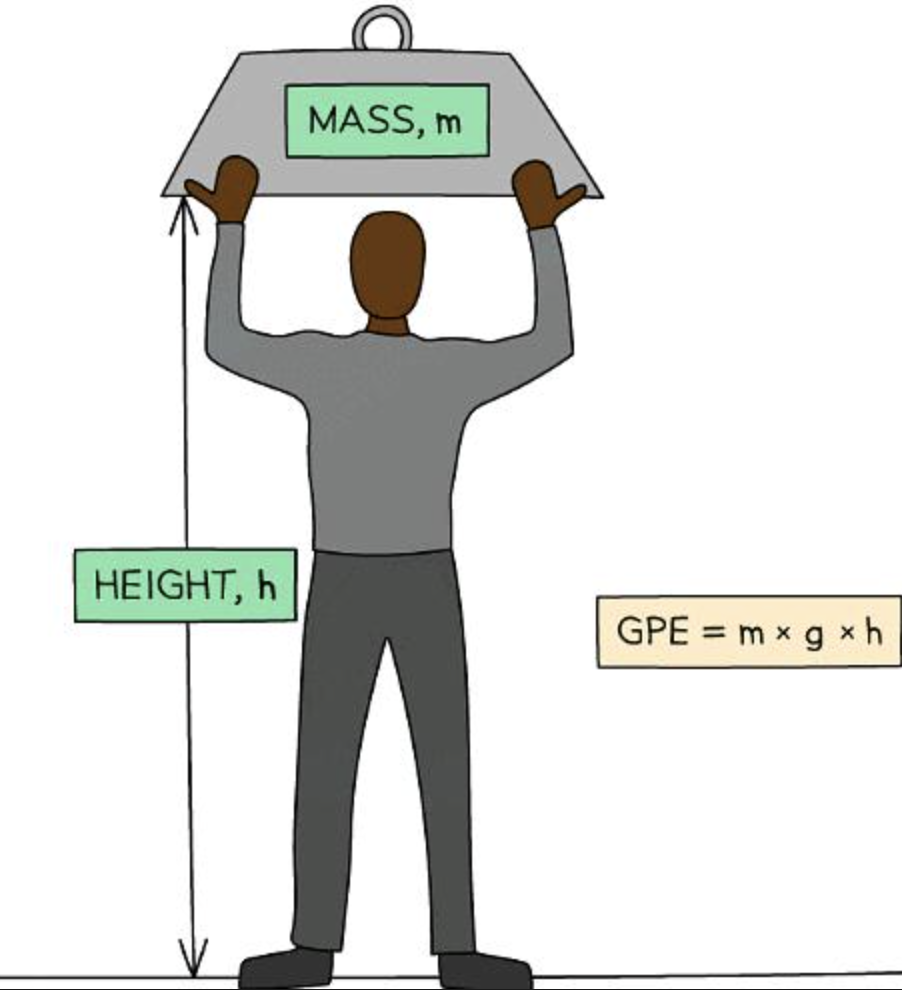
When an object is lifted, work is done against gravity.
For an object lifted vertically at constant speed:
\[ F=mg \]
and:
\[ W=Fd \]
Therefore:
\[ W=mgh \]
This work increases the object's gravitational potential energy:
\[ \boxed{\Delta E_p=mgh} \]
So:
\[ \boxed{W=\Delta E_p} \]
when no other significant energy transfers occur.
Worked Example: Lifting a Backpack
A student lifts a 6 kg backpack vertically through 1.5 m.
Use:
\[ g=9.8\text{ N/kg} \]
First find the weight:
\[ F=mg \]\[ F=6(9.8) \]\[ F=58.8\text{ N} \]
Now calculate work:
\[ W=Fd \]\[ W=58.8(1.5) \]\[ \boxed{W=88.2\text{ J}} \]
Approximately 88 J of energy is transferred into gravitational potential energy.
Conservation of Energy
The principle of conservation of energy states that:
Energy cannot be created or destroyed. It can only be transferred from one store to another or transformed from one form to another.
Work is one way that energy is transferred.
For example, when you push a box:
chemical energy in muscles
↓
work done by force
↓
kinetic energy + thermal energy
The energy has not disappeared.
It has simply changed form or location.
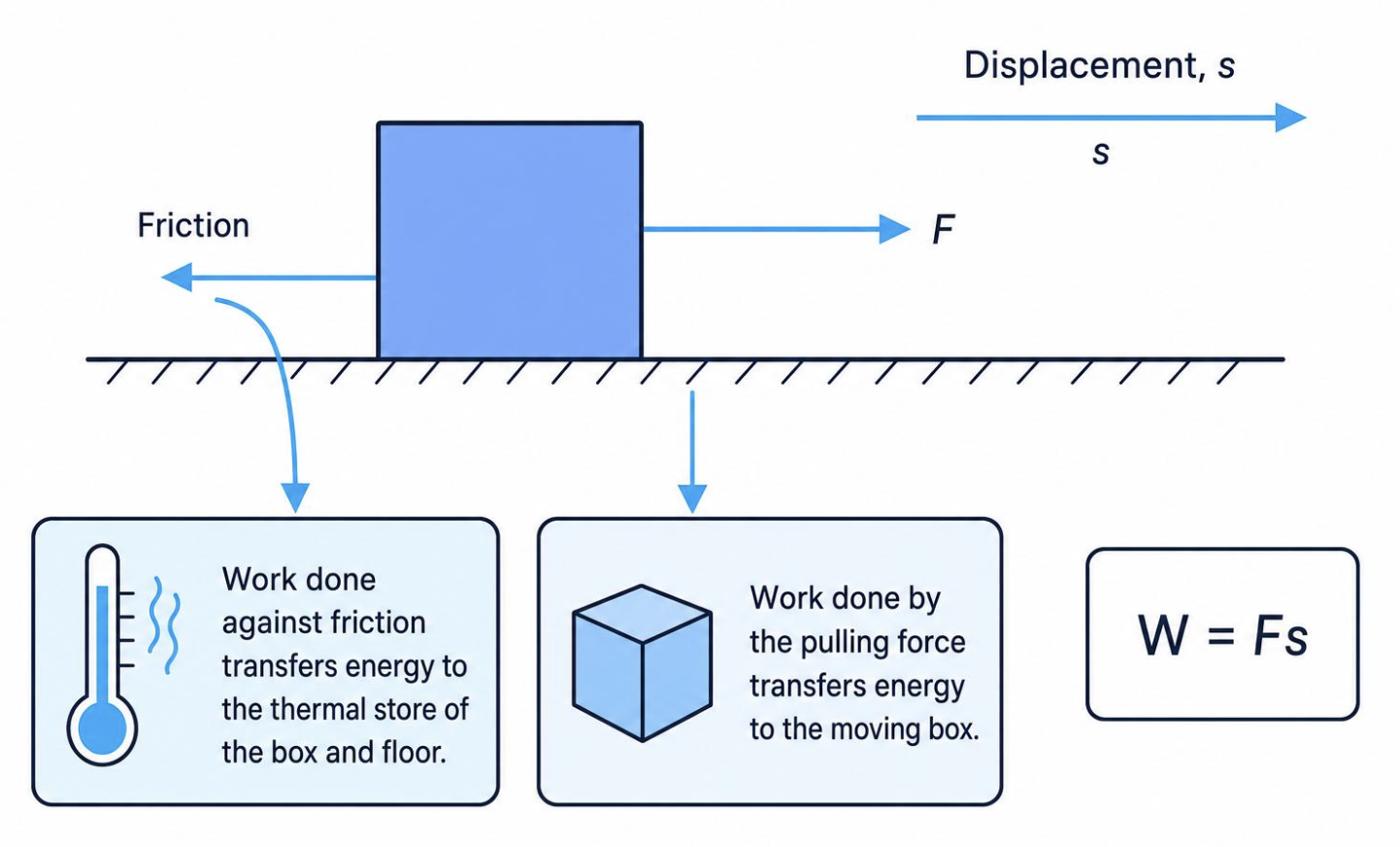
Energy Transfers with Friction
Suppose you push a box along a rough floor.
You do positive work on the box.
At the same time, friction does negative work.
Some of the energy transferred by your push increases the box's kinetic energy.
Some becomes thermal energy.
If the box moves at constant speed, its kinetic energy does not change.
In that case, the positive work done by the applied force is balanced by the negative work done by friction.
Worked Example: Work Against Friction
A box is pushed 8 m across a floor at constant speed.
The friction force is 25 N.
Calculate the work done against friction.
\[ W=Fd \]\[ W=25(8) \]\[ \boxed{W=200\text{ J}} \]
Approximately 200 J of mechanical energy is transferred into thermal energy.
If the box moves at constant speed, the applied force must do approximately +200 J of work while friction does −200 J of work.
The net work is therefore:
\[ W_{\text{net}}=0 \]
and the kinetic energy remains constant.
Work in Electrical Systems
The concept of work also applies to electricity.
When electric charge moves through a potential difference, energy is transferred.
Electrical work can be calculated using:
\[ \boxed{W=VQ} \]
where:
- \(W\) = energy transferred or work done, in joules
- \(V\) = potential difference, in volts
- \(Q\) = charge transferred, in coulombs
Recall:
\[ 1\text{ V}=1\text{ J/C} \]
So a potential difference of 6 V transfers 6 J of energy for every coulomb of charge.
Worked Example: Electrical Work
A charge of 4 C moves through a potential difference of 12 V.
Calculate the electrical energy transferred.
\[ W=VQ \]\[ W=12(4) \]\[ \boxed{W=48\text{ J}} \]
Therefore, 48 J of electrical energy is transferred.
Mechanical and Electrical Work
Although mechanical and electrical systems may look very different, the underlying idea is similar.
Mechanical system
A force moves an object:
\[ W=Fd \]
Energy is transferred mechanically.
Electrical system
Charge moves through a potential difference:
\[ W=VQ \]
Energy is transferred electrically.
In both cases:
\[ \boxed{\text{Work done = energy transferred}} \]
Example: Electric Motor
An electric motor provides an excellent connection between electrical and mechanical work.
Electrical energy enters the motor.
The motor produces a force that causes something to move.
For example:
electrical energy
↓
motor
↓
mechanical work
↓
kinetic energy
Some energy is also transferred into:
- thermal energy
- sound
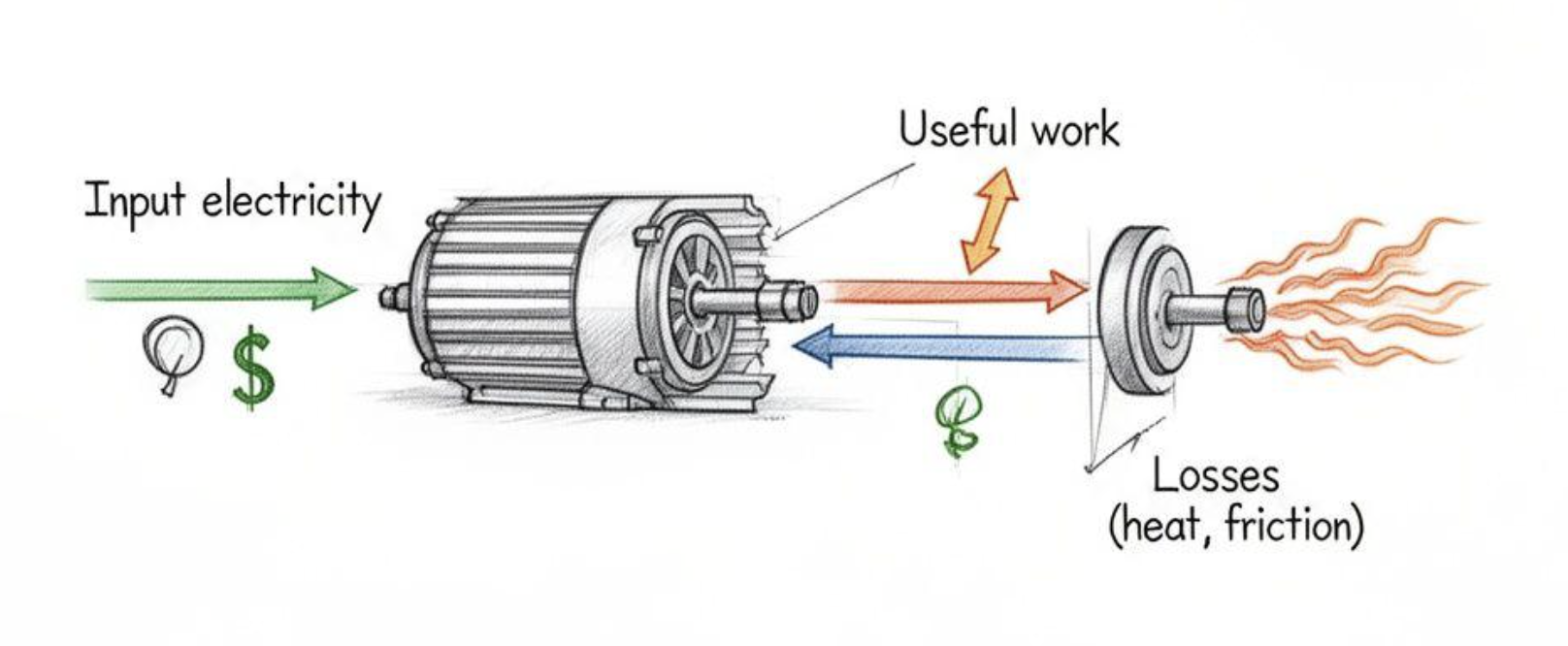
Because energy is conserved:
\[ E_{\text{input}}=E_{\text{useful}}+E_{\text{wasted}} \]
Example: Electric Lift
Imagine an electric motor lifting an elevator.
Electrical energy is supplied to the motor.
The motor does mechanical work against gravity.
Energy is transferred into the gravitational potential energy of the elevator.
So the chain is:
electrical energy
↓
work done by motor
↓
gravitational potential energy
This is a good example of mechanical and electrical work being connected within the same system.
Work and Power
Work tells us how much energy is transferred.
Power tells us how quickly the energy is transferred.
The relationship is:
\[ \boxed{P=\frac{W}{t}} \]
where:
- \(P\) = power in watts
- \(W\) = work done in joules
- \(t\) = time in seconds
Two machines can do the same amount of work but have different powers if one completes the work more quickly.
Worked Example: Same Work, Different Power
Machine A does 600 J of work in 3 s.
\[ P=\frac{600}{3} \]\[ P=200\text{ W} \]
Machine B does the same 600 J of work in 12 s.
\[ P=\frac{600}{12} \]\[ P=50\text{ W} \]
Both machines perform the same amount of work, but Machine A transfers energy four times faster.
Real-World Connections
Work and energy transfer appear throughout everyday life and technology.
Climbing Stairs
Your muscles do work against gravity, increasing your gravitational potential energy.
Braking a Bicycle
Friction does negative work on the bicycle, reducing its kinetic energy and increasing thermal energy.
Cranes
A crane performs work when it lifts heavy loads against gravity.
Cars
Engines and motors perform mechanical work to increase a vehicle's kinetic energy and overcome friction and drag.
Electric Motors
Electrical work is converted into mechanical work.
Generators
Mechanical work is used to produce electrical energy.
Household Appliances
Electrical energy is transferred into thermal, kinetic, light, or sound energy depending on the appliance.
Common Mistakes
Mistake 1: A force automatically means work is done
A force alone is not enough.
There must also be a displacement.
Mistake 2: Being tired means mechanical work was done
You can hold a heavy object and become tired while doing zero mechanical work on the object.
If:
\[ d=0 \]
then:
\[ W=0 \]
Mistake 3: Using the full force when it acts at an angle
Only the component parallel to the displacement contributes to work.
Use:
\[ W=Fd\cos\theta \]
Mistake 4: Forgetting the angle is between force and displacement
The angle \(\theta\) must be measured between the force direction and displacement direction.
Mistake 5: Assuming work is always positive
Work can be:
- positive
- negative
- zero
depending on the directions of force and displacement.
Mistake 6: Saying energy is "used up"
Energy is conserved.
It may become less useful because it spreads into thermal energy, but it has not disappeared.
Mistake 7: Confusing work with power
Work measures energy transferred.
Power measures the rate of energy transfer.
Check Your Understanding
1. Define work done in physics.
2. State the SI unit of work.
3. Explain what 1 joule of work means.
4. Calculate the work done when a 30 N force moves an object 5 m in the same direction.
5. A student pushes against a wall with a force of 150 N, but the wall does not move. Calculate the mechanical work done on the wall.
6. Explain why holding a heavy object stationary involves no mechanical work on the object.
7. A 60 N force acts on an object moving 4 m in the same direction. Calculate the work done.
8. A 100 N force acts at \(60^\circ\) to the direction of motion. The object moves 3 m. Calculate the work done.
9. What is the work done by a force acting at \(90^\circ\) to the displacement?
10. Explain why the normal force does no work on a box sliding horizontally across a level floor.
11. What does negative work mean?
12. Explain why friction often does negative work.
13. A 5 kg object is lifted vertically through 2 m. Calculate the work done against gravity using \(g=9.8\text{ N/kg}\).
14. Explain how this work is related to gravitational potential energy.
15. A 12 V battery moves 5 C of charge through a circuit. Calculate the electrical work done.
16. Explain how an electric motor connects electrical work and mechanical work.
17. A box moves across a rough floor at constant speed. Explain why the net work done on the box is zero.
18. Challenge: A person pulls a trolley with a 120 N force at \(35^\circ\) above the horizontal for 8 m. Calculate the work done by the pulling force.
Key Terms
- Work done – energy transferred when a force acts through a displacement.
- Force – a push or pull that can change an object's motion.
- Displacement – the change in position of an object in a particular direction.
- Joule (J) – the SI unit of work and energy.
- Positive work – work done by a force with a component in the direction of displacement.
- Negative work – work done by a force opposing the displacement.
- Zero work – occurs when there is no displacement or when force is perpendicular to displacement.
- Energy transfer – movement of energy from one store or system to another.
- Conservation of energy – energy cannot be created or destroyed.
- Kinetic energy – energy associated with motion.
- Gravitational potential energy – energy associated with position in a gravitational field.
- Electrical work – energy transferred when charge moves through a potential difference.
- Power – the rate at which work is done or energy is transferred.
Key Takeaways
- Work is done when a force acts through a displacement.
- Work represents an energy transfer.
- Work is measured in joules (J).
- For a force acting parallel to displacement:
\[ \boxed{W=Fd} \]
- For a force acting at an angle:
\[ \boxed{W=Fd\cos\theta} \]
- If there is no displacement, no mechanical work is done on the object.
- A force perpendicular to displacement does zero work.
- A force acting in the same direction as displacement does positive work.
- A force opposing displacement does negative work.
- The net work done on an object is related to its change in kinetic energy:
\[ \boxed{W_{\text{net}}=\Delta E_k} \]
- Work done against gravity can increase gravitational potential energy.
- Energy is conserved; work transfers energy rather than creating or destroying it.
- Electrical work can be calculated using:
\[ \boxed{W=VQ} \]
- Mechanical and electrical systems both involve energy being transferred through work.