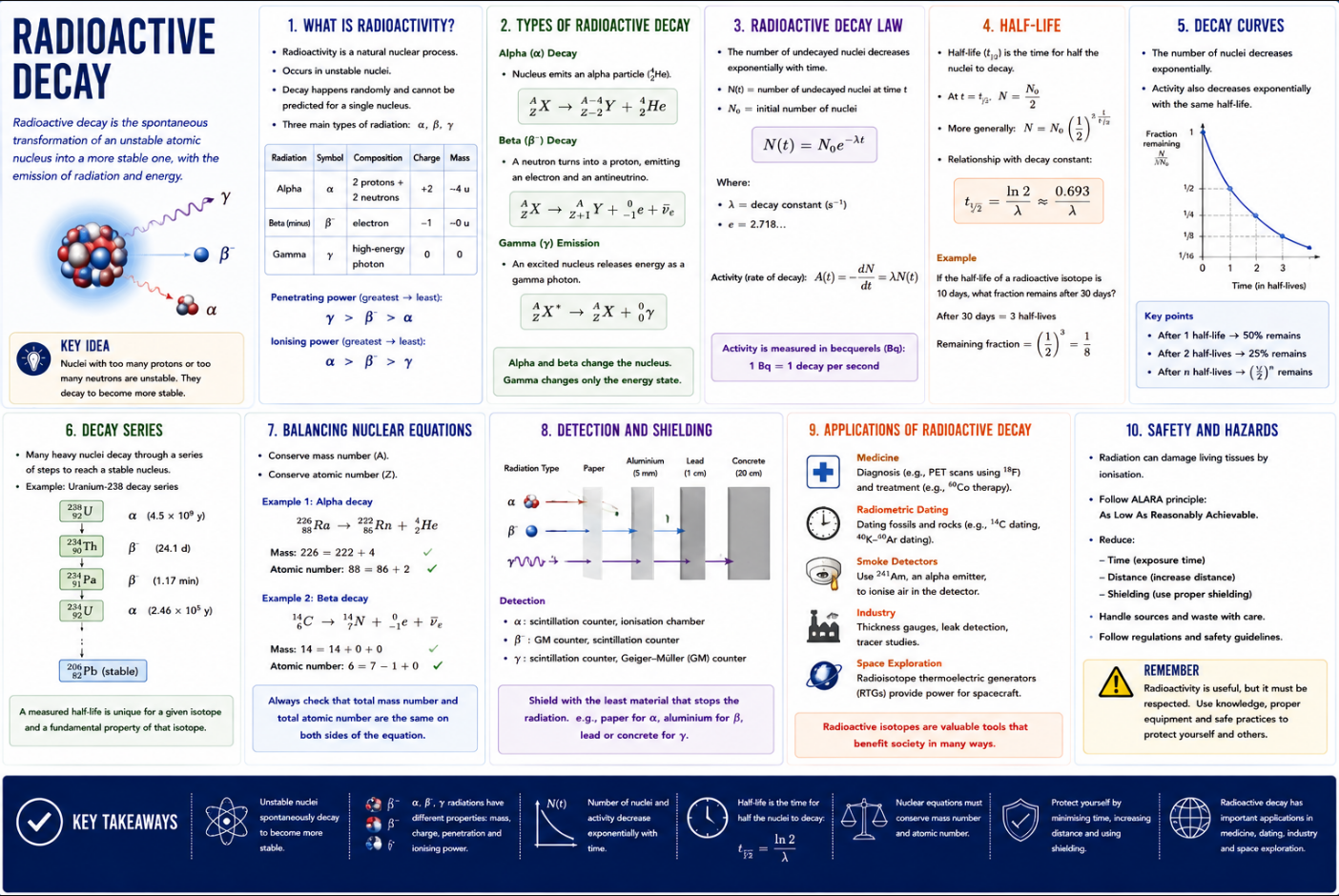
Radioactive decay is one of the most fascinating processes in nature, revealing how unstable atomic nuclei transform into more stable forms while releasing energy in the form of radiation. From the age of ancient fossils to the operation of nuclear power plants and the diagnosis and treatment of disease, radioactivity plays an important role in science, medicine, engineering, and everyday life.
In this course, students will develop a strong understanding of atomic nuclei, isotopes, and the processes that make certain elements radioactive. They will investigate the different types of nuclear radiation, learn how radioactive decay is measured and modeled using half-life, and apply mathematical reasoning to solve decay problems. Students will also examine how radiation is detected, explore its many practical applications, evaluate the risks and benefits associated with radioactive materials, and investigate how nuclear fission and fusion provide enormous amounts of energy. Throughout the course, emphasis is placed on scientific reasoning, real-world applications, and informed decision-making about nuclear technologies.
- Profesor: Mr. Young