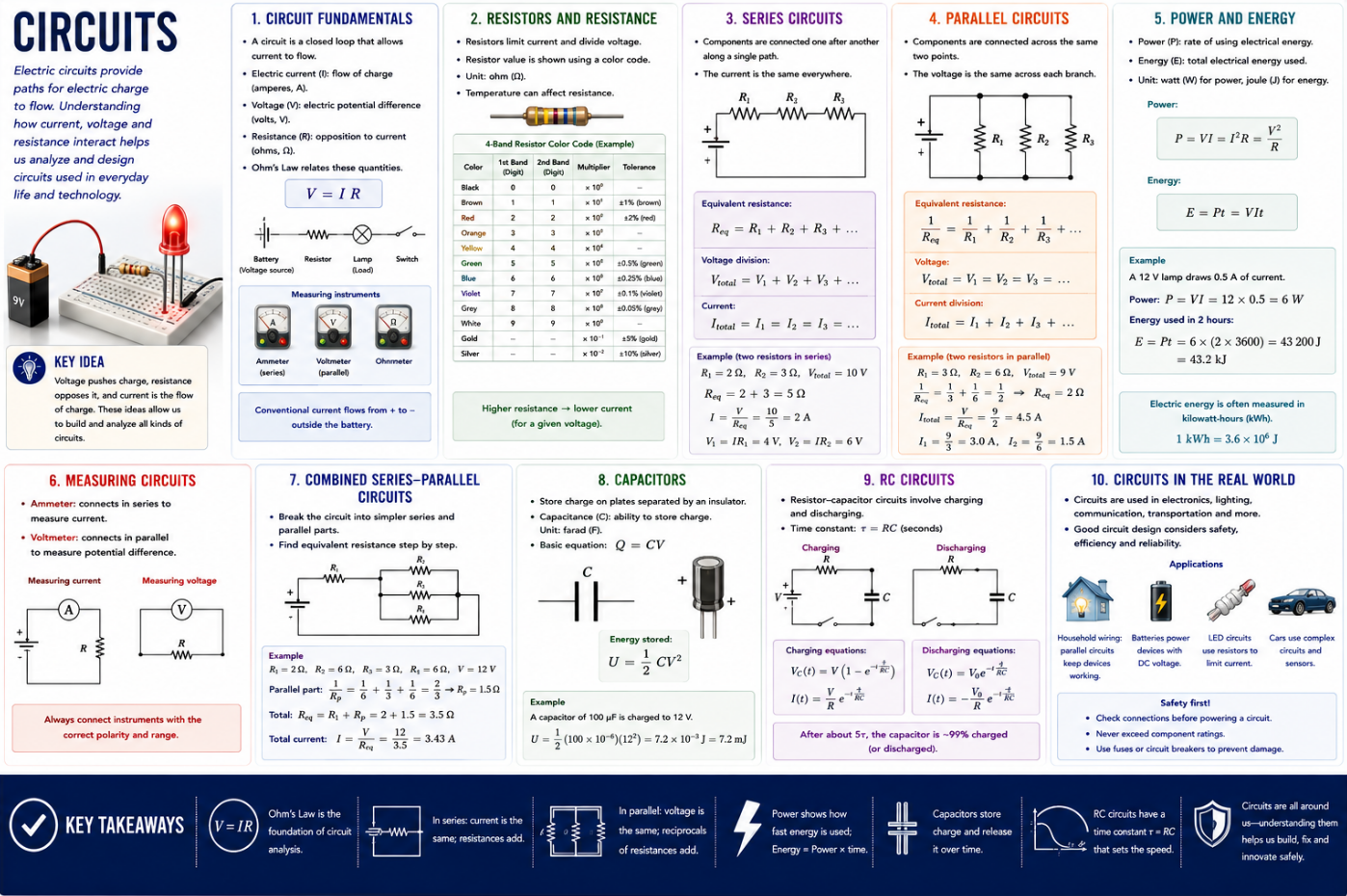
Electric circuits are at the heart of modern technology, powering everything from household appliances and smartphones to electric vehicles and space exploration. This course introduces the fundamental principles of electricity and circuit analysis, helping students understand how electric charge, current, voltage, resistance, and energy interact within electrical systems. Through both conceptual understanding and mathematical problem solving, students develop the skills needed to analyze, design, and troubleshoot electrical circuits.
Students begin by exploring the nature of electric charge, current, voltage, and the basic components that make up electrical circuits. They then investigate resistance, Ohm's Law, and the behavior of series and parallel circuits before advancing to Kirchhoff's Laws and more complex circuit analysis techniques. The course continues with electrical energy, power, efficiency, and household electricity before concluding with capacitors, RC circuits, electronic components, sensors, and digital electronics. Throughout the course, students connect theoretical concepts with practical applications while developing laboratory skills and engineering problem-solving techniques.
By the end of the course, students will have a strong foundation in electrical circuits and electronics, preparing them for further study in physics, engineering, robotics, computer science, and modern technology.
Main Topics
Unit 1: Electric Charge and Basic Circuits
Develop an understanding of electric charge, current, voltage, circuit components, and the construction of simple electrical circuits.
Unit 2: Resistance and DC Circuits
Investigate electrical resistance, Ohm's Law, and the behavior of series and parallel circuits through quantitative analysis and experimentation.
Unit 3: Kirchhoff's Laws and Circuit Analysis
Apply Kirchhoff's Laws to analyze increasingly complex electrical circuits while exploring internal resistance, circuit design, and troubleshooting techniques.
Unit 4: Electrical Energy and Power
Explore how electrical energy is transferred, transformed, and used in real-world systems while studying electrical power, efficiency, and household electricity.
Unit 5: Capacitors and Electronic Circuits
Examine energy storage, capacitor behavior, electronic components, sensors, and digital electronics to understand the foundations of modern electronic technology.
- Викладач: Young Mr.