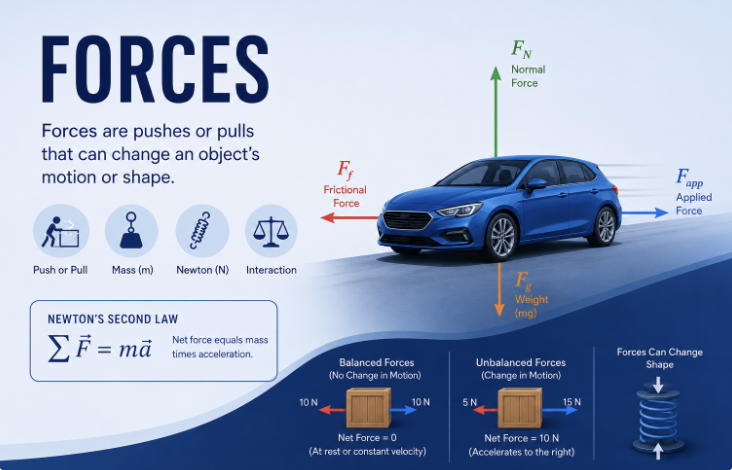
Forces
Why do objects accelerate, slow down, change direction, or remain at rest? Forces are responsible for every change in motion we observe, from a falling apple and a moving vehicle to the motion of roller coasters and satellites. In this course, students will develop a deep understanding of how forces influence the motion of objects and how physicists use mathematical models to describe and predict that motion.
The course begins with Forces and Newton's Laws, where students explore the fundamental principles that govern motion. They will learn about Newton's three laws of motion, different types of forces, free-body diagrams, and the concept of equilibrium.
Students will then investigate Contact Forces, examining the forces that arise when objects interact directly. Topics include normal force, friction, tension, elastic forces, and drag. Students will learn how these forces affect motion and how they can be represented and analyzed using physics models.
In Forces in Two Dimensions, students move beyond simple one-dimensional situations and develop the skills needed to analyze more realistic systems. They will resolve forces into components, study equilibrium in two dimensions, and solve problems involving inclined planes, Atwood machines, and elevators.
The course continues with Momentum and Collisions, where students explore how motion is transferred between objects. They will investigate momentum, impulse, conservation of momentum, collisions, explosions, and recoil, applying these concepts to real-world situations ranging from vehicle safety to rocket propulsion.
Finally, students will study Circular Motion, examining the forces required to keep objects moving along curved paths. They will explore centripetal force, centripetal acceleration, banking, and a variety of applications involving transportation, engineering, and amusement rides.
Course Units
Unit 1: Forces and Newton's Laws
- Newton's Laws of Motion
- Types of Forces
- Newton's Second Law
- Free-Body Diagrams
- Equilibrium and Net Force
Unit 2: Contact Forces
- Normal Force
- Friction
- Tension
- Elastic Forces and Hooke's Law
- Drag Forces and Terminal Velocity
Unit 3: Forces in Two Dimensions
- Resolving Forces into Components
- Equilibrium in Two Dimensions
- Inclined Planes
- Atwood Machines
- Elevators and Apparent Weight
Unit 4: Momentum and Collisions
- Momentum
- Impulse
- Conservation of Momentum
- Collisions
- Explosions and Recoil
Unit 5: Circular Motion
- Motion in a Circle
- Centripetal Force
- Centripetal Acceleration
- Banking and Curved Motion
- Applications of Circular Motion
By the end of this course, students will be able to analyze forces acting on objects, construct and interpret free-body diagrams, solve problems involving Newton's Laws, investigate momentum and collisions, and explain the motion of objects in both straight-line and circular motion. Through mathematical modeling, problem-solving, and real-world applications, students will develop a strong foundation in one of the most important branches of physics.
- Leraar: Mr. Young