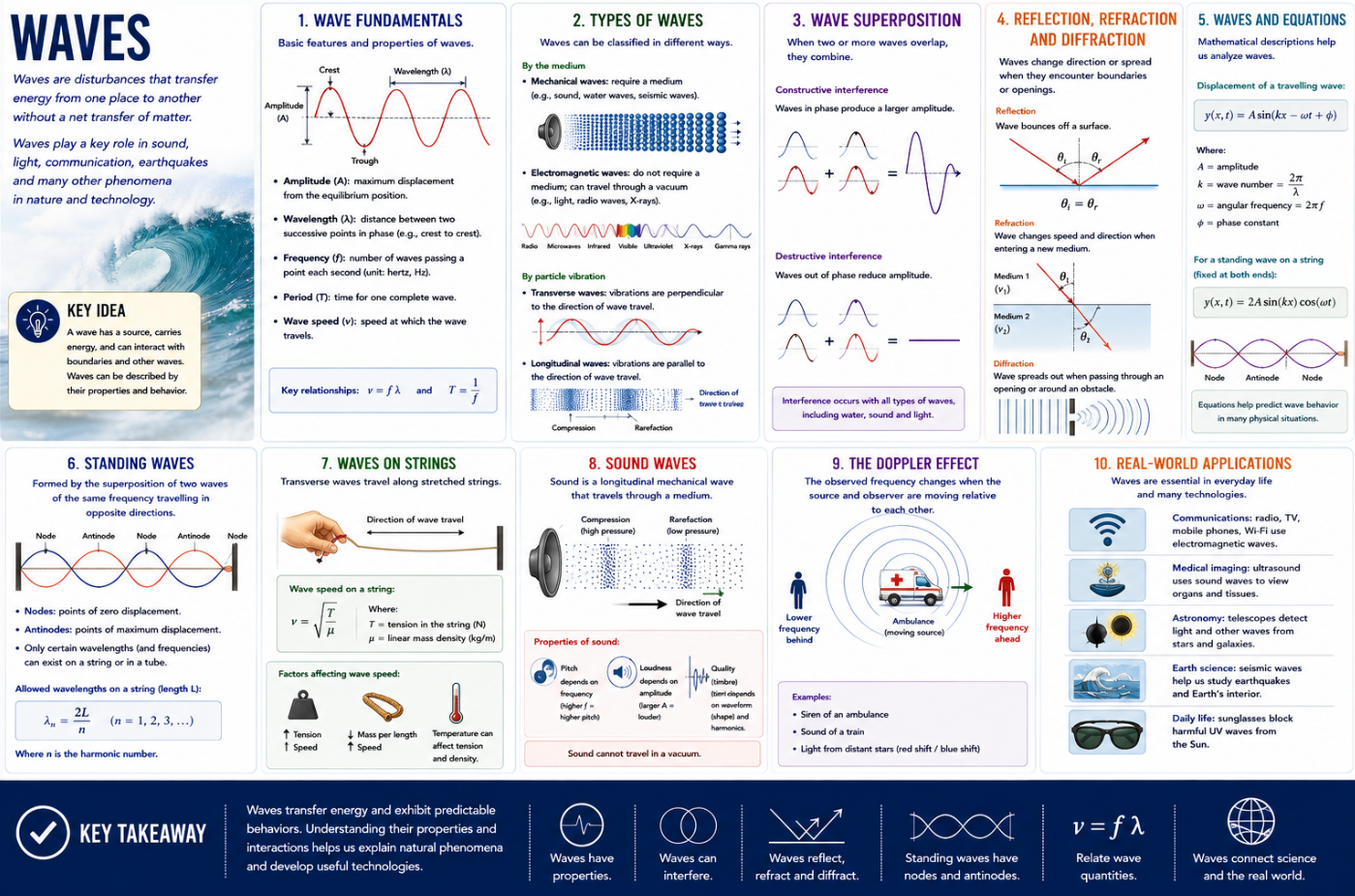
Waves are all around us, carrying energy through air, water, solids, and even empty space. From the sound of music and the colors of a rainbow to medical imaging and wireless communication, waves play a fundamental role in both nature and modern technology. In this course, students develop a strong foundation in wave physics by exploring how waves are generated, how they travel, and how they interact with matter and with one another.
Students begin by learning the fundamental properties of waves, including amplitude, wavelength, frequency, period, and wave speed. They then investigate mechanical waves such as sound, water, and seismic waves before exploring light as an electromagnetic wave. Students learn how mirrors and lenses form images through reflection and refraction, including ray diagrams, focal length, image formation, and magnification. The course concludes with an exploration of wave behavior—including superposition, interference, diffraction, and refraction—and the Doppler Effect, connecting these concepts to astronomy, medicine, engineering, and everyday life.
This course provides the essential foundation for more advanced studies in oscillations, resonance, wave optics, and modern physics.
This course is organized into five units:
- Wave Fundamentals
- Mechanical Waves
- Light Waves
- Wave Behavior
- Doppler Effect
Whether you're curious about how glasses correct vision, why a siren changes pitch as it passes by, or how scientists study distant galaxies, this course will help you understand the fascinating physics of waves.
- Teacher: Mr. Young