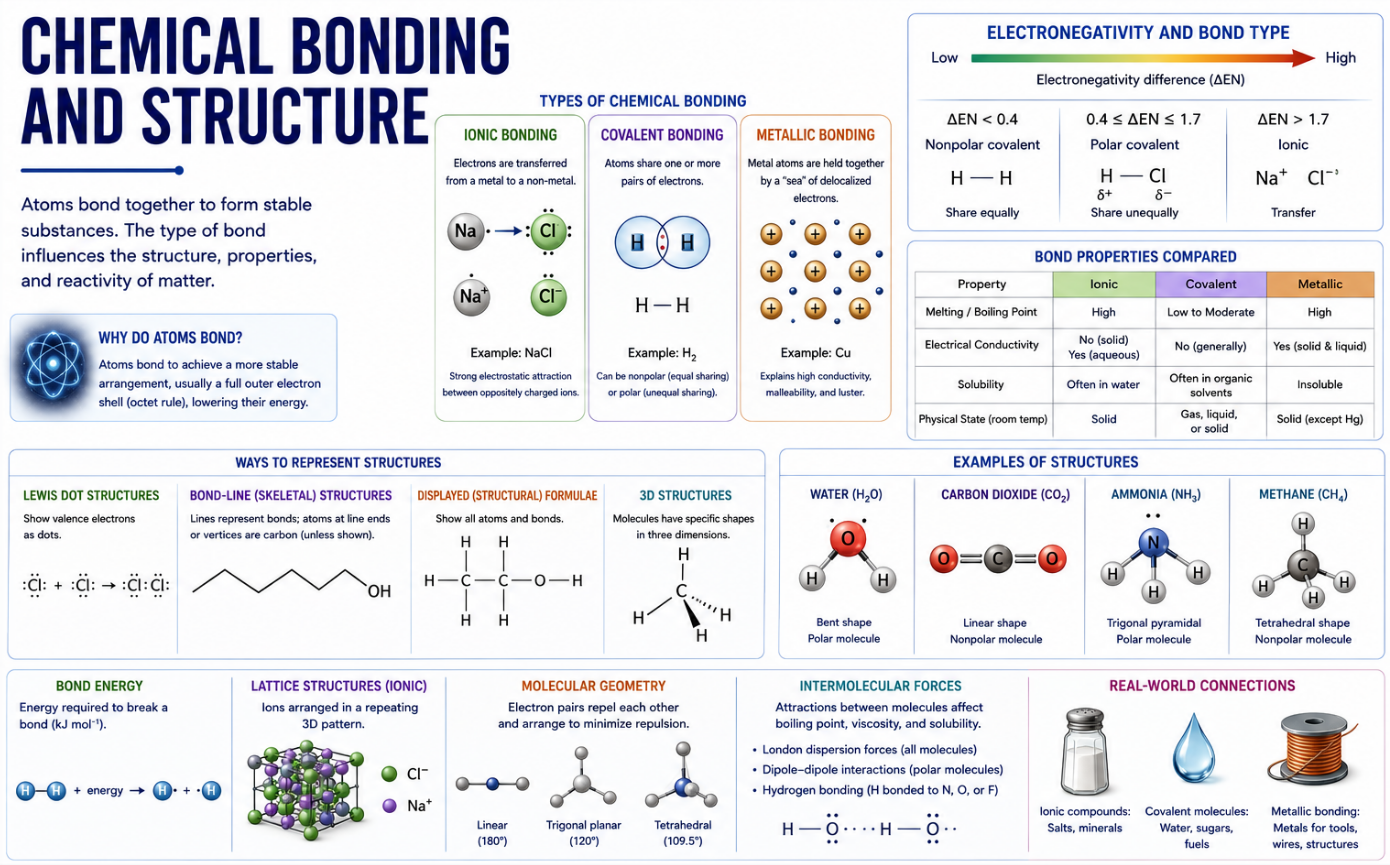
Chemical bonding is one of the most important concepts in chemistry because it explains how atoms join together to form the substances that make up our world. Everything from the water we drink and the air we breathe to metals, plastics, minerals, and living organisms depends on the interactions between atoms. By understanding chemical bonding and structure, students gain the tools needed to explain the properties and behavior of matter at the atomic level.
This course begins by exploring ionic bonding, where atoms transfer electrons to form charged particles known as ions. Students will investigate how ionic compounds form, examine crystal lattice structures, and relate these structures to the characteristic properties of ionic substances such as high melting points and electrical conductivity.
Students will then investigate covalent bonding, where atoms share electrons to form molecules. They will learn how to represent molecules using Lewis structures, distinguish between single, double, and triple bonds, and explore both simple molecular substances and giant covalent networks. Through these topics, students will develop an understanding of how electron sharing creates an enormous variety of compounds.
The course continues with an examination of molecular structure and intermolecular forces. Students will investigate molecular shapes, polarity, and the attractive forces between molecules. They will discover how these interactions influence important physical properties such as melting point, boiling point, solubility, and evaporation. These concepts help explain why substances with similar compositions can behave very differently.
Next, students will explore metallic bonding and materials science. They will investigate the unique structure of metals, explain conductivity, malleability, and ductility, and examine how alloys are engineered to improve material performance. By connecting bonding theory to engineering applications, students will gain a deeper appreciation of how materials are selected and designed for specific purposes.
Throughout the course, students will compare different types of bonding and investigate how structure determines properties. They will explore modern materials, nanotechnology, and real-world applications of chemistry while developing the ability to predict and explain material behavior based on atomic structure. By the end of the course, students will understand one of the most powerful ideas in chemistry: the properties of substances are determined by the way their atoms are arranged and bonded together.
Main Topics
Unit 1: Ionic Bonding
Explore how atoms transfer electrons to form ions, build crystal lattices, and create ionic compounds with unique physical and chemical properties.
Unit 2: Covalent Bonding
Investigate how atoms share electrons to form molecules and discover the wide variety of substances produced through covalent bonding.
Unit 3: Molecular Structure and Intermolecular Forces
Examine molecular shapes, polarity, and intermolecular attractions to understand how molecular structure influences physical properties.
Unit 4: Metallic Bonding and Materials
Explore the structure of metals, the properties that arise from metallic bonding, and the development of alloys and engineered materials.
Unit 5: Structure Determines Properties
Bring together all forms of bonding to explain how atomic structure determines the properties, uses, and performance of materials.
Perfect For
- High school chemistry students studying chemical bonding and matter
- Students preparing for advanced chemistry, materials science, or engineering courses
- Homeschool learners seeking a structured chemistry program
- Learners interested in understanding why materials behave differently
- Students preparing for studies in chemistry, physics, engineering, or nanotechnology
- Future scientists, engineers, and materials researchers
By the End of This Course
Students will be able to:
- Explain how ionic, covalent, and metallic bonds form.
- Describe the formation and properties of ionic compounds.
- Draw and interpret Lewis structures for molecules.
- Distinguish between single, double, and triple covalent bonds.
- Explain the structure and properties of giant covalent networks.
- Describe molecular shapes and determine molecular polarity.
- Explain how intermolecular forces influence physical properties.
- Describe the structure and properties of metals and alloys.
- Compare different bonding types and relate them to material properties.
- Predict the behavior of substances based on their bonding and structure.
- Apply bonding concepts to modern materials and technological applications.
This course provides a foundational understanding of chemical bonding and structure, helping students explain why materials behave the way they do and how atomic interactions influence the physical world. Through the study of ions, molecules, metals, intermolecular forces, and advanced materials, students will develop the scientific reasoning skills needed for future studies in chemistry, engineering, materials science, and technology.
- Athro: Mr. Young