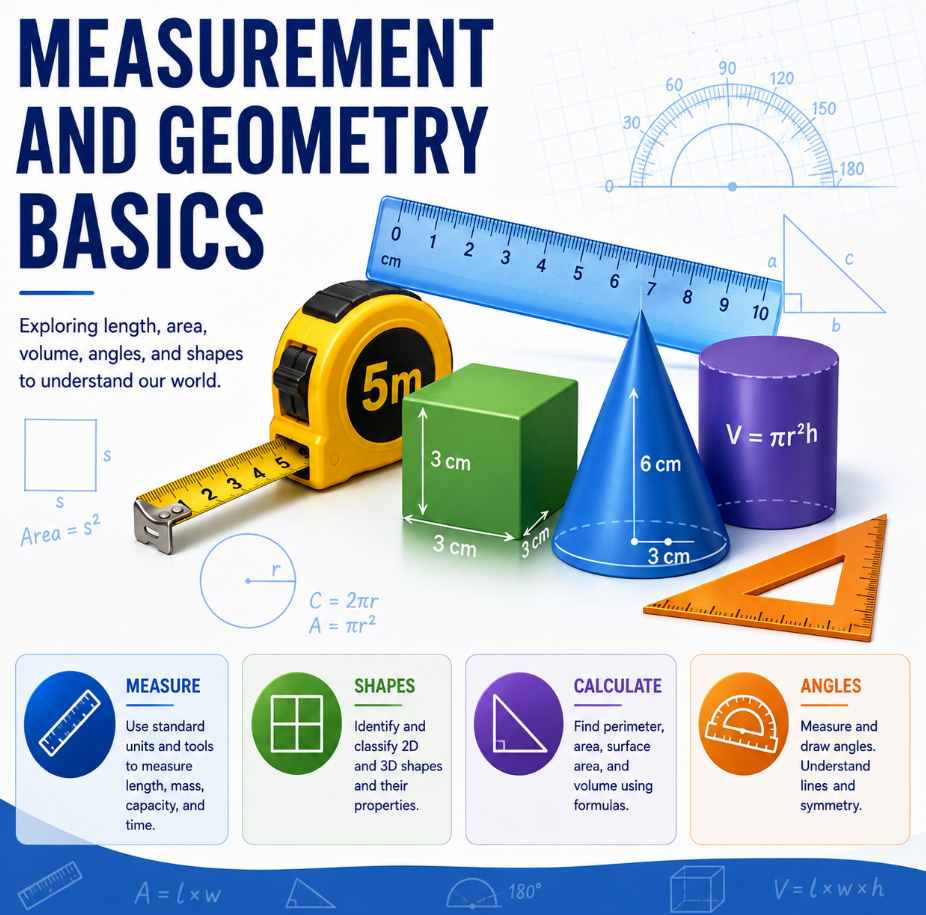
Measurement and geometry help us make sense of the physical world. Whether calculating the area of a room, reading a map, designing a building, or measuring ingredients for a recipe, these mathematical concepts are used every day. In this course, students will develop a strong understanding of measurement, shapes, space, and geometric reasoning while learning how mathematics can be applied to solve practical problems.
The course begins by exploring the concept of measurement and the metric system. Students will learn how to measure length, mass, volume, time, and temperature, as well as how to convert between units and choose appropriate measurements for different situations. These skills provide an important foundation for science, engineering, and everyday life.
Students will then investigate perimeter, area, volume, and surface area, learning how measurement can be used to describe two-dimensional and three-dimensional objects. Through real-world examples, they will discover how these concepts are used in fields such as architecture, construction, design, and manufacturing.
The course continues with an introduction to geometry, where students explore points, lines, angles, polygons, triangles, quadrilaterals, and circles. They will learn to classify shapes, identify geometric properties, and develop spatial reasoning skills. Students will also examine coordinate systems, transformations, scale drawings, and symmetry, discovering how geometry can be used to describe movement, position, and patterns.
Throughout the course, students will apply measurement and geometry to authentic situations involving maps, floor plans, design projects, navigation, and problem solving. By combining mathematical understanding with practical applications, students will develop the confidence and skills needed for future studies in geometry, algebra, trigonometry, science, engineering, and technology.
Main Topics
Unit 1: Measuring the World
Learn how measurement is used to describe length, mass, volume, time, and temperature using standard units and conversion techniques.
Unit 2: Perimeter, Area, and Volume
Explore how measurement is used to describe the size of two-dimensional and three-dimensional objects.
Unit 3: Exploring Shapes and Geometry
Investigate geometric figures, angles, polygons, triangles, quadrilaterals, and circles.
Unit 4: Coordinates, Transformations, and Symmetry
Discover how geometry can represent movement, position, scaling, and patterns.
Unit 5: Geometry in the Real World
Apply measurement and geometry to maps, construction, design, navigation, and practical problem-solving situations.
Perfect For
- Upper elementary and middle school students building geometry foundations
- Students preparing for formal geometry and algebra courses
- Homeschool learners seeking a structured mathematics program
- Learners interested in practical applications of mathematics
- Students pursuing future studies in science, engineering, architecture, or technology
By the End of This Course
Students will be able to:
- Measure and convert between common metric units.
- Calculate perimeter, area, volume, and surface area.
- Identify and classify common geometric figures.
- Understand and apply angle relationships and shape properties.
- Plot and interpret points on a coordinate plane.
- Perform geometric transformations and identify symmetry.
- Apply measurement and geometry concepts to real-world problems.
- Develop strong spatial reasoning and mathematical communication skills.
This course provides the essential foundation for geometry and spatial reasoning, helping students understand how mathematics can be used to describe, analyze, and interact with the world around them. Through measurement, visualization, and problem solving, students will gain skills that support success in mathematics, science, engineering, and everyday life.
- Teacher: Mr. Young