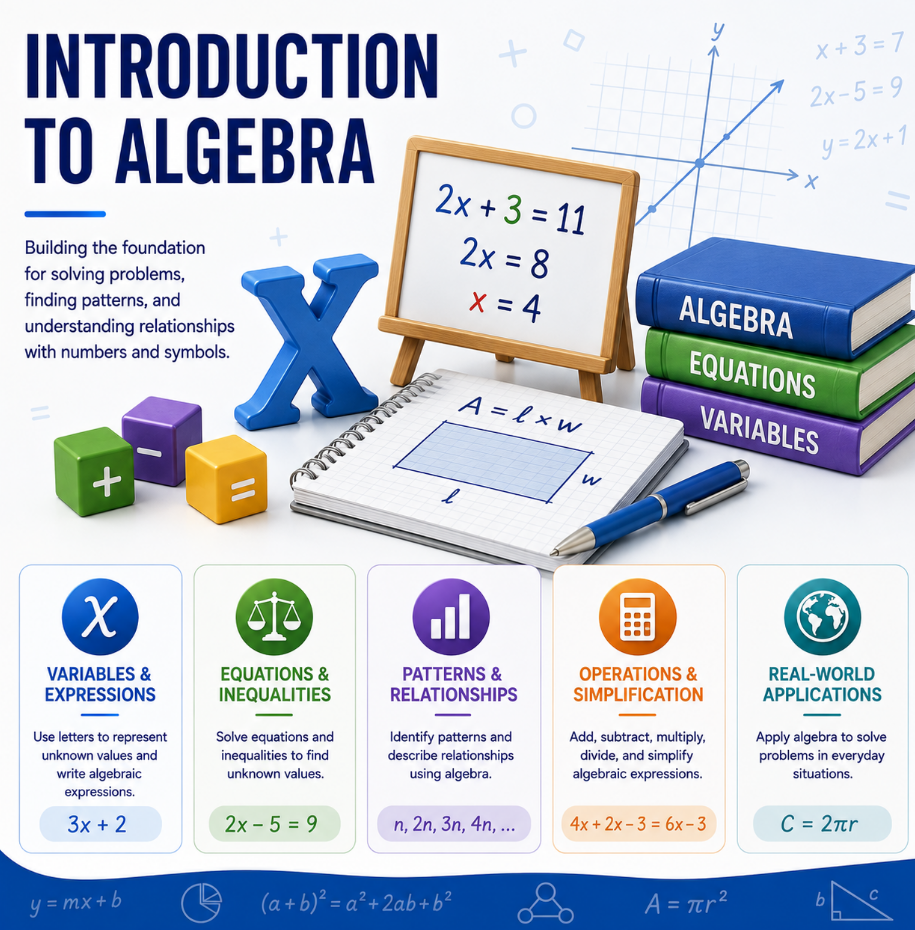
Algebra is often described as the language of mathematics. It allows us to represent patterns, describe relationships, solve problems, and make predictions using symbols and equations. While arithmetic focuses on working with known numbers, algebra introduces the powerful idea of using variables to represent unknown quantities and changing values. In this course, students will make the transition from arithmetic thinking to algebraic reasoning, developing skills that form the foundation for all higher-level mathematics.
The course begins by exploring patterns, sequences, and variables, helping students recognize how mathematical relationships can be represented using symbols. Students will learn to write and evaluate algebraic expressions, apply the order of operations, and translate real-world situations into mathematical language. These skills provide the foundation for understanding how algebra can be used to model and solve problems.
Students will then learn how to solve equations by applying logical reasoning and inverse operations. Through a variety of examples and applications, they will develop confidence in finding unknown values and verifying solutions. Building on these skills, students will simplify expressions, use the distributive property, evaluate formulas, and explore how algebra can describe relationships involving measurement, geometry, and science.
The course continues with an investigation of ratios, proportions, and linear relationships. Students will learn how quantities can change together and how these relationships can be represented mathematically. They will develop the ability to model real-world situations, identify patterns, and predict future values using algebraic rules.
Finally, students will be introduced to graphing and coordinate systems. They will learn how equations, tables, and graphs are connected and how visual representations can help describe relationships between variables. Through graphing activities and modeling projects, students will begin to see how algebra serves as a bridge between numerical calculations and mathematical analysis.
Throughout the course, students will strengthen their problem-solving skills, logical reasoning, and mathematical communication. They will discover that algebra is not simply a collection of rules and procedures, but a powerful tool for understanding patterns, solving problems, and describing the world around them.
Main Topics
Unit 1: Patterns, Variables, and Algebraic Thinking
Explore patterns, variables, expressions, and the foundations of algebraic reasoning.
Unit 2: Solving One-Step and Multi-Step Equations
Develop strategies for solving equations and finding unknown values.
Unit 3: Algebraic Expressions and Formulas
Learn how to simplify expressions, evaluate formulas, and represent mathematical relationships.
Unit 4: Ratios, Proportions, and Linear Relationships
Investigate proportional reasoning, direct variation, and relationships between changing quantities.
Unit 5: Introduction to Graphing
Connect equations, tables, and graphs while exploring coordinate systems and linear relationships.
Perfect For
- Middle school students transitioning into formal algebra
- Students preparing for secondary school mathematics
- Homeschool learners seeking a structured introduction to algebra
- Learners who want to strengthen problem-solving and logical reasoning skills
- Students preparing for future courses in algebra, science, economics, and engineering
By the End of This Course
Students will be able to:
- Use variables to represent unknown quantities.
- Write, evaluate, and simplify algebraic expressions.
- Solve one-step and multi-step equations.
- Apply the distributive property and combine like terms.
- Use formulas to solve mathematical and real-world problems.
- Solve ratio and proportion problems using algebraic methods.
- Identify and model linear relationships.
- Represent relationships using tables, equations, and graphs.
- Communicate mathematical thinking using algebraic language.
This course provides the essential foundation for future studies in linear equations, functions, graphing, advanced algebra, and many scientific disciplines. By learning to think algebraically, students develop a powerful set of tools for analyzing patterns, solving problems, and understanding the mathematical structure of the world around them.
- 教師: Young Mr.