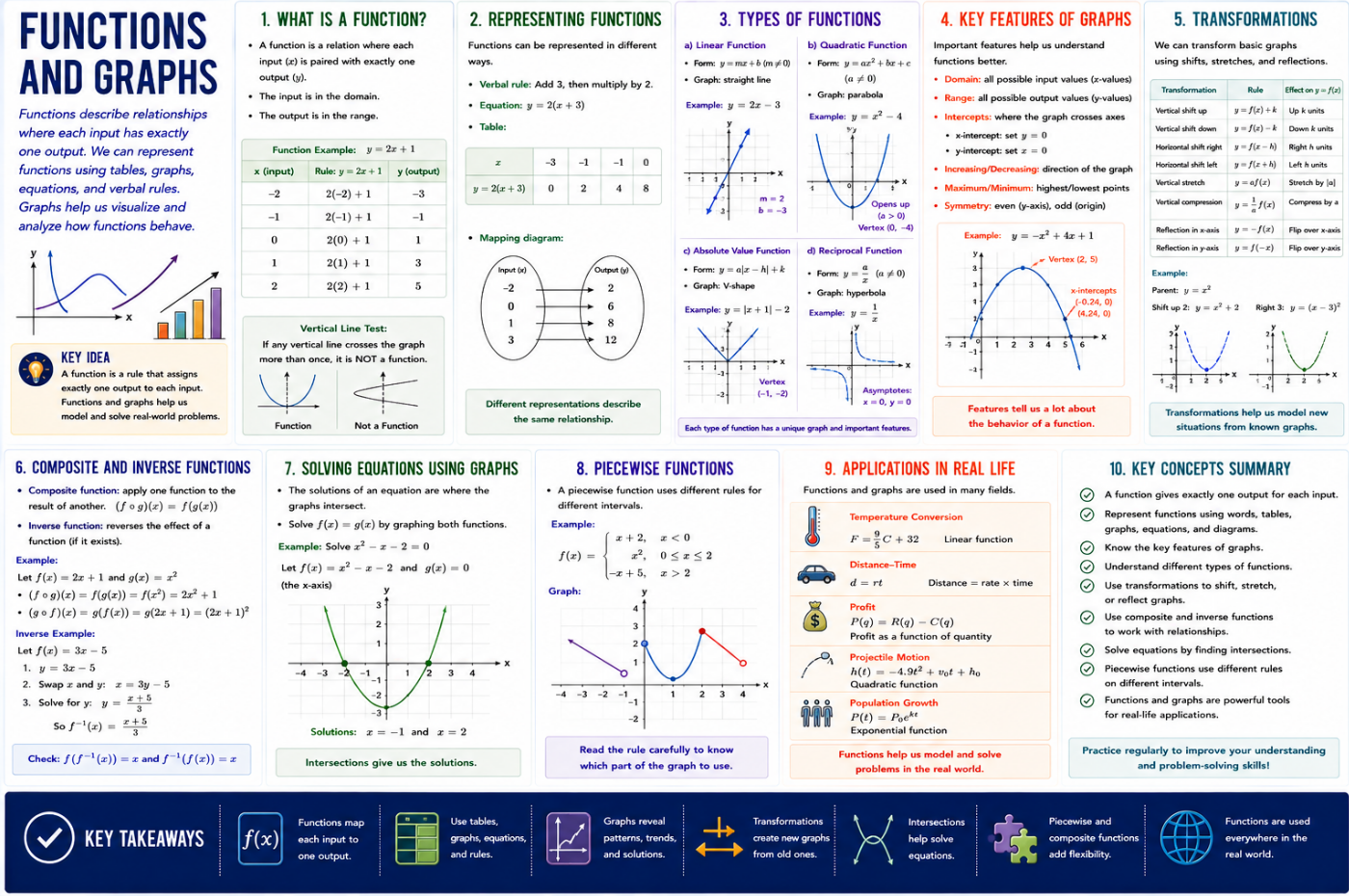
Functions are one of the most powerful ideas in mathematics because they describe how one quantity changes in relation to another. In this course, students develop a strong understanding of functions by exploring how mathematical relationships can be represented using equations, tables, graphs, and real-world models. They begin by learning what functions are and how to interpret function notation before investigating linear and non-linear relationships. Students then examine how graphs can be transformed and learn to analyze important features such as intercepts, rates of change, and turning points. Throughout the course, learners connect mathematical concepts to practical situations, preparing them for more advanced studies in algebra, trigonometry, calculus, and the sciences.
This course is organized into five main units:
- Introduction to Functions
- Linear Functions
- Non-Linear Functions
- Transformations of Graphs
- Analyzing and Interpreting Graphs
By the end of this course, students will confidently represent, analyze, and model mathematical relationships using functions and graphs, providing a strong foundation for higher-level mathematics and scientific applications.
- Leraar: Mr. Young