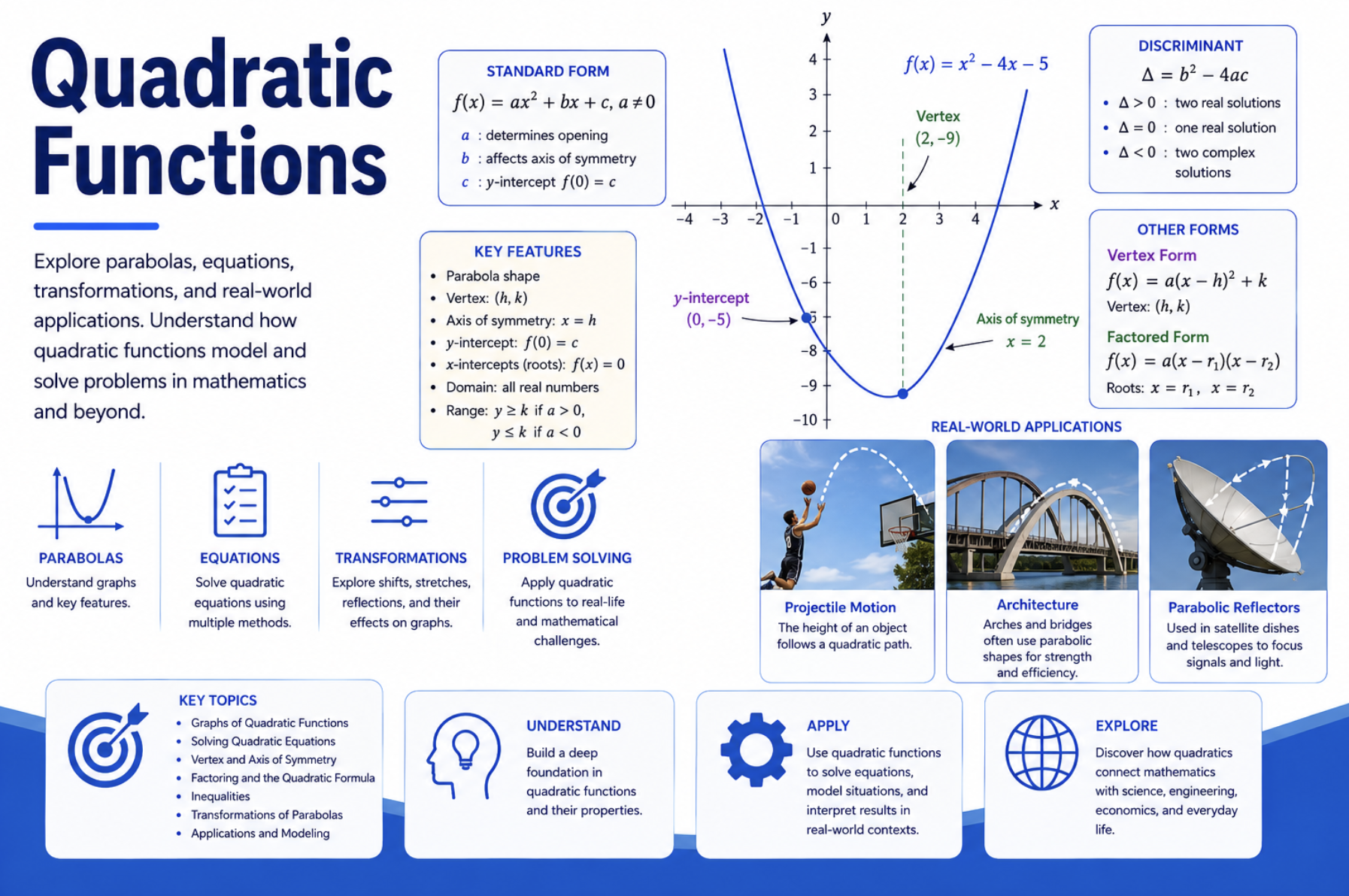
The Quadratic Functions course introduces students to the algebraic, graphical, and practical features of quadratic relationships. Students begin by identifying quadratic functions and exploring the key characteristics of parabolas, including vertices, axes of symmetry, intercepts, maximum and minimum points, domain, and range.
Throughout the course, students examine quadratic functions written in standard, vertex, and factored forms. They learn how each form reveals different information about a function and develop strategies for converting between forms. Students also build proficiency in solving quadratic equations using factoring, completing the square, and the quadratic formula, while using the discriminant to predict the number and type of solutions.
Students investigate how translations, reflections, stretches, and compressions affect quadratic graphs. They then apply their understanding to real-world contexts such as projectile motion, area problems, optimisation, and quadratic modelling. Technology is used where appropriate to graph functions, analyse data, verify solutions, and make predictions.
By the end of the course, students will be able to represent, analyse, solve, graph, and model quadratic relationships with confidence. Emphasis is placed on mathematical reasoning, selecting efficient methods, interpreting solutions in context, and communicating mathematical ideas clearly.
- Enseignant: Mr. Young