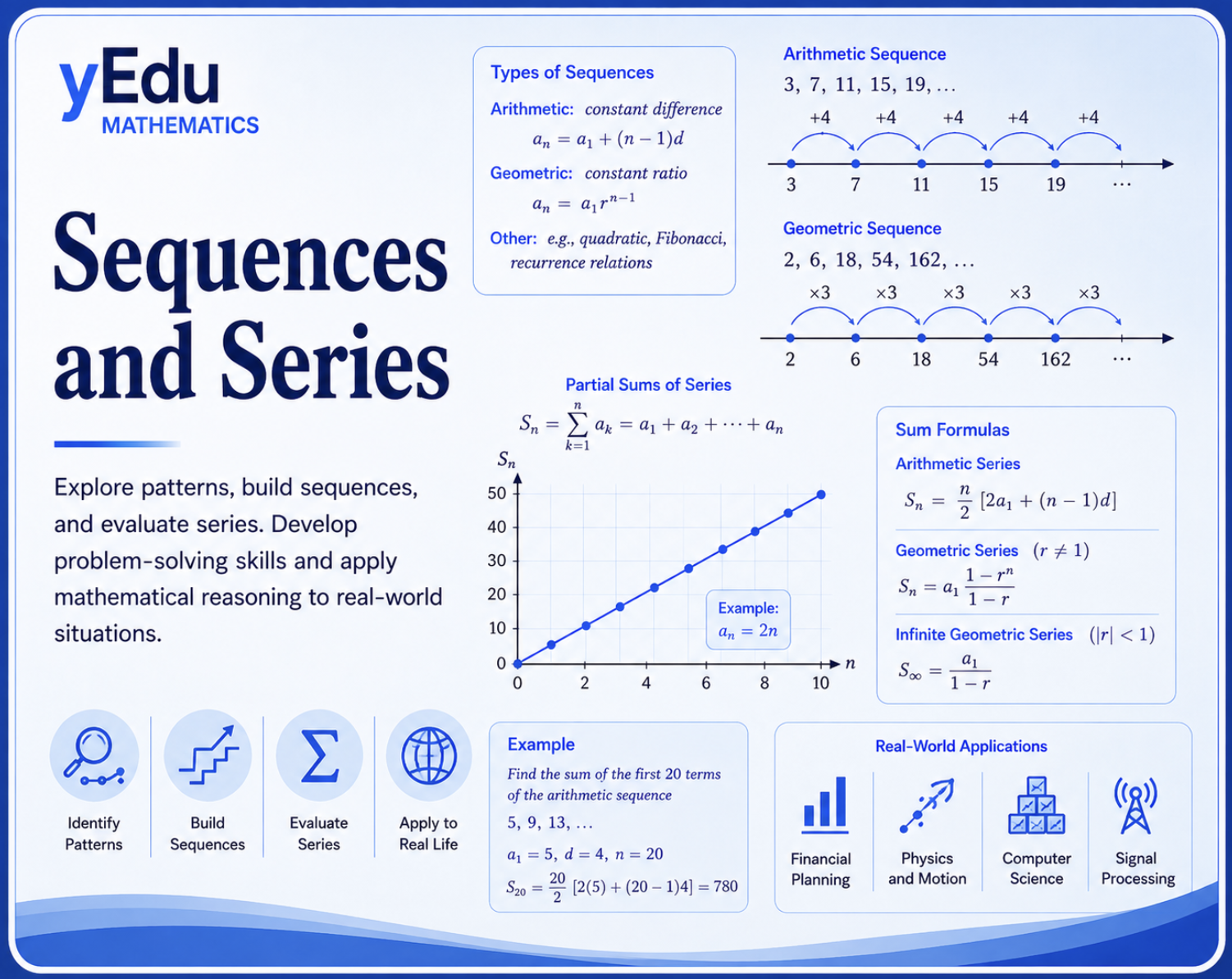
Patterns are everywhere in mathematics. They appear in growing populations, financial investments, architectural designs, computer algorithms, and even the arrangement of leaves on plants. The study of sequences and series allows mathematicians to recognize, describe, and predict these patterns using mathematical rules and relationships. In this course, students will explore how patterns evolve over time, learn to develop formulas that describe them, and apply these ideas to solve real-world problems.
The course begins by introducing sequences as ordered lists of numbers that follow specific rules. Students will learn how to identify patterns, predict future terms, and develop both recursive and explicit formulas. By examining numerical and visual patterns, they will discover how mathematics can be used to describe change and make predictions.
Students will then investigate arithmetic sequences and series, which are based on constant differences between terms. They will learn how these patterns connect directly to linear relationships and how formulas can be used to determine any term in a sequence or calculate the sum of many terms efficiently. Through graphing and modeling activities, students will see how arithmetic sequences form the foundation of many real-world situations involving steady growth or change.
The course continues with geometric sequences and series, where terms are generated using constant ratios. Students will explore exponential growth and decay, develop formulas for geometric patterns, and examine applications such as population growth, compound interest, and scientific modeling. These concepts provide an important introduction to exponential functions that will be studied in greater depth in future mathematics courses.
Students will also explore special sequences and mathematical patterns, including the Fibonacci sequence, Pascal’s Triangle, triangular numbers, and square numbers. Through these investigations, they will discover surprising connections between algebra, geometry, nature, and probability. These topics help develop mathematical curiosity while strengthening pattern-recognition and problem-solving skills.
The course concludes by applying sequences and series to authentic situations involving finance, science, technology, and mathematical modeling. Students will learn how repeated processes can be analyzed mathematically and how patterns can be used to make predictions and informed decisions.
Throughout the course, students will strengthen their algebraic reasoning, analytical thinking, and ability to communicate mathematical ideas. They will come to see mathematics not simply as a collection of procedures, but as a powerful system for recognizing patterns and understanding change.
Main Topics
Unit 1: Understanding Sequences
Explore numerical patterns, recursive rules, explicit formulas, and the foundations of sequence notation.
Unit 2: Arithmetic Sequences and Series
Investigate sequences with constant differences and learn how to calculate sums efficiently.
Unit 3: Geometric Sequences and Series
Study exponential patterns, geometric growth, geometric decay, and real-world applications.
Unit 4: Special Sequences and Mathematical Patterns
Discover famous sequences, figurate numbers, Pascal’s Triangle, and recursive models.
Unit 5: Applications of Sequences and Series
Apply mathematical patterns to finance, science, technology, and real-world modeling problems.
Perfect For
- Students who have completed introductory algebra and linear equations
- Learners interested in mathematical patterns and problem solving
- Students preparing for advanced algebra, functions, and pre-calculus
- Homeschool learners seeking a structured enrichment course
- Anyone curious about how mathematics describes growth, change, and prediction
By the End of This Course
Students will be able to:
- Identify and extend numerical and visual patterns.
- Write recursive and explicit formulas for sequences.
- Analyze arithmetic and geometric sequences.
- Calculate sums of arithmetic and geometric series.
- Model real-world situations involving linear and exponential growth.
- Interpret and graph sequence relationships.
- Explore famous mathematical patterns and their applications.
- Apply sequence concepts to financial, scientific, and technological problems.
- Communicate mathematical reasoning using appropriate notation and vocabulary.
This course serves as a bridge between algebra and higher-level mathematics, introducing students to many of the ideas that underpin functions, exponential modeling, finance, computer science, and calculus. By learning to recognize and describe patterns, students develop a deeper understanding of how mathematics can be used to analyze the world and predict future outcomes.
- Leraar: Mr. Young