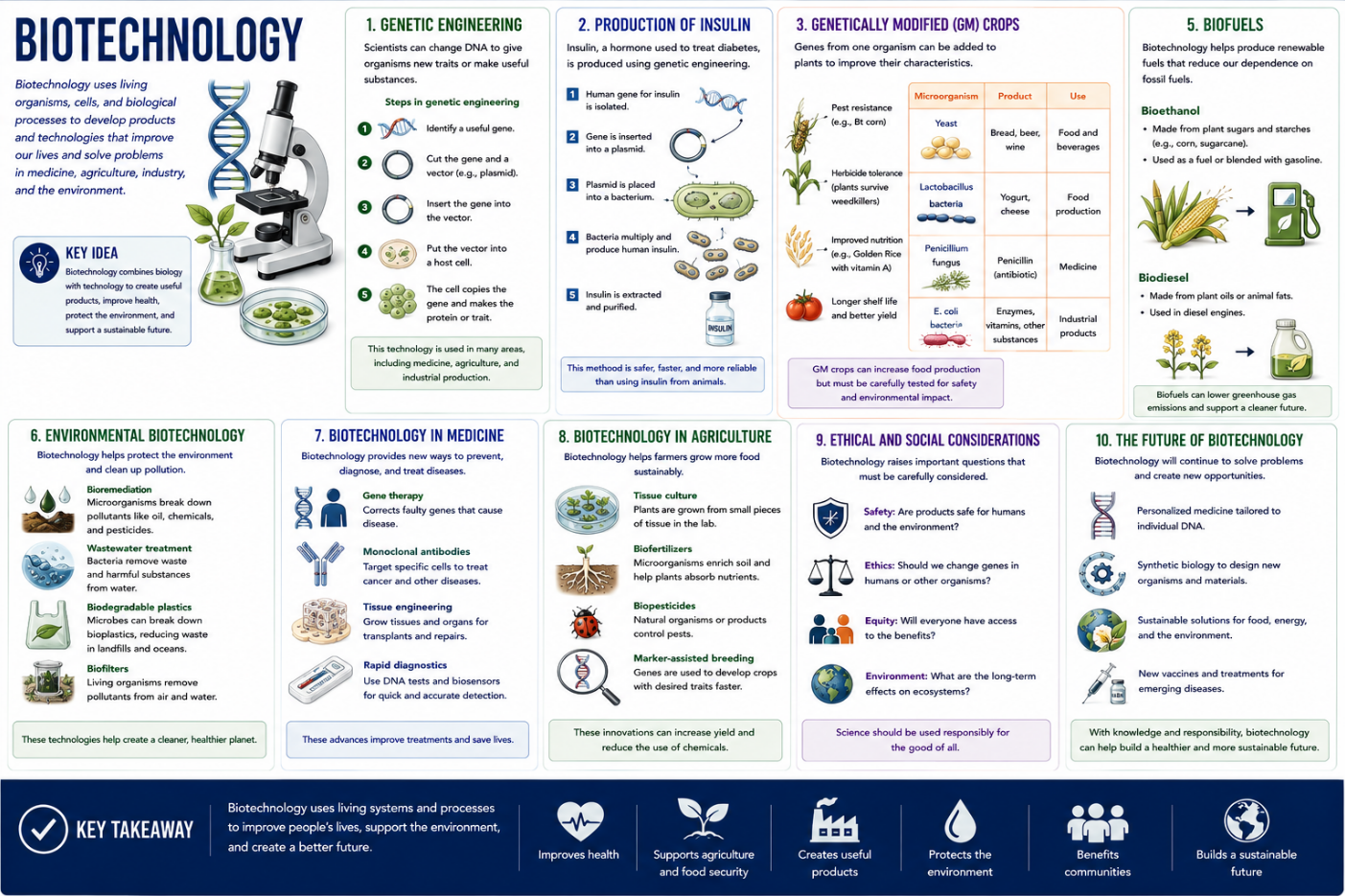
Biotechnology is one of the fastest-growing and most influential fields in modern science. By combining biology, chemistry, genetics, and technology, biotechnology allows scientists to use living organisms and biological systems to solve problems, improve health, increase food production, protect the environment, and develop innovative new products. From the production of insulin and vaccines to genetic engineering and gene editing, biotechnology plays an increasingly important role in shaping the future of society.
This course begins by exploring the foundations of biotechnology. Students will investigate the history of biotechnology, learn how microorganisms have been used for thousands of years, and develop an understanding of cells, DNA, and genes as the building blocks of modern biotechnology. They will discover how biological knowledge has led to powerful technologies that improve human life.
Students will then explore DNA technology and genetic engineering. They will learn how scientists manipulate genetic material using restriction enzymes, recombinant DNA technology, and genetic modification techniques. Through real-world examples, students will examine how genetic engineering is used in medicine, agriculture, and scientific research.
The course continues with biotechnology in medicine, where students investigate how biotechnology is used to produce medicines, develop vaccines, treat diseases, and advance personalized healthcare. They will explore gene therapy, stem cell technologies, and regenerative medicine while considering the benefits and challenges of these medical innovations.
Students will also examine biotechnology in agriculture and industry. They will explore genetically modified crops, biotechnology in animal production, fermentation technologies, industrial enzymes, and food biotechnology. These applications demonstrate how biotechnology helps meet global demands for food, materials, and sustainable production.
Throughout the course, students will consider the ethical and societal implications of biotechnology. They will investigate cloning, CRISPR gene editing, environmental biotechnology, and future developments in the field. By evaluating both opportunities and challenges, students will develop a balanced understanding of how biotechnology can influence the future of medicine, agriculture, industry, and the environment.
Main Topics
Unit 1: Foundations of Biotechnology
Explore the history, principles, and biological foundations of biotechnology, including microorganisms, cells, DNA, and modern applications.
Unit 2: DNA Technology and Genetic Engineering
Investigate how DNA can be analyzed, modified, and transferred between organisms using modern genetic engineering techniques.
Unit 3: Biotechnology in Medicine
Discover how biotechnology is transforming healthcare through medicines, vaccines, gene therapy, stem cells, and personalized medicine.
Unit 4: Biotechnology in Agriculture and Industry
Examine how biotechnology improves food production, agriculture, manufacturing, and industrial processes.
Unit 5: Ethics and Future Biotechnology
Evaluate the ethical issues, emerging technologies, and future possibilities associated with biotechnology and genetic innovation.
Perfect For
- High school biology students interested in genetics and biotechnology
- Students preparing for advanced biology, biotechnology, or biomedical science courses
- Homeschool learners seeking a structured life science program
- Learners interested in medicine, agriculture, genetics, and scientific innovation
- Students preparing for careers in healthcare, biotechnology, agriculture, or research
- Future geneticists, biotechnologists, biomedical engineers, and healthcare professionals
By the End of This Course
Students will be able to:
- Explain the principles and history of biotechnology.
- Describe the roles of cells, DNA, genes, and microorganisms in biotechnology.
- Explain how restriction enzymes and recombinant DNA technology are used in genetic engineering.
- Analyze applications of genetic modification and gene editing.
- Describe how biotechnology is used to produce medicines and vaccines.
- Explain the principles of gene therapy and stem cell technologies.
- Evaluate agricultural and industrial applications of biotechnology.
- Analyze the benefits and risks of genetically modified organisms.
- Explain the role of biotechnology in environmental sustainability.
- Evaluate ethical issues associated with biotechnology and genetic engineering.
- Investigate emerging technologies such as CRISPR and personalized medicine.
- Apply scientific reasoning to biotechnology-related challenges and case studies.
This course provides a comprehensive introduction to biotechnology, helping students understand how biological knowledge can be used to improve human health, food production, environmental sustainability, and technological innovation. Through the study of genetics, medicine, agriculture, and bioethics, students will gain insight into one of the most exciting and rapidly advancing areas of modern science.
- Teacher: Mr. Young