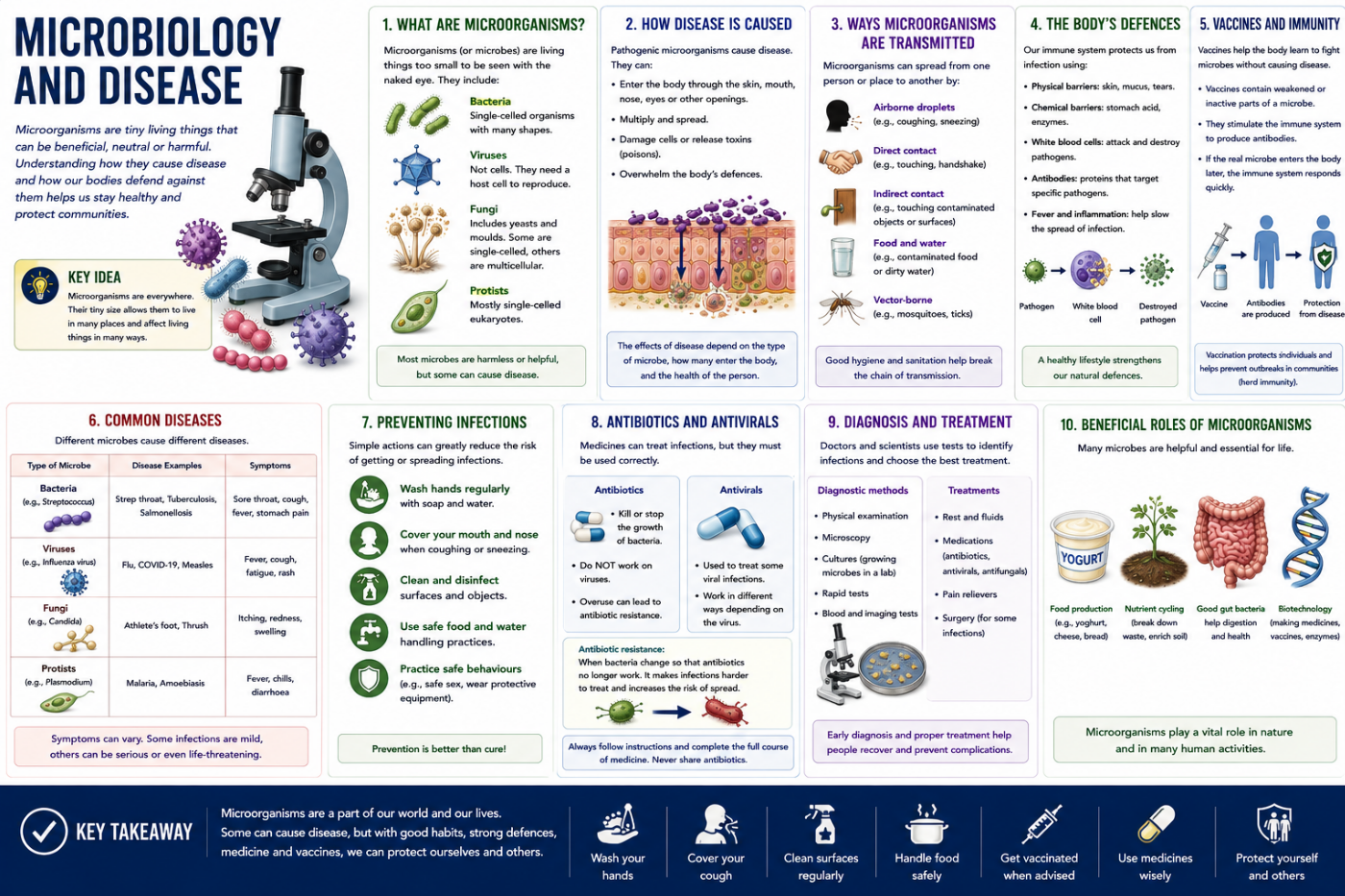
Microorganisms are among the most abundant and influential forms of life on Earth. Although they are invisible to the naked eye, microbes play essential roles in ecosystems, human health, food production, biotechnology, and medicine. Some microorganisms help sustain life, while others cause disease and present major challenges to global health. Understanding the microbial world provides important insights into biology, medicine, agriculture, and modern technology.
This course begins by exploring the diversity of microorganisms and their roles in nature. Students will investigate bacteria, viruses, fungi, and protists while learning how these organisms are classified, how they reproduce, and how they interact with living systems. They will discover that microorganisms can be both beneficial and harmful and are essential components of ecosystems around the world.
Students will then examine pathogens and infectious diseases. They will investigate how diseases are transmitted, compare bacterial and viral infections, and explore factors that contribute to the emergence and spread of infectious diseases. Through real-world examples, students will develop an understanding of the challenges involved in preventing and controlling disease outbreaks.
The course continues with an exploration of the human immune system and disease prevention. Students will learn how physical barriers, immune responses, vaccines, and medicines help protect the body from infection. They will investigate how public health measures reduce disease transmission and examine the importance of vaccination and responsible antimicrobial use.
Next, students will discover how microorganisms are used in industry and biotechnology. They will explore fermentation, food production, industrial microbiology, genetic engineering, and environmental biotechnology. These topics demonstrate how microbes contribute to medicine, manufacturing, agriculture, and environmental sustainability.
Throughout the course, students will investigate the evolution of disease and the challenges facing global health. They will examine antibiotic resistance, pathogen evolution, pandemics, disease surveillance, and emerging health threats. By connecting microbiology to public health and biotechnology, students will gain a deeper understanding of how microorganisms influence both individual lives and society as a whole.
Main Topics
Unit 1: The Microbial World
Explore the diversity of microorganisms, including bacteria, viruses, fungi, and protists, while investigating their roles in ecosystems and human life.
Unit 2: Pathogens and Infectious Disease
Investigate how pathogens cause disease, how infections spread, and the challenges involved in controlling infectious diseases.
Unit 3: The Immune System and Disease Prevention
Learn how the body's defenses, vaccines, medicines, and public health measures help prevent and control disease.
Unit 4: Microorganisms in Industry and Biotechnology
Discover how microbes are used in food production, biotechnology, medicine, environmental management, and industrial processes.
Unit 5: Evolution of Disease and Global Health
Examine antibiotic resistance, pathogen evolution, pandemics, and future challenges in global health.
Perfect For
- High school biology students studying microorganisms and disease
- Students preparing for advanced biology, microbiology, or health science courses
- Homeschool learners seeking a structured life science program
- Learners interested in medicine, biotechnology, and public health
- Students preparing for careers in healthcare, research, biotechnology, or environmental science
- Future microbiologists, doctors, epidemiologists, and biomedical researchers
By the End of This Course
Students will be able to:
- Describe the major groups of microorganisms and their characteristics.
- Compare bacteria, viruses, fungi, and protists.
- Explain how pathogens cause infectious diseases.
- Analyze methods of disease transmission and prevention.
- Describe the structure and function of the immune system.
- Explain how vaccines, antibiotics, and antiviral drugs work.
- Evaluate strategies for preventing disease spread.
- Describe industrial and environmental applications of microorganisms.
- Explain the role of microbes in biotechnology and genetic engineering.
- Analyze the development of antibiotic resistance and pathogen evolution.
- Evaluate public health responses to disease outbreaks and pandemics.
- Apply microbiology concepts to real-world health and environmental issues.
This course provides a strong foundation in microbiology and disease, helping students understand the microscopic organisms that influence life on Earth. Through the study of pathogens, immunity, biotechnology, and global health, students will develop scientific literacy and critical-thinking skills while gaining insight into some of the most important biological challenges facing humanity today.
- Profesor: Mr. Young