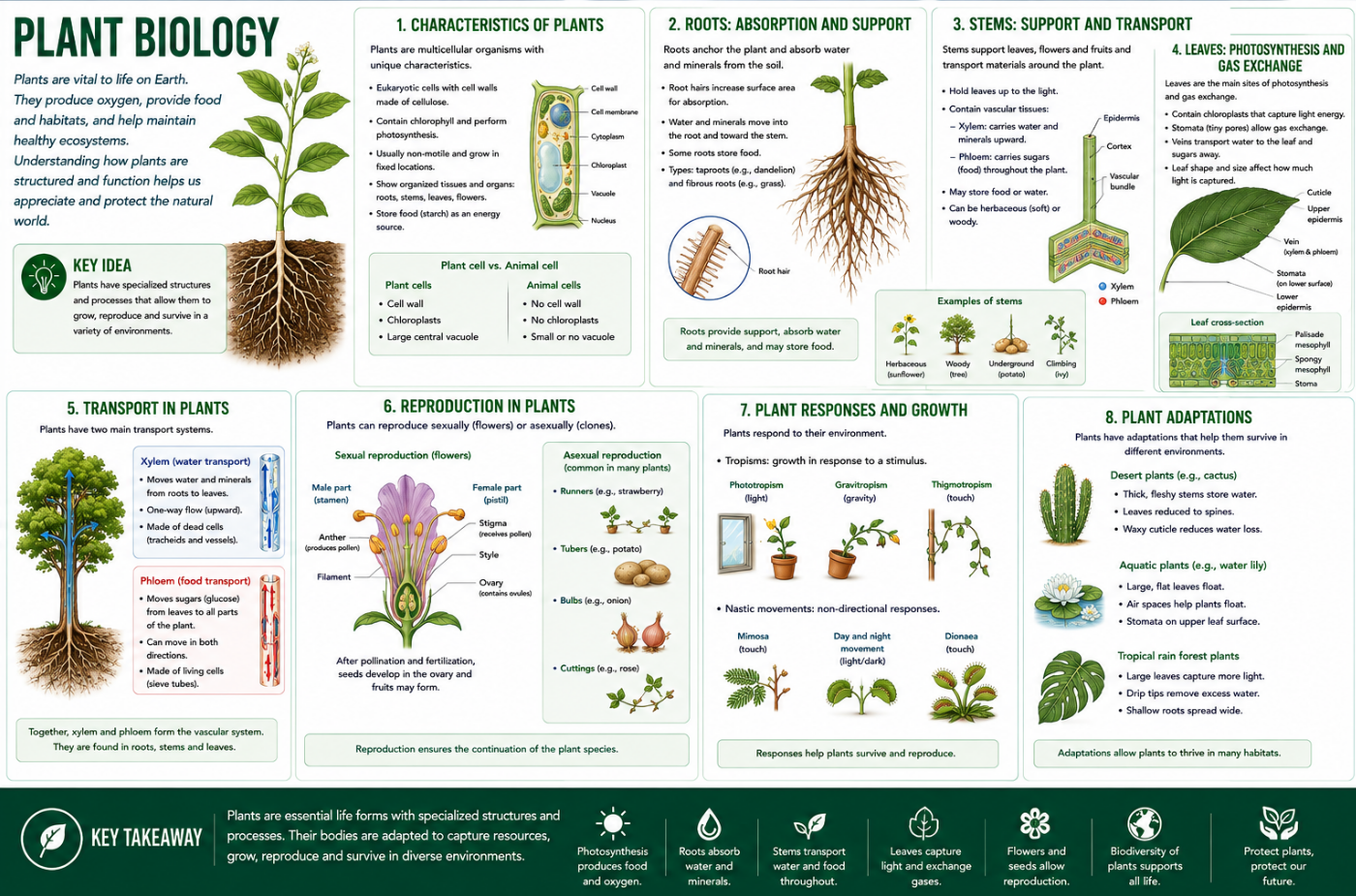
Plants are the foundation of nearly every ecosystem on Earth. They produce oxygen, provide food, regulate climate, support biodiversity, and form the basis of many human industries. In this course, students will explore the structure, function, growth, reproduction, and ecological importance of plants while developing an understanding of how plants survive and thrive in a wide variety of environments.
The course begins by examining the structure and function of plants. Students will investigate the roles of roots, stems, leaves, and other plant organs, discovering how specialized structures work together to support growth, transport materials, and maintain life processes. Through the study of plant anatomy and organization, students will develop an appreciation for the complexity of plant systems.
Students will then explore photosynthesis and plant nutrition, learning how plants capture sunlight and convert it into chemical energy. They will examine chloroplasts, chlorophyll, limiting factors affecting photosynthesis, and the essential mineral nutrients required for healthy plant growth. The role of fertilizers in modern agriculture will also be investigated.
The course continues with an in-depth study of transport in plants. Students will learn how water, minerals, and sugars move through specialized tissues such as xylem and phloem. They will examine transpiration, translocation, and the factors that influence water balance within plants.
Building on these foundations, students will investigate plant reproduction. They will explore flower structure, pollination, fertilization, seed formation, dispersal mechanisms, and germination. Students will discover how plants reproduce and spread successfully across diverse habitats.
Finally, students will examine plant adaptations and the importance of plants in ecosystems and human society. They will investigate tropisms, environmental adaptations, agriculture, food production, and the many ways plants contribute to life on Earth. Through real-world examples, students will gain an understanding of the vital role plants play in sustaining ecosystems and supporting human civilization.
Throughout the course, students will develop scientific inquiry skills while exploring the remarkable diversity and importance of the plant kingdom.
Main Topics
Unit 1: Plant Structure and Function
Explore the organization of plants and the roles of roots, stems, leaves, and plant organ systems.
Unit 2: Photosynthesis and Plant Nutrition
Investigate how plants produce food, obtain nutrients, and support growth.
Unit 3: Transport in Plants
Study the movement of water, minerals, and sugars through plant tissues.
Unit 4: Plant Reproduction
Examine pollination, fertilization, seed development, and germination.
Unit 5: Plant Adaptations and Importance
Discover how plants survive in different environments and their significance to ecosystems and society.
Perfect For
- Middle and high school biology students.
- Learners interested in ecology, agriculture, environmental science, or botany.
- Homeschool students seeking a comprehensive plant biology course.
- Students preparing for advanced biology studies.
- Anyone interested in understanding the living organisms that support life on Earth.
By the End of This Course
Students will be able to:
- Describe the major structures and functions of plants.
- Explain how photosynthesis provides energy for plant growth.
- Identify the mineral nutrients required by plants.
- Describe the transport of water, minerals, and sugars through xylem and phloem.
- Explain the processes of pollination, fertilization, seed formation, and germination.
- Identify adaptations that allow plants to survive in diverse environments.
- Explain how plants respond to environmental stimuli.
- Analyze the role of plants in ecosystems and food webs.
- Describe the importance of plants in agriculture and food production.
- Evaluate the contributions of plants to human society and environmental sustainability.
Plant biology connects the study of living organisms with ecology, agriculture, environmental science, and human well-being. By understanding how plants function and interact with their environment, students gain insight into some of the most important organisms on our planet and the critical roles they play in sustaining life.
- 教師: Young Mr.