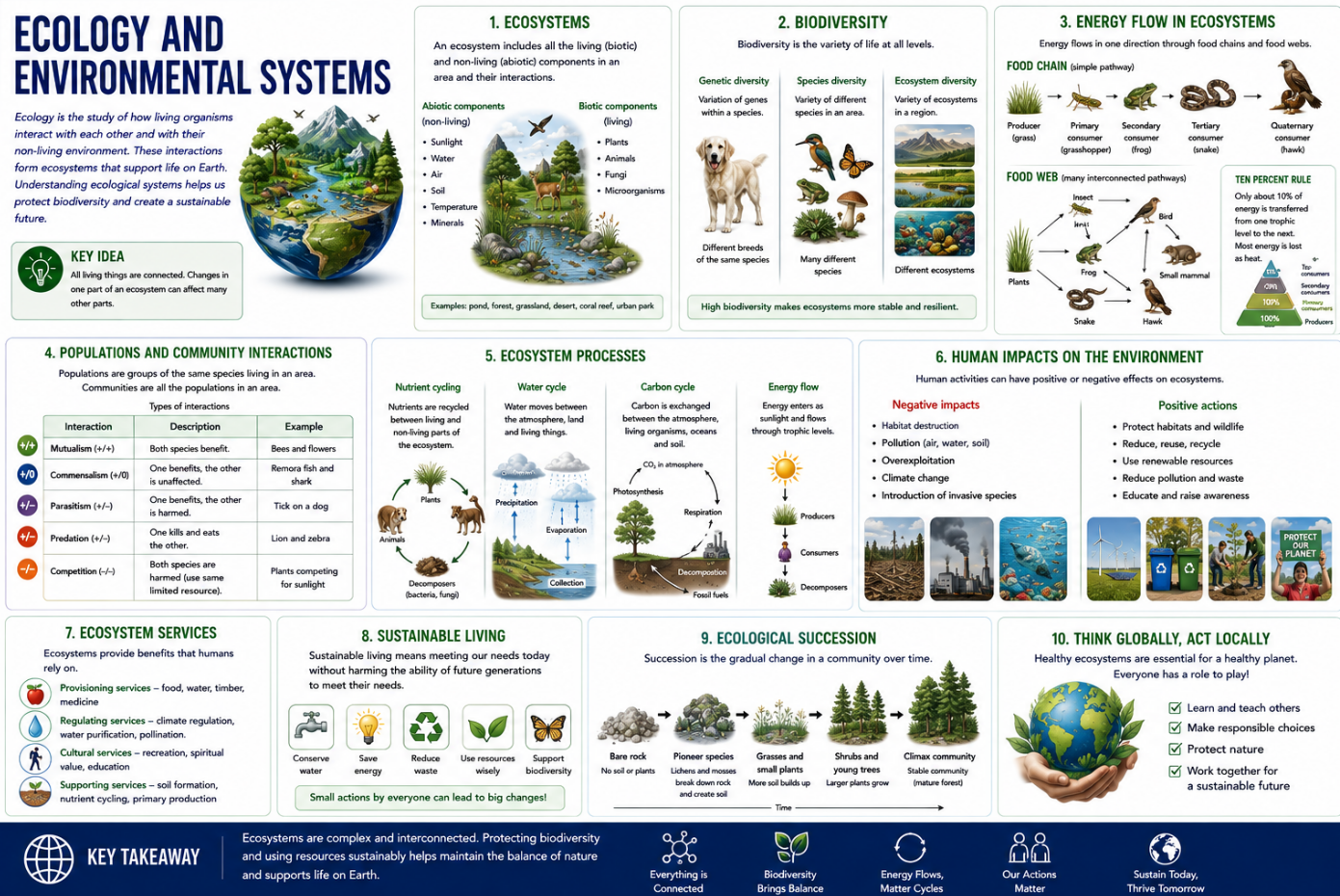
Ecology is the study of how living organisms interact with one another and with their environment. From tiny microorganisms in the soil to vast forests, oceans, and atmospheric systems, every organism is part of a complex network of relationships that helps sustain life on Earth. Understanding these interactions allows us to better appreciate the natural world and address the environmental challenges facing our planet.
This course begins by exploring ecosystems and the many interactions that occur within them. Students will investigate biotic and abiotic factors, examine habitats and niches, and discover how organisms depend on one another for survival. Through the study of populations and species interactions, they will gain an understanding of how ecosystems function as interconnected systems.
Students will then examine how energy moves through ecosystems. They will investigate the roles of producers, consumers, and decomposers, construct food chains and food webs, and analyze trophic levels and energy pyramids. These concepts help explain how energy supports life and why ecosystems depend on a continuous flow of energy.
The course continues with an exploration of the major cycles that recycle matter through Earth's systems. Students will investigate the water, carbon, and nitrogen cycles, examine the role of decomposition in nutrient recycling, and analyze how human activities can disrupt these natural processes. By understanding these cycles, students will gain a deeper appreciation for the connections between living organisms and the environment.
Next, students will study biodiversity and conservation. They will learn how biodiversity is measured, why it is important for ecosystem stability, and how human activities threaten species and habitats. Students will evaluate conservation strategies and explore how protected areas and restoration projects help preserve Earth's biological diversity.
Throughout the course, students will investigate the impact of human activities on ecosystems and explore the principles of sustainability. They will examine pollution, climate change, resource use, sustainable development, and future environmental challenges. By connecting ecological concepts to real-world issues, students will develop the scientific understanding and critical-thinking skills needed to become informed environmental stewards and responsible global citizens.
Main Topics
Unit 1: Ecosystems and Interactions
Explore how ecosystems function by examining biotic and abiotic factors, habitats, niches, species interactions, and population dynamics.
Unit 2: Energy Flow in Ecosystems
Investigate how energy moves through ecosystems through producers, consumers, decomposers, food chains, food webs, trophic levels, and energy pyramids.
Unit 3: Cycles in Nature
Discover how matter is recycled through the water, carbon, and nitrogen cycles and examine the role of decomposition and nutrient recycling in sustaining ecosystems.
Unit 4: Biodiversity and Conservation
Learn about the importance of biodiversity, how it is measured, the threats it faces, and the strategies used to conserve and restore ecosystems.
Unit 5: Human Impacts and Sustainability
Examine how human activities affect the environment and explore solutions related to pollution, climate change, resource management, sustainable development, and environmental stewardship.
Perfect For
- Middle school and early high school students studying life science, biology, or environmental science
- Students interested in ecosystems, wildlife, and conservation
- Homeschool learners seeking a structured ecology course
- Learners interested in sustainability and environmental issues
- Students preparing for advanced biology or environmental science courses
- Future scientists, environmentalists, conservationists, and policy makers
By the End of This Course
Students will be able to:
- Describe the structure and function of ecosystems.
- Explain how organisms interact with each other and their environment.
- Analyze the flow of energy through food chains, food webs, and trophic levels.
- Describe the major biogeochemical cycles and their importance.
- Explain the role of biodiversity in ecosystem stability.
- Evaluate threats to biodiversity and conservation strategies.
- Analyze the environmental impacts of human activities.
- Explain the causes and consequences of climate change.
- Apply principles of sustainability to environmental challenges.
- Use scientific evidence to evaluate ecological and environmental issues.
This course provides a strong foundation in ecology and environmental science, helping students understand the complex relationships that sustain life on Earth. Through the study of ecosystems, energy flow, biodiversity, and sustainability, students will develop the knowledge and critical-thinking skills needed to understand environmental challenges and contribute to a more sustainable future.
- Giáo viên: Mr. Young