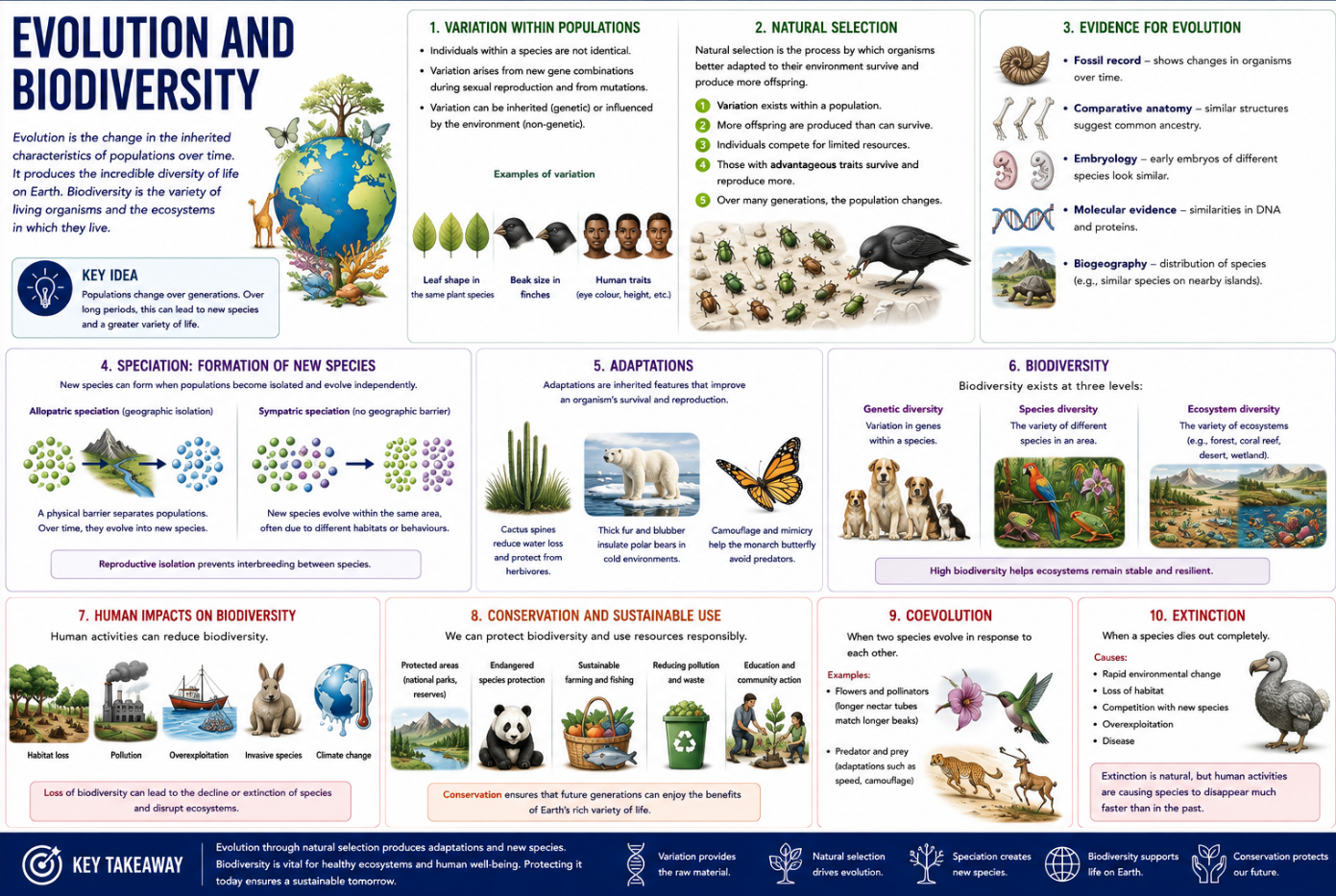
Why are there so many different forms of life on Earth? How do species change over time? What evidence supports the theory of evolution, and why is biodiversity so important for the health of ecosystems? In this course, students will explore the processes that drive evolution and the incredible diversity of life that exists today.
The course begins with Variation Within Species, where students investigate the differences that exist among individuals within populations. They will examine genetic and environmental causes of variation and learn how variation provides the foundation for evolutionary change.
Students then explore Natural Selection and Adaptation, studying Darwin's theory of evolution by natural selection and the role of competition, adaptation, and selection pressures in shaping populations over time. They will discover how advantageous traits become more common across generations.
In Evidence for Evolution, students investigate the scientific evidence supporting evolutionary theory, including fossils, comparative anatomy, embryology, molecular biology, and modern examples of evolution occurring today. These lines of evidence help scientists reconstruct the history of life on Earth.
The course continues with Classification and Biodiversity, where students learn how organisms are classified and how biodiversity is measured. They will explore taxonomic systems, scientific naming, domains, kingdoms, and the importance of biodiversity in maintaining healthy ecosystems.
Finally, students examine Speciation and Conservation, investigating how new species form, why extinction occurs, and the challenges facing biodiversity in the modern world. They will evaluate conservation strategies and explore how humans can help protect Earth's living resources.
Course Units
Unit 1: Variation Within Species
- What Is Variation?
- Genetic Variation
- Environmental Variation
- Continuous and Discontinuous Variation
- Measuring Variation in Populations
Unit 2: Natural Selection and Adaptation
- The Theory of Natural Selection
- Competition and Survival
- Adaptations
- Selection Pressures
- Evolution Through Natural Selection
Unit 3: Evidence for Evolution
- Fossil Evidence
- Comparative Anatomy
- Embryology
- Molecular Evidence and DNA
- Observing Evolution Today
Unit 4: Classification and Biodiversity
- Why Organisms Are Classified
- Taxonomic Hierarchy
- Binomial Nomenclature
- Domains and Kingdoms
- Measuring Biodiversity
Unit 5: Speciation and Conservation
- What Is a Species?
- Speciation
- Extinction
- Threats to Biodiversity
- Conservation Strategies
By the end of this course, students will understand how variation, natural selection, and environmental pressures drive evolution, how scientists gather evidence for evolutionary change, and why biodiversity is essential for life on Earth. Through case studies, investigations, and real-world examples, students will gain a deeper appreciation for the interconnectedness of living organisms and the importance of conserving biological diversity for future generations.
"Nothing in biology makes sense except in the light of evolution." — Theodosius Dobzhansky
- Teacher: Mr. Young