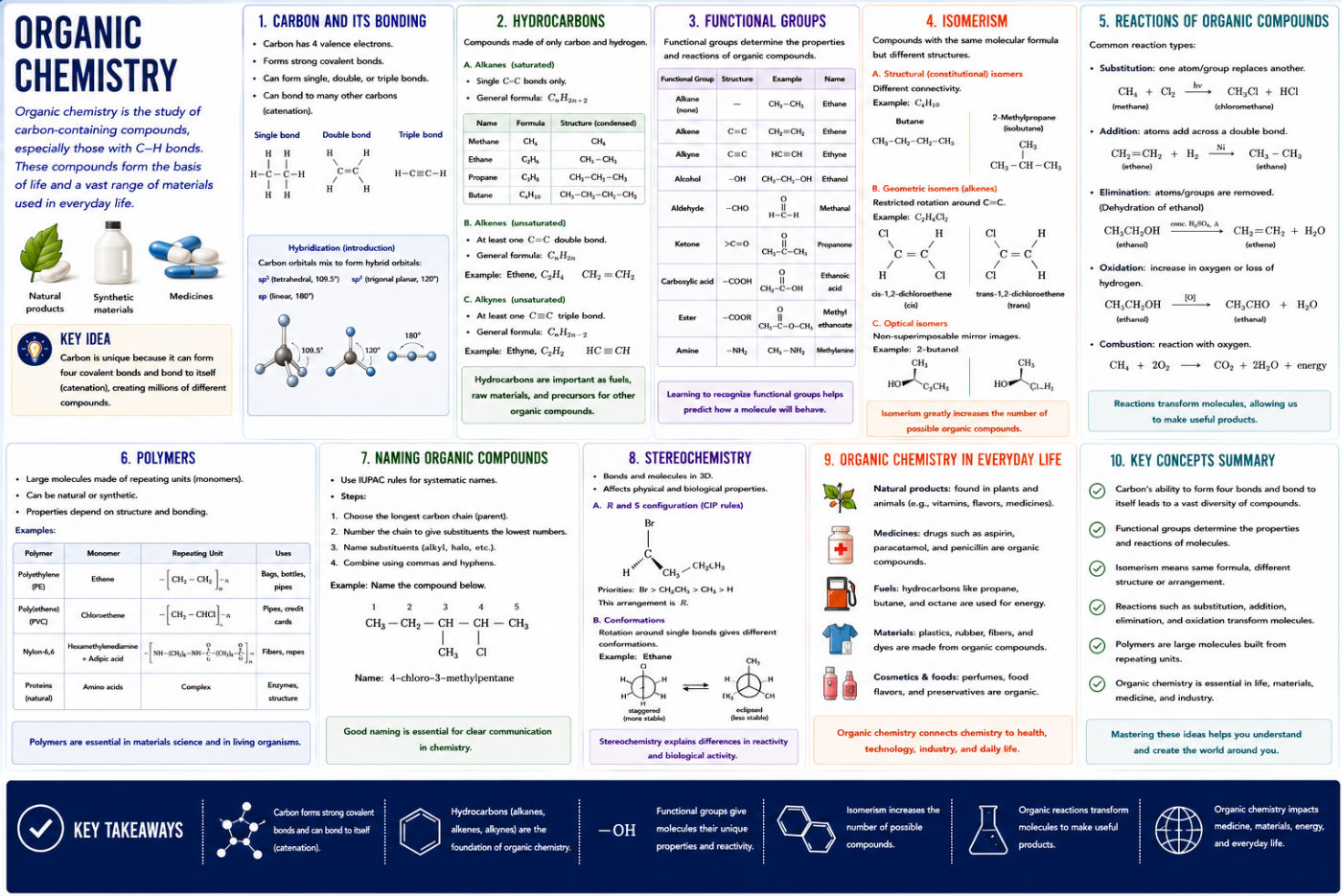
Organic chemistry is the study of carbon-containing compounds and the incredible variety of molecules that form the basis of life, fuels, medicines, plastics, and countless everyday products. Although all living organisms are built from organic molecules, organic chemistry extends far beyond biology, playing a central role in modern industry, technology, agriculture, medicine, and environmental science. In this course, students will explore how carbon atoms combine to form complex structures, investigate the properties and reactions of organic compounds, and discover how organic chemistry shapes the world around us.
The course begins with an introduction to the unique properties of carbon and the foundations of organic chemistry. Students will learn why carbon is capable of forming such a vast range of compounds and how chemists use molecular, structural, and displayed formulas to represent organic molecules. They will also explore hydrocarbons and homologous series, providing a framework for classifying organic compounds.
Students will then investigate the alkane family and the important role hydrocarbons play as fuels. Through the study of combustion reactions, crude oil, and fractional distillation, they will learn how organic chemistry contributes to global energy production while considering the environmental implications of fossil fuel use.
The course continues with alkenes and polymers, introducing unsaturated hydrocarbons and their greater chemical reactivity. Students will explore addition reactions, polymerization processes, and the production of plastics, while examining the benefits and environmental challenges associated with synthetic materials.
Building on these foundations, students will study functional groups, which are responsible for many of the physical and chemical properties of organic compounds. They will investigate alcohols, carboxylic acids, esters, amines, and amino acids, developing an understanding of how molecular structure influences behavior and applications.
Finally, students will explore the role of organic chemistry in everyday life. From biomolecules and pharmaceuticals to food chemistry and sustainable technologies, they will discover how organic chemistry contributes to human health, technological innovation, and environmental stewardship. Through real-world case studies, students will gain an appreciation for the impact of organic chemistry on society and the future challenges facing chemists.
Throughout the course, students will strengthen their understanding of molecular structure, chemical reactions, and scientific problem-solving while developing an appreciation for the remarkable diversity of carbon-based compounds.
Main Topics
Unit 1: Introduction to Organic Chemistry
Explore the unique properties of carbon, hydrocarbons, chemical formulas, and homologous series.
Unit 2: Alkanes and Fuels
Investigate saturated hydrocarbons, combustion reactions, crude oil, and energy production.
Unit 3: Alkenes and Polymers
Study unsaturated hydrocarbons, addition reactions, polymerization, and plastics.
Unit 4: Functional Groups
Examine alcohols, carboxylic acids, esters, amines, amino acids, and how functional groups influence chemical behavior.
Unit 5: Organic Chemistry in Everyday Life
Discover the role of organic chemistry in biology, medicine, food science, sustainability, and modern technology.
Perfect For
- High school chemistry students seeking a strong introduction to organic chemistry.
- Learners interested in medicine, pharmacy, biotechnology, or environmental science.
- Students preparing for advanced chemistry courses.
- Homeschool learners looking for a structured organic chemistry curriculum.
- Anyone curious about the chemistry behind living organisms and modern materials.
By the End of This Course
Students will be able to:
- Explain the unique bonding properties of carbon.
- Identify and classify major families of organic compounds.
- Interpret and draw molecular, structural, and displayed formulas.
- Describe the properties and reactions of alkanes and alkenes.
- Explain the processes of combustion and polymerization.
- Identify common functional groups and predict their effects on molecular behavior.
- Describe the structure and importance of biomolecules.
- Explain how organic chemistry contributes to medicine, food science, and industry.
- Evaluate environmental issues related to fuels, plastics, and chemical production.
- Apply organic chemistry concepts to real-world situations and technological applications.
This course provides a strong foundation in one of the most important branches of chemistry. By exploring the chemistry of carbon and its compounds, students gain insight into the molecules that power life, drive modern technology, and influence many of the scientific and environmental challenges of the twenty-first century.
- Profesor: Mr. Young