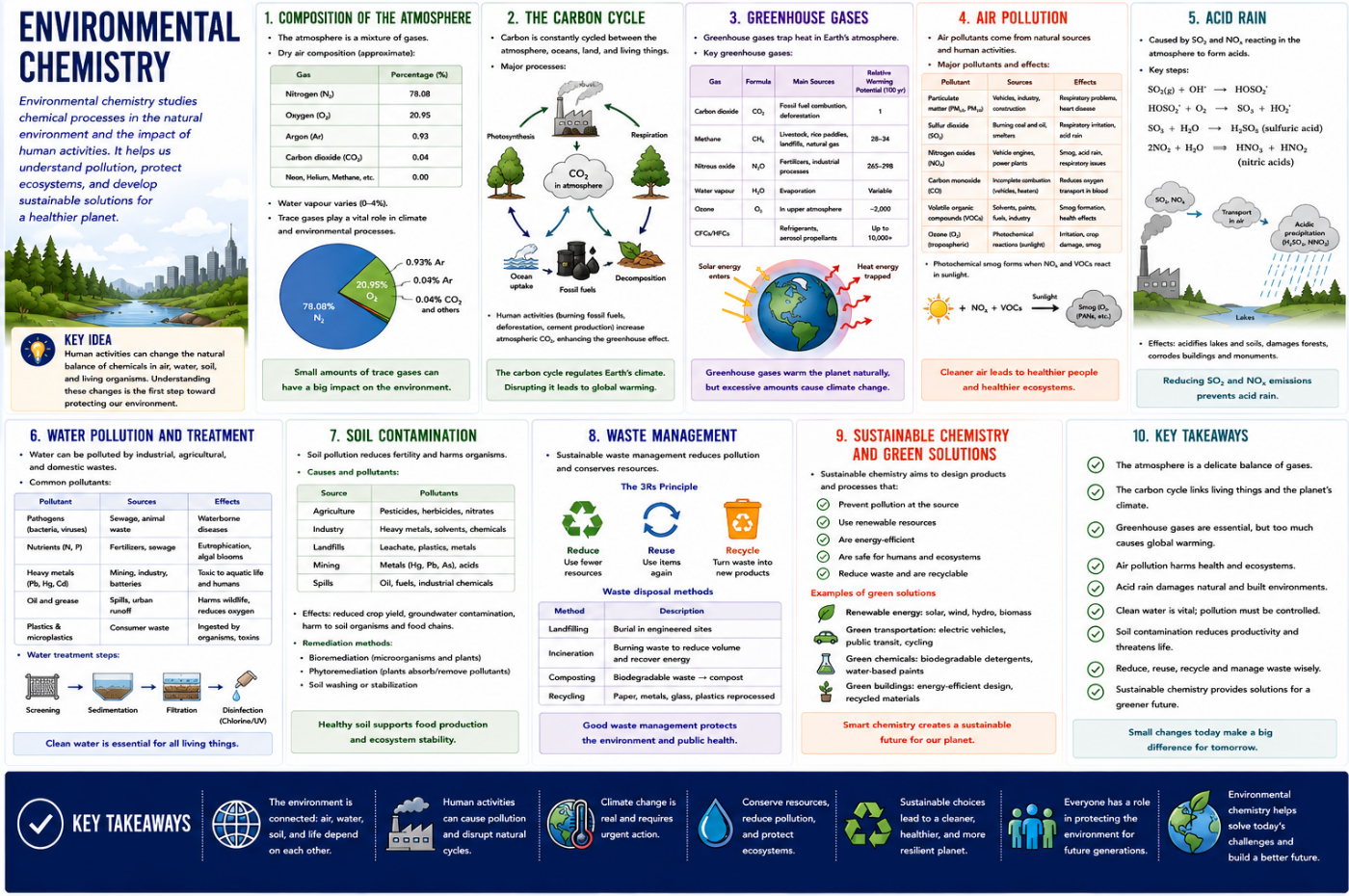
Environmental chemistry explores the chemical processes that shape Earth's atmosphere, water, soil, and ecosystems. From the air we breathe and the water we drink to the resources we use every day, chemistry plays a central role in understanding environmental systems and addressing global challenges. By studying environmental chemistry, students gain insight into how natural cycles operate, how human activities affect the environment, and how science can help create a more sustainable future.
This course begins with an exploration of Earth's atmosphere and the chemical processes that influence air quality and climate. Students will investigate the composition of the atmosphere, examine the carbon cycle, and explore the roles of greenhouse gases, air pollution, and acid rain. Through these topics, they will develop an understanding of how atmospheric chemistry affects both ecosystems and human societies.
Students will then examine water and water quality, learning about the water cycle, sources of water pollution, and methods used to treat and monitor water supplies. They will investigate how water quality is assessed and explore strategies for managing freshwater resources sustainably. These concepts highlight the importance of clean water for both human health and ecosystem stability.
The course continues with an investigation of soil and agriculture. Students will explore soil composition, nutrient cycles, fertilizers, and agricultural chemicals while examining how farming practices influence environmental quality. They will evaluate sustainable agricultural methods and consider the challenges of balancing food production with environmental protection.
Next, students will study the relationship between natural resources, waste management, and sustainability. They will investigate resource use, plastic pollution, recycling technologies, green chemistry, and sustainable materials. Through these topics, students will learn how chemistry can contribute to reducing waste and supporting more sustainable patterns of production and consumption.
Throughout the course, students will examine climate change and future environmental challenges. They will investigate scientific evidence for climate change, explore its causes and impacts, evaluate mitigation strategies, and examine emerging technologies designed to support a sustainable future. By connecting chemistry concepts to real-world environmental issues, students will develop the scientific literacy and critical-thinking skills needed to understand and address some of the most important challenges facing society today.
Main Topics
Unit 1: Earth's Atmosphere
Explore the composition of Earth's atmosphere and investigate the chemical processes involved in the carbon cycle, greenhouse effect, air pollution, and acid rain.
Unit 2: Water and Water Quality
Examine the water cycle, water pollution, treatment methods, and sustainable approaches to managing freshwater resources.
Unit 3: Soil and Agriculture
Investigate soil chemistry, nutrient cycles, fertilizers, pesticides, and sustainable agricultural practices.
Unit 4: Resources, Waste, and Sustainability
Explore resource use, plastic pollution, recycling technologies, green chemistry, and the development of sustainable materials.
Unit 5: Climate Change and Future Challenges
Analyze the evidence, causes, and impacts of climate change while evaluating solutions and emerging environmental technologies.
Perfect For
- High school students studying environmental science, chemistry, or Earth science
- Students interested in sustainability and environmental issues
- Homeschool learners seeking a structured environmental chemistry course
- Learners interested in climate change, pollution, and resource management
- Students preparing for advanced studies in environmental science or chemistry
- Future scientists, engineers, environmental consultants, policy makers, and sustainability professionals
By the End of This Course
Students will be able to:
- Describe the composition and chemical processes of Earth's atmosphere.
- Explain the carbon cycle and the role of greenhouse gases.
- Analyze sources and impacts of air and water pollution.
- Evaluate methods used to treat and monitor water quality.
- Explain the role of nutrient cycles in soil and agriculture.
- Assess the environmental impacts of fertilizers, pesticides, and agricultural practices.
- Distinguish between renewable and non-renewable resources.
- Evaluate recycling technologies and sustainable resource-management strategies.
- Explain the principles of green chemistry and sustainable materials.
- Analyze evidence, causes, and consequences of climate change.
- Evaluate technological and policy solutions to environmental challenges.
This course provides a strong foundation in environmental chemistry, helping students understand how chemical processes influence Earth's systems and how human activities affect the environment. Through the study of atmospheric chemistry, water quality, agriculture, sustainability, and climate change, students will develop the knowledge and problem-solving skills needed to make informed decisions about environmental issues and contribute to a more sustainable future.
- 教師: Young Mr.