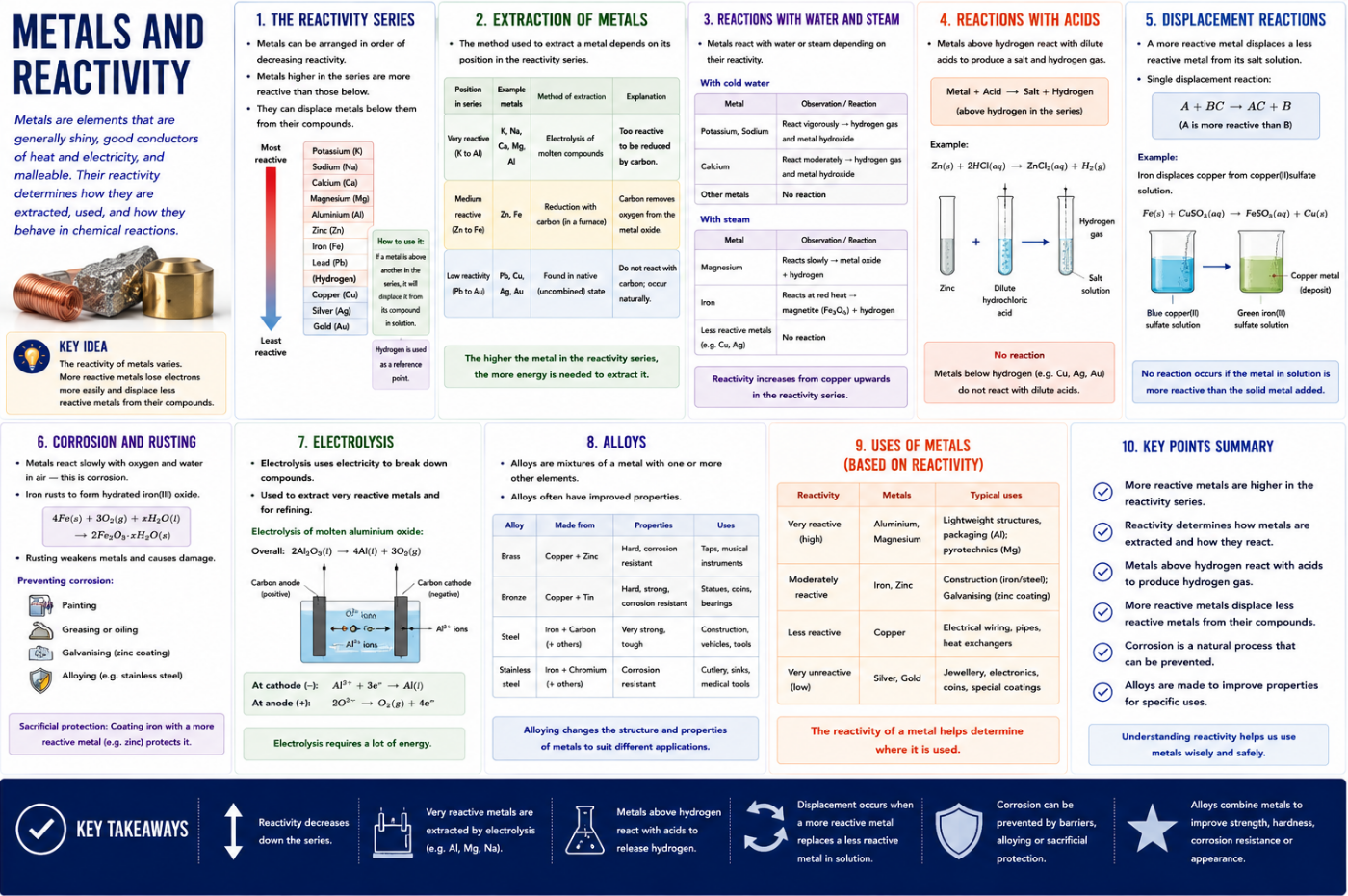
Metals are among the most important materials used by humans. From buildings and bridges to vehicles, electronics, and everyday tools, metals play a vital role in modern society. Their unique physical and chemical properties make them useful for a wide variety of applications, while their reactivity determines how they interact with other substances and how they can be extracted, used, and protected.
This course begins by exploring the fundamental properties of metals. Students will investigate both the physical and chemical characteristics of metals, including conductivity, malleability, ductility, and reactivity. They will learn how metallic bonding gives rise to these properties and discover how alloys are created to improve the performance of pure metals. Through real-world examples, students will see how the properties of metals influence their many uses.
Students will then examine the reactivity series, a powerful tool for predicting how metals behave in chemical reactions. They will investigate reactions with oxygen, water, and acids, compare the reactivity of different metals, and use experimental evidence to identify patterns and trends. These concepts provide an important foundation for understanding many industrial and environmental processes.
The course continues with the study of displacement reactions and the transfer of electrons. Students will learn how more reactive metals can displace less reactive metals from compounds and will explore oxidation and reduction as key chemical processes. Through particle-level explanations and reaction analysis, they will develop a deeper understanding of redox chemistry and the role of electron transfer in chemical change.
Next, students will investigate how metals are extracted from the Earth. They will examine the difference between native metals and ores, compare extraction methods such as carbon reduction and electrolysis, and evaluate how reactivity influences the choice of extraction technique. Students will also consider the environmental impacts of mining and metal production, connecting chemistry concepts to sustainability and resource management.
Throughout the course, students will explore the challenges of corrosion and the methods used to protect metals from deterioration. They will investigate rusting, identify the conditions required for corrosion, and evaluate techniques such as galvanizing and sacrificial protection. By connecting chemistry to engineering, industry, and environmental issues, students will gain a comprehensive understanding of how metals are used, produced, and maintained in the modern world.
Main Topics
Unit 1: Properties of Metals
Explore the physical and chemical characteristics of metals, investigate metallic bonding, and discover how alloys enhance the properties of materials used in everyday life.
Unit 2: The Reactivity Series
Learn how metals are ranked according to their reactivity and investigate how they react with oxygen, water, and acids.
Unit 3: Displacement Reactions
Examine how metals compete in chemical reactions, explore electron transfer, and develop an understanding of oxidation and reduction.
Unit 4: Extraction of Metals
Discover how metals are obtained from ores, compare extraction methods, and investigate the environmental challenges associated with metal production.
Unit 5: Corrosion and Protection
Explore the causes of corrosion and evaluate the methods used to protect metals in engineering, transportation, and infrastructure.
Perfect For
- Middle school and early high school students studying chemistry or physical science
- Students preparing for advanced chemistry courses
- Homeschool learners seeking a structured introduction to metals and chemical reactivity
- Learners interested in materials science, engineering, and industrial processes
- Students who enjoy connecting chemistry concepts to real-world applications
- Future scientists, engineers, technicians, and environmental professionals
By the End of This Course
Students will be able to:
- Identify and explain the physical and chemical properties of metals.
- Describe metallic bonding and relate it to the properties of metals.
- Compare pure metals and alloys and explain their uses.
- Use the reactivity series to predict chemical reactions.
- Explain reactions between metals and oxygen, water, and acids.
- Predict and analyze displacement reactions.
- Describe oxidation and reduction in terms of electron transfer.
- Compare extraction methods including carbon reduction and electrolysis.
- Evaluate the environmental impacts of metal extraction.
- Explain the causes of corrosion and methods used to prevent it.
- Apply chemistry concepts to industrial, environmental, and engineering contexts.
This course provides a strong foundation in the chemistry of metals and reactivity, helping students understand how materials interact, how resources are extracted and refined, and how chemistry influences the technologies and infrastructure that support modern life. Through investigations, problem solving, and real-world applications, students will develop the scientific knowledge and analytical skills needed for future studies in chemistry, engineering, environmental science, and technology.
- 教師: Young Mr.