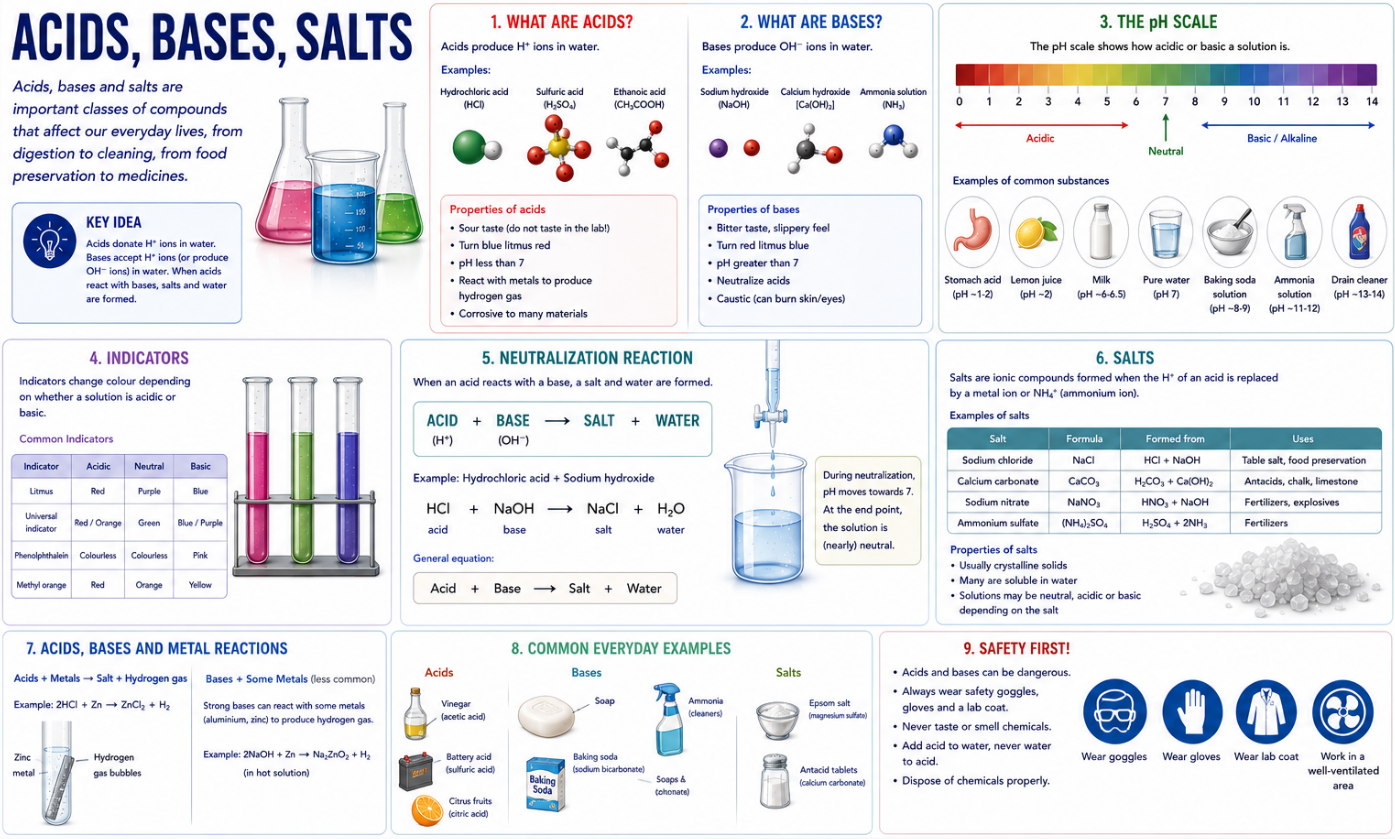
Acids, bases, and salts are among the most important groups of chemicals encountered in science and everyday life. They are found in foods, cleaning products, medicines, agriculture, industry, and even within the human body. In this course, students will explore the properties, reactions, and practical applications of acids, bases, and salts while developing the laboratory and analytical skills used by chemists around the world.
The course begins with an introduction to acids and bases, where students learn to identify common acidic and basic substances and investigate their characteristic properties. Through real-world examples, students discover how these substances affect everyday life and why understanding their behavior is important.
Students then explore pH and indicators, learning how chemists measure acidity and alkalinity. They will investigate the pH scale, use indicators to classify substances, and develop an understanding of how pH influences chemical reactions and biological systems.
Building on this foundation, students examine acid-base reactions. They will study neutralization reactions and investigate how acids react with metals, metal oxides, and carbonates. Students will learn to recognize reaction patterns and represent chemical processes using word and symbol equations.
The course continues with a study of salts and salt preparation. Students will learn how salts are formed, named, and prepared in the laboratory. They will explore techniques such as crystallization, precipitation, filtration, and purification while gaining practical experience with common laboratory procedures.
Finally, students investigate the applications of acids, bases, and salts in industry, agriculture, medicine, environmental management, and consumer products. Through real-world case studies, they will discover how these substances play essential roles in manufacturing, food production, health care, and environmental protection.
Throughout the course, students will develop scientific inquiry skills, perform investigations, analyze experimental results, and apply chemical concepts to solve practical problems.
Main Topics
Unit 1: Introduction to Acids and Bases
Explore the characteristics, properties, and everyday uses of acids and bases.
Unit 2: pH and Indicators
Investigate the pH scale and learn how indicators are used to measure acidity and alkalinity.
Unit 3: Acid-Base Reactions
Study the reactions of acids and bases and learn how chemical equations describe these processes.
Unit 4: Salts and Salt Preparation
Discover how salts are formed, named, and prepared using laboratory techniques.
Unit 5: Applications of Acids, Bases, and Salts
Examine how acids, bases, and salts are used in industry, agriculture, medicine, environmental science, and daily life.
Perfect For
- Middle and high school chemistry students.
- Learners beginning their study of chemical reactions.
- Students interested in laboratory investigations and practical chemistry.
- Homeschool students seeking a structured chemistry course.
- Anyone curious about the chemistry behind everyday products and processes.
By the End of This Course
Students will be able to:
- Distinguish between acids, bases, alkalis, and salts.
- Describe the characteristic properties of acids and bases.
- Use the pH scale and indicators to classify substances.
- Explain and predict common acid-base reactions.
- Write word equations and simple balanced chemical equations.
- Describe how salts are formed and prepared.
- Use laboratory techniques such as filtration and crystallization.
- Explain the importance of acids, bases, and salts in industry, agriculture, medicine, and environmental science.
- Apply chemical knowledge to real-world situations and problem-solving tasks.
- Demonstrate safe laboratory practices when working with chemicals.
Acids, bases, and salts form the foundation of many important chemical processes. By studying their properties, reactions, and applications, students gain a deeper understanding of how chemistry influences the world around them—from the food we eat and the medicines we take to the industries that support modern society.
- Викладач: Young Mr.