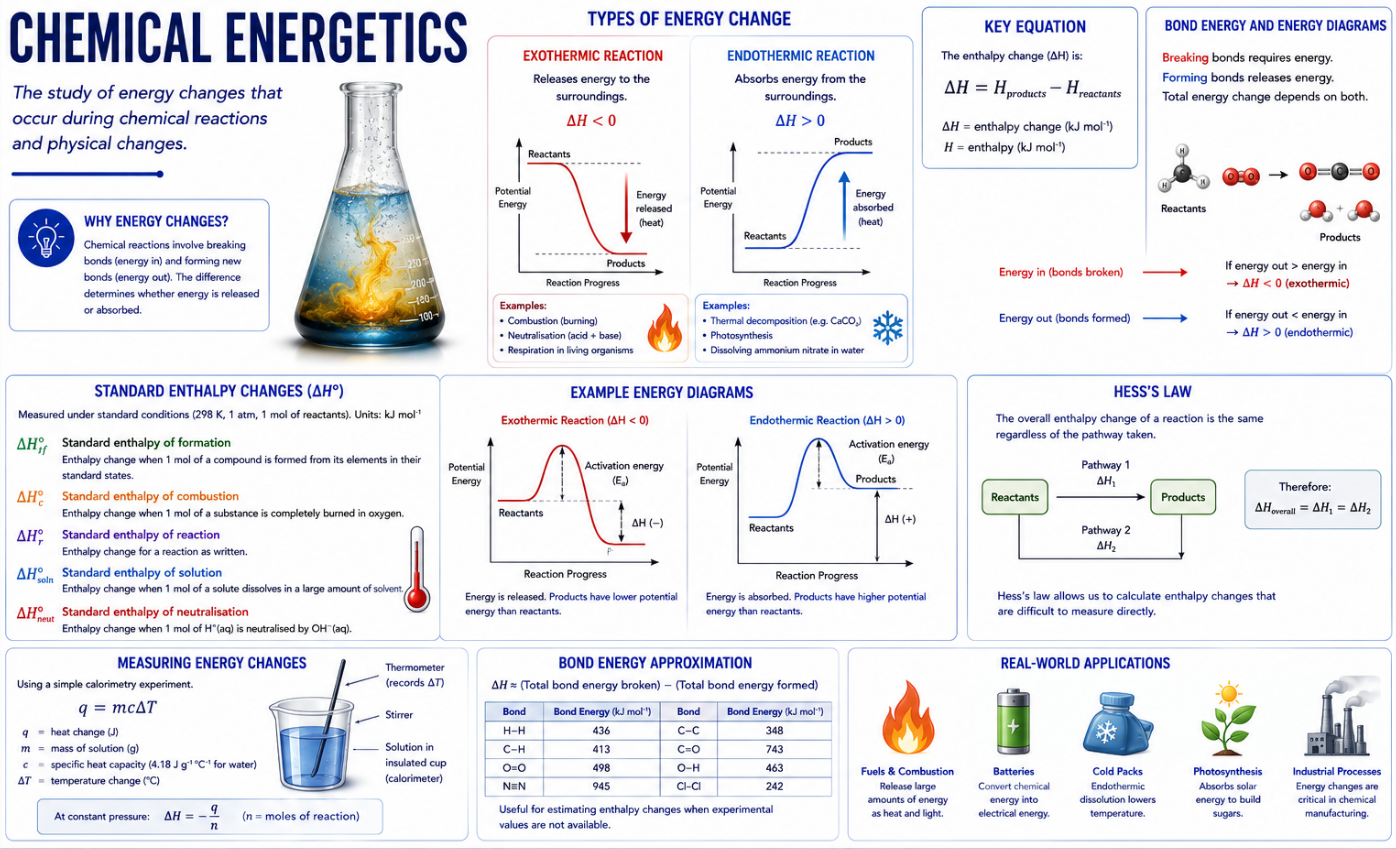
Why do some chemical reactions release heat while others absorb it? Why do some reactions occur almost instantly while others take years? How do catalysts speed up reactions, and how can scientists predict the energy changes that occur during chemical processes? In this course, students will explore the fascinating relationship between energy and chemical reactions, developing a deeper understanding of how and why chemical changes occur.
The course begins with Energy Changes in Chemical Reactions, where students investigate chemical energy, exothermic and endothermic reactions, and the transfer of energy between reacting substances and their surroundings. They will explore how energy changes can be observed in both laboratory experiments and everyday life.
Students then move on to Energy Profiles and Activation Energy, where they learn how reaction profile diagrams illustrate energy changes during reactions. They will examine activation energy, catalysts, and enzymes, and discover how these factors influence whether a reaction occurs and how quickly it proceeds.
In Bond Energies and Energy Calculations, students investigate the energy involved in breaking and forming chemical bonds. They will use bond energy data to calculate reaction energies and predict whether reactions are likely to be exothermic or endothermic.
The course continues with Rates of Reaction, where students explore how quickly chemical reactions occur and why reaction rates vary. Through collision theory and experimental investigations, they will examine how factors such as temperature, concentration, pressure, surface area, and catalysts influence reaction speed.
Finally, students will study Reaction Rate Graphs and Applications, learning how to interpret and analyze graphs that show changes in reactants and products over time. They will apply their knowledge of energetics and kinetics to industrial processes, biological systems, and real-world technologies.
Course Units
Unit 1: Energy Changes in Chemical Reactions
- Chemical Energy
- Exothermic Reactions
- Endothermic Reactions
- Energy Transfer During Reactions
- Everyday Examples of Energy Changes
Unit 2: Energy Profiles and Activation Energy
- Reaction Profile Diagrams
- Activation Energy
- Catalysts and Enzymes
- Exothermic Reaction Profiles
- Endothermic Reaction Profiles
Unit 3: Bond Energies and Energy Calculations
- Breaking Chemical Bonds
- Forming Chemical Bonds
- Bond Energy Data Tables
- Calculating Reaction Energies
- Predicting Energy Changes
Unit 4: Rates of Reaction
- What Is Reaction Rate?
- Measuring Reaction Rates
- Collision Theory
- Factors Affecting Reaction Rate
- Catalysts and Reaction Rates
Unit 5: Reaction Rate Graphs and Applications
- Concentration-Time Graphs
- Product Formation Graphs
- Determining Rate from Graphs
- Industrial and Biological Reactions
- Energy, Rates, and Real-World Applications
By the end of this course, students will be able to explain and predict energy changes in chemical reactions, interpret reaction profile diagrams, calculate reaction energies using bond data, analyze factors affecting reaction rates, and evaluate the role of chemistry in industrial, biological, and everyday systems. Through experiments, graph analysis, and real-world applications, students will develop a strong foundation in one of the most important areas of chemistry.
"Chemical reactions are not just about substances changing—they are about energy being transformed and transferred throughout the universe."
- Trainer/in: Mr. Young
- Trainer/in: Shari Young