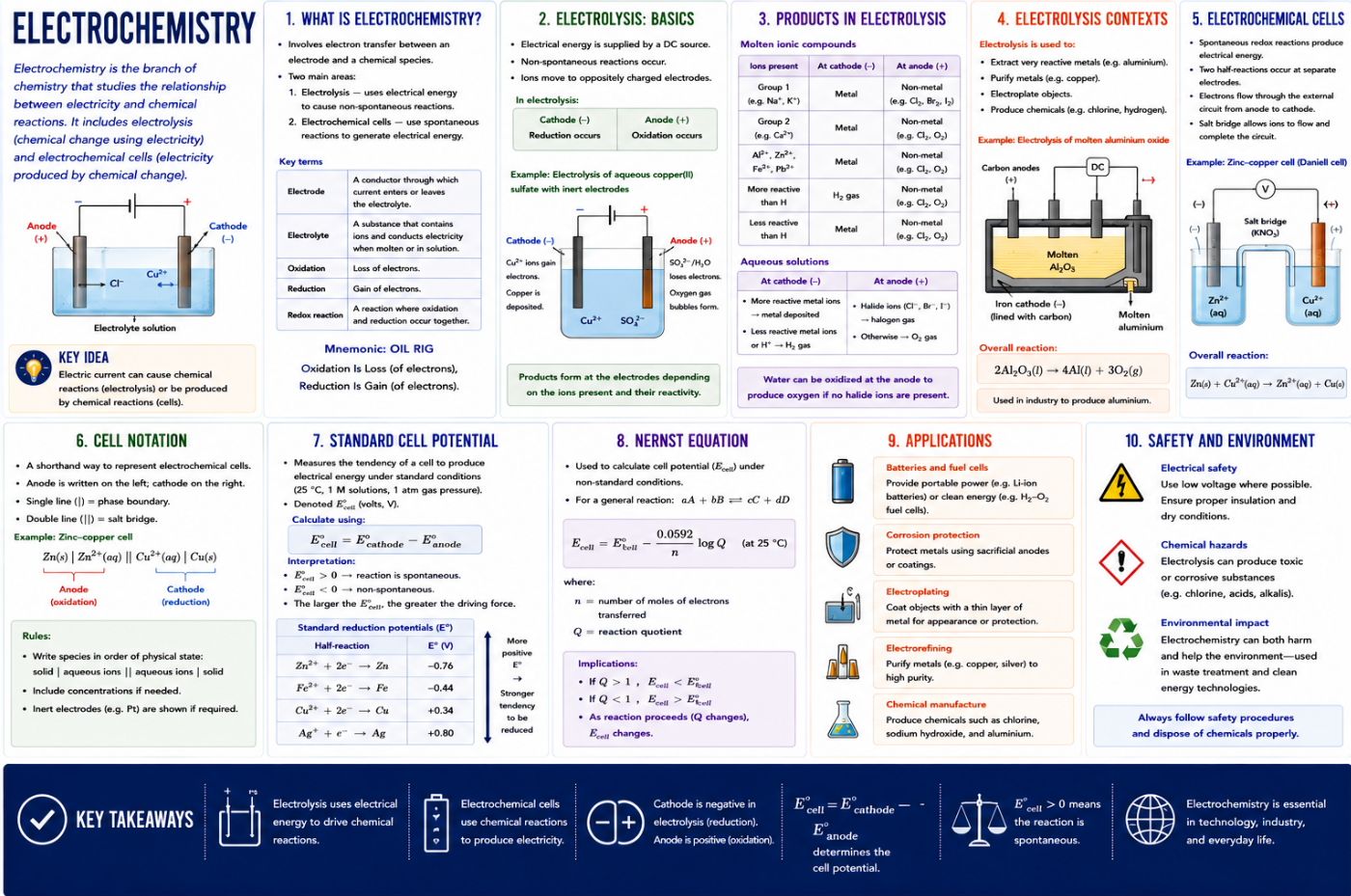
Electrochemistry is the branch of chemistry that explores the relationship between chemical reactions and electrical energy. From the batteries that power our devices to the biological signals that travel through our nervous systems, electrochemical processes play a vital role in both technology and life itself. By studying electrochemistry, students gain insight into how chemical reactions can produce electricity and how electricity can be used to drive chemical change.
This course begins by introducing the fundamental concepts of oxidation and reduction, collectively known as redox reactions. Students will learn how electrons are transferred during chemical reactions, investigate oxidation states, and identify oxidizing and reducing agents. These concepts provide the foundation for understanding all electrochemical systems.
Students will then explore galvanic cells, where spontaneous chemical reactions are used to generate electrical energy. They will investigate half-cells, electron flow, cell notation, and cell potential while learning how chemical energy is converted into electricity. Through these studies, students will develop a deeper understanding of the principles that power batteries and other electrochemical devices.
The course continues with an examination of batteries and fuel cells. Students will compare primary and secondary cells, investigate rechargeable battery technologies, and evaluate the advantages and challenges of fuel cells as emerging energy sources. They will also explore modern energy storage technologies and their role in supporting renewable energy systems.
Next, students will investigate electrolysis, the process of using electrical energy to drive non-spontaneous chemical reactions. They will study electrolytes, electrodes, molten compounds, and aqueous solutions while learning how electrolysis is used in metal extraction, purification, and manufacturing. These concepts demonstrate the practical applications of electrochemistry in industry and technology.
Throughout the course, students will explore the diverse applications of electrochemistry and bioelectricity. They will investigate electroplating, corrosion prevention, industrial electrochemical processes, and the electrical activity of living systems. By connecting chemistry, technology, engineering, and biology, students will gain a comprehensive understanding of how electrochemical processes shape the modern world.
Main Topics
Unit 1: Oxidation and Reduction
Explore the transfer of electrons in chemical reactions and develop an understanding of oxidation states, redox reactions, and oxidizing and reducing agents.
Unit 2: Galvanic Cells
Investigate how chemical reactions generate electrical energy through electrochemical cells, electron flow, and cell potentials.
Unit 3: Batteries and Fuel Cells
Examine the operation of batteries and fuel cells while exploring modern energy storage technologies and renewable energy applications.
Unit 4: Electrolysis
Learn how electrical energy can drive chemical reactions and explore applications in metal extraction, purification, and manufacturing.
Unit 5: Applications of Electrochemistry and Bioelectricity
Discover how electrochemistry is applied in industry, corrosion prevention, medicine, and the electrical systems of living organisms.
Perfect For
- High school chemistry students studying electrochemistry and redox reactions
- Students preparing for advanced chemistry, engineering, or materials science courses
- Homeschool learners seeking a structured electrochemistry program
- Learners interested in batteries, renewable energy, and emerging technologies
- Students curious about the connections between chemistry and biology
- Future chemists, engineers, medical researchers, and technology professionals
By the End of This Course
Students will be able to:
- Explain oxidation and reduction in terms of electron transfer and oxidation states.
- Identify oxidizing and reducing agents in chemical reactions.
- Analyze and interpret redox reactions.
- Describe the structure and operation of galvanic cells.
- Calculate and interpret cell potentials.
- Compare primary cells, secondary cells, rechargeable batteries, and fuel cells.
- Explain how electrolysis drives chemical change.
- Predict products formed during electrolysis of molten compounds and aqueous solutions.
- Evaluate industrial applications of electrochemistry.
- Explain the electrochemical basis of corrosion and corrosion prevention.
- Describe the role of bioelectricity in living systems and medical technologies.
This course provides a strong foundation in electrochemistry, helping students understand how chemical reactions and electrical energy are interconnected. Through the study of redox chemistry, electrochemical cells, electrolysis, batteries, and bioelectric systems, students will develop scientific reasoning and problem-solving skills that support future studies in chemistry, engineering, medicine, environmental science, and technology.
- Giáo viên: Mr. Young