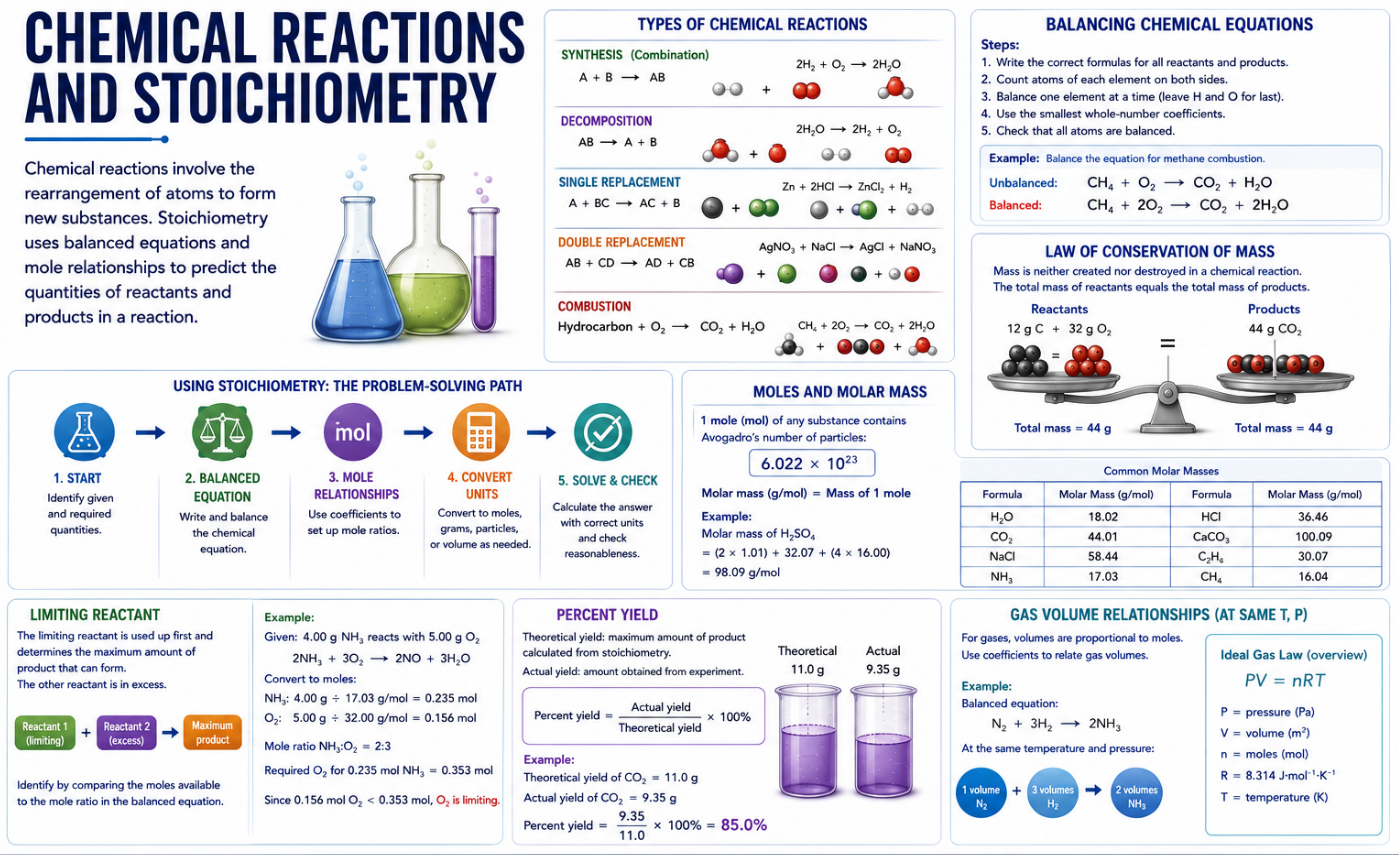
Chemistry is not just about identifying substances—it is also about understanding how substances react and predicting the quantities involved in chemical reactions. In this course, students will develop the quantitative skills that allow chemists to calculate the amounts of reactants required and products formed in chemical processes. Through problem-solving, real-world applications, and practical investigations, students will learn how chemistry uses mathematics to describe and predict the behavior of matter.
The course begins with The Mole Concept, introducing the mole as the fundamental counting unit of chemistry and exploring Avogadro's number, molar mass, and conversions between particles, moles, and mass. Students then move into Chemical Equations and Mole Ratios, where they learn how balanced equations reveal the relationships between reactants and products and form the basis of stoichiometric calculations.
Next, students investigate Mass Relationships in Reactions, applying stoichiometry to determine limiting reactants, excess reactants, theoretical yields, and percentage yields. In Solutions and Concentration, students explore solutes, solvents, concentration calculations, molar concentration, dilution, and reactions occurring in solution. Finally, the course concludes with Chemical Analysis and Applications, where students determine empirical and molecular formulae, analyze percentage composition, and apply stoichiometric principles to laboratory and industrial processes.
By the end of the course, students will be able to confidently perform quantitative chemical calculations, analyze reaction data, and apply stoichiometric reasoning to both laboratory investigations and real-world chemical systems.
Topics Covered
- The Mole Concept
- Chemical Equations and Mole Ratios
- Mass Relationships in Reactions
- Solutions and Concentration
- Chemical Analysis and Applications
This course serves as the mathematical foundation of chemistry and prepares students for advanced studies in chemical energetics, acids and bases, electrochemistry, organic chemistry, and beyond.
- Athro: Mr. Young