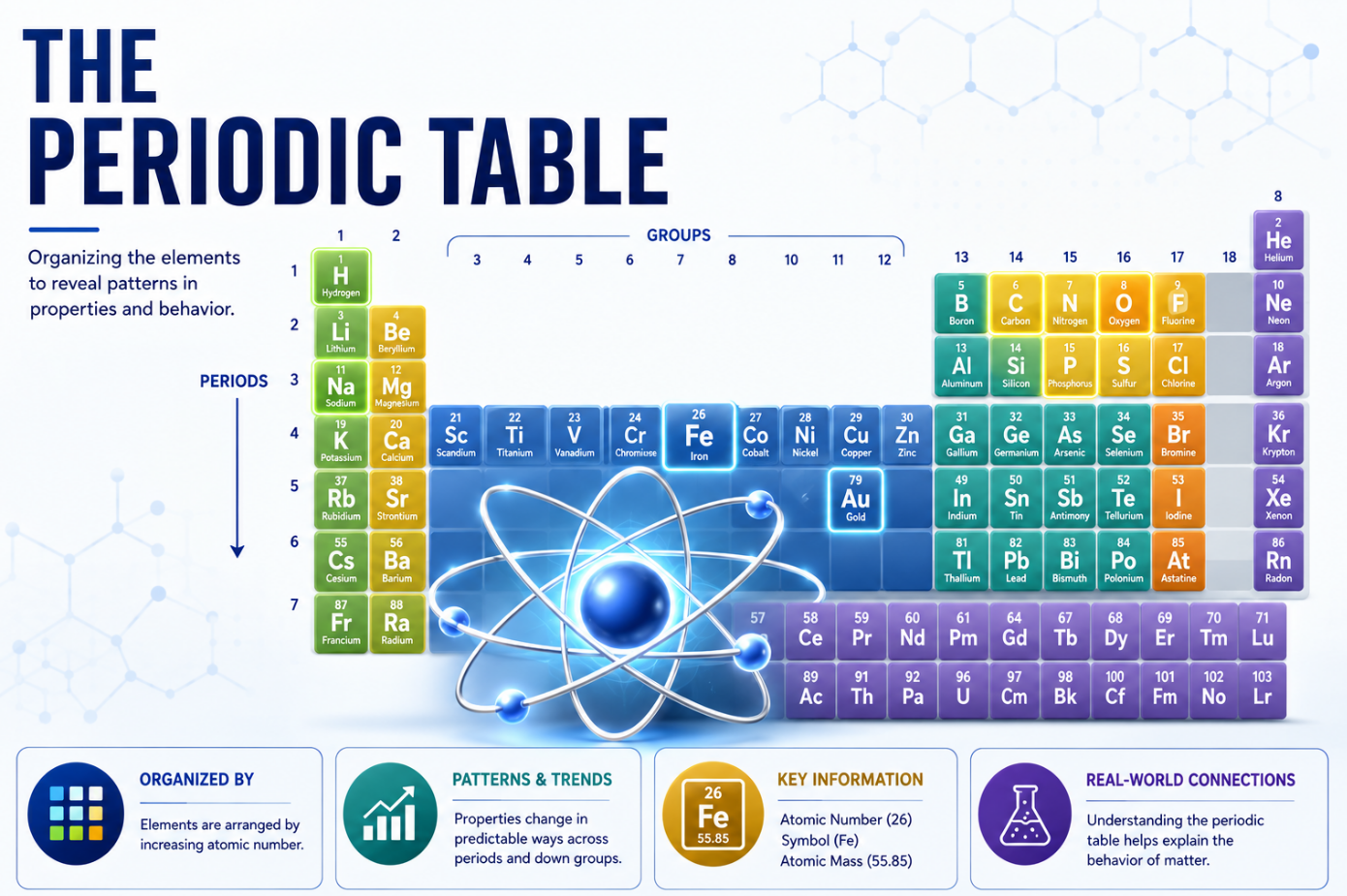
How did scientists organize the building blocks of matter into one of the most powerful tools in science? Why do elements in the same column behave similarly? How can chemists predict the properties of substances they have never encountered before? In this course, students will explore the structure, history, and predictive power of the periodic table.
The course begins with Development of the Periodic Table, where students trace the historical journey from early attempts at classifying elements to Mendeleev's groundbreaking periodic table and the modern arrangement based on atomic number. They will discover how scientific observations, predictions, and discoveries shaped one of chemistry's most important models.
Students then investigate the Structure of the Periodic Table, learning how periods, groups, atomic number, electron arrangements, and element classifications help organize the known elements. They will explore how an element's position reveals important information about its properties and behavior.
In Periodic Trends, students examine patterns that occur across periods and down groups, including atomic radius, ion formation, reactivity, metallic character, and electronegativity. These trends help explain why elements behave the way they do and allow scientists to make predictions about unfamiliar elements.
The course continues with Important Groups, where students study the properties and behavior of major families of elements, including alkali metals, halogens, noble gases, and transition metals. They will compare these groups and investigate how electron arrangements influence their characteristics.
Finally, students will focus on Using the Periodic Table, applying their knowledge to predict chemical behavior, bonding patterns, ion formation, and real-world applications. By combining trends, structure, and group properties, students will learn how chemists use the periodic table as a predictive scientific tool.
Course Units
Unit 1: Development of the Periodic Table
- Early Attempts at Classification
- Mendeleev's Periodic Table
- Predicting Missing Elements
- Moseley and Atomic Number
- The Modern Periodic Table
Unit 2: Structure of the Periodic Table
- Periods and Groups
- Atomic Number and Position
- Metals, Non-Metals, and Metalloids
- Electron Arrangements and Group Number
- Predicting Element Properties
Unit 3: Periodic Trends
- Atomic Radius
- Ion Formation
- Reactivity Trends
- Metallic Character
- Electronegativity and Periodicity
Unit 4: Important Groups
- Group 1: Alkali Metals
- Group 17: Halogens
- Group 18: Noble Gases
- Transition Metals
- Comparing the Major Groups
Unit 5: Using the Periodic Table
- Predicting Chemical Behaviour
- Predicting Bonding and Compounds
- Predicting Ion Formation
- Element Families and Applications
- Case Studies in Periodic Trends
By the end of this course, students will understand how the periodic table is organized, why periodic trends exist, and how chemists use the table to predict the properties and behavior of elements and compounds. Through scientific reasoning, pattern recognition, and real-world applications, students will gain an appreciation for one of the most important organizing principles in all of science.
"The periodic table is more than a chart of elements—it is a map that reveals the patterns and relationships that govern the chemical world."
- 教師: Young Mr.