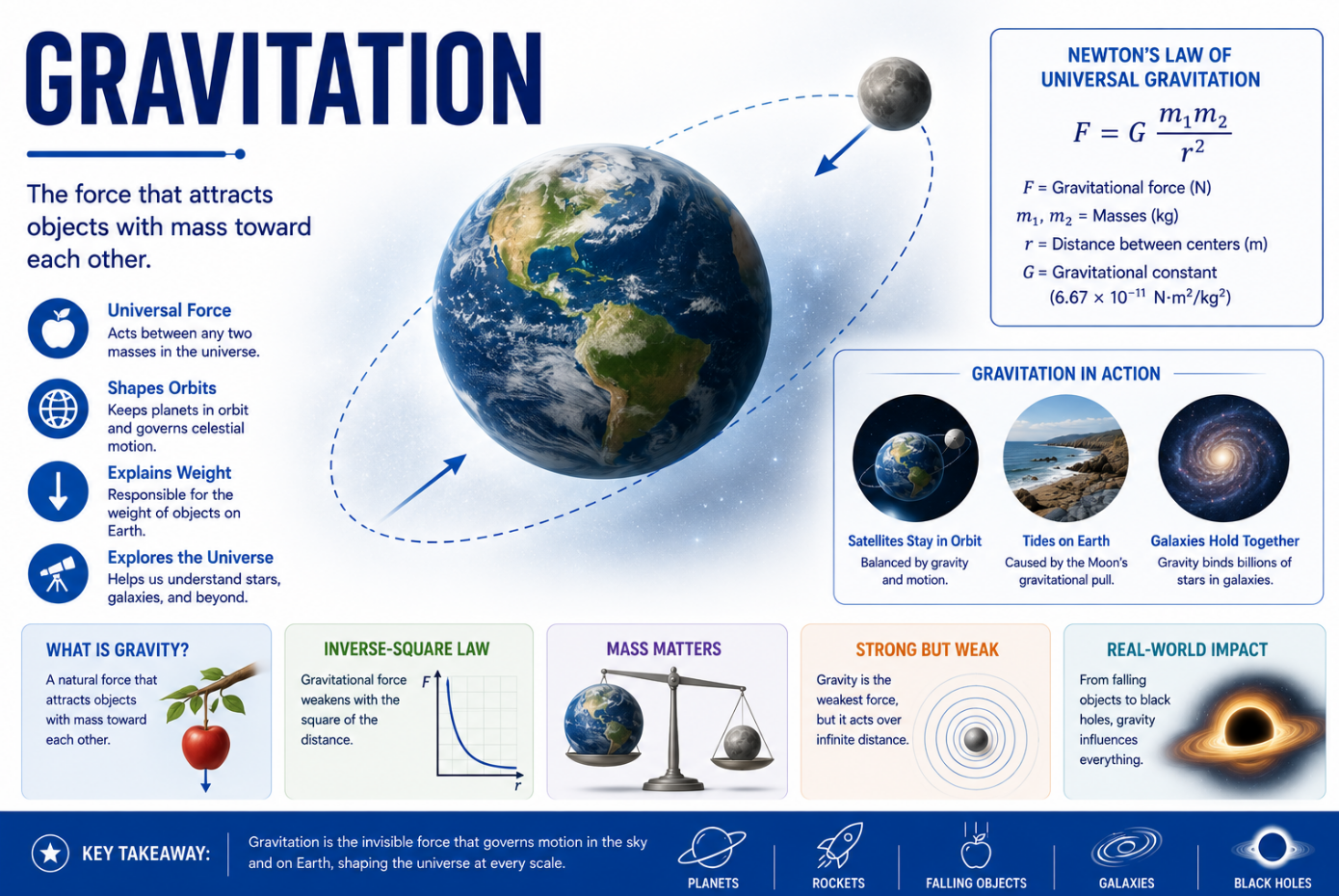
Gravity is one of the most fundamental forces in the universe. It governs the motion of planets, moons, stars, galaxies, and even the structure of the universe itself. From the falling of an apple to the orbit of satellites and the movement of distant planets, gravitational interactions influence objects on every scale. By studying gravitational fields, students gain a deeper understanding of how mass creates forces and how those forces shape the motion of objects throughout space.
This course begins by exploring the basic principles of gravitation. Students will investigate Newton's Law of Universal Gravitation, examine the role of the gravitational constant, and discover how gravitational forces follow an inverse-square relationship. Through these concepts, they will develop a mathematical and conceptual understanding of how masses interact across vast distances.
Students will then investigate gravitational field strength and learn how gravitational fields describe the influence of massive objects on their surroundings. They will compare radial and uniform fields, examine field superposition, and explore methods used to calculate and visualize gravitational fields. These ideas provide the foundation for understanding planetary motion and gravitational interactions.
The course continues with an exploration of gravitational potential and gravitational potential energy. Students will investigate how energy changes within gravitational fields, examine equipotential surfaces, and relate field strength to potential. Through conservation of energy principles, they will learn how energy governs motion within gravitational systems.
Next, students will explore escape speed and energy considerations. They will derive escape velocity using energy concepts, investigate orbital velocity, and examine the factors that determine whether an object can escape a gravitational field. Students will also explore advanced applications such as gravitational slingshots and their use in space exploration.
Throughout the course, students will investigate orbital mechanics and the motion of planets and satellites. They will explore different types of orbits, examine orbital energy, study Kepler's Laws of Planetary Motion, and apply gravitational principles to modern technologies such as GPS systems, communication satellites, and space missions. By connecting theory to real-world applications, students will develop a comprehensive understanding of one of the most important forces in nature.
Main Topics
Unit 1: Basics of Gravitational Fields
Explore the fundamental principles of gravitation, including Newton's Law of Universal Gravitation, the gravitational constant, and the inverse-square law.
Unit 2: Gravitational Field Strength
Investigate how gravitational fields are defined, measured, and represented while examining radial fields, superposition, and practical applications.
Unit 3: Gravitational Potential and Potential Energy
Examine how energy is stored and transferred within gravitational fields through gravitational potential, potential energy, and equipotential surfaces.
Unit 4: Escape Speed and Energy Considerations
Learn how energy conservation leads to escape speed and orbital velocity while exploring applications in space travel and planetary exploration.
Unit 5: Orbital Mechanics and Applications
Study the motion of planets and satellites through orbital mechanics, Kepler's Laws, and modern applications of orbital technology.
Perfect For
- High school physics students studying gravitation and fields
- Students preparing for advanced physics, astronomy, or engineering courses
- Homeschool learners seeking a structured astrophysics or mechanics course
- Learners interested in space exploration and planetary science
- Students preparing for university-level physics studies
- Future physicists, aerospace engineers, astronomers, and space scientists
By the End of This Course
Students will be able to:
- Explain Newton's Law of Universal Gravitation.
- Apply the inverse-square law to gravitational systems.
- Calculate gravitational forces between masses.
- Define and calculate gravitational field strength.
- Analyze radial and uniform gravitational fields.
- Explain gravitational potential and gravitational potential energy.
- Apply conservation of energy to gravitational systems.
- Calculate escape speed and orbital velocity.
- Analyze the factors that influence orbital motion.
- Apply Kepler's Laws to planetary and satellite systems.
- Evaluate real-world applications of gravitation in astronomy and space exploration.
This course provides a strong foundation in gravitational physics, helping students understand how mass, force, and energy govern motion throughout the universe. Through the study of gravitational fields, orbital mechanics, and space applications, students will develop mathematical modeling, problem-solving, and scientific reasoning skills that support future studies in physics, astronomy, aerospace engineering, and space science.
- 教师: YoungMr.