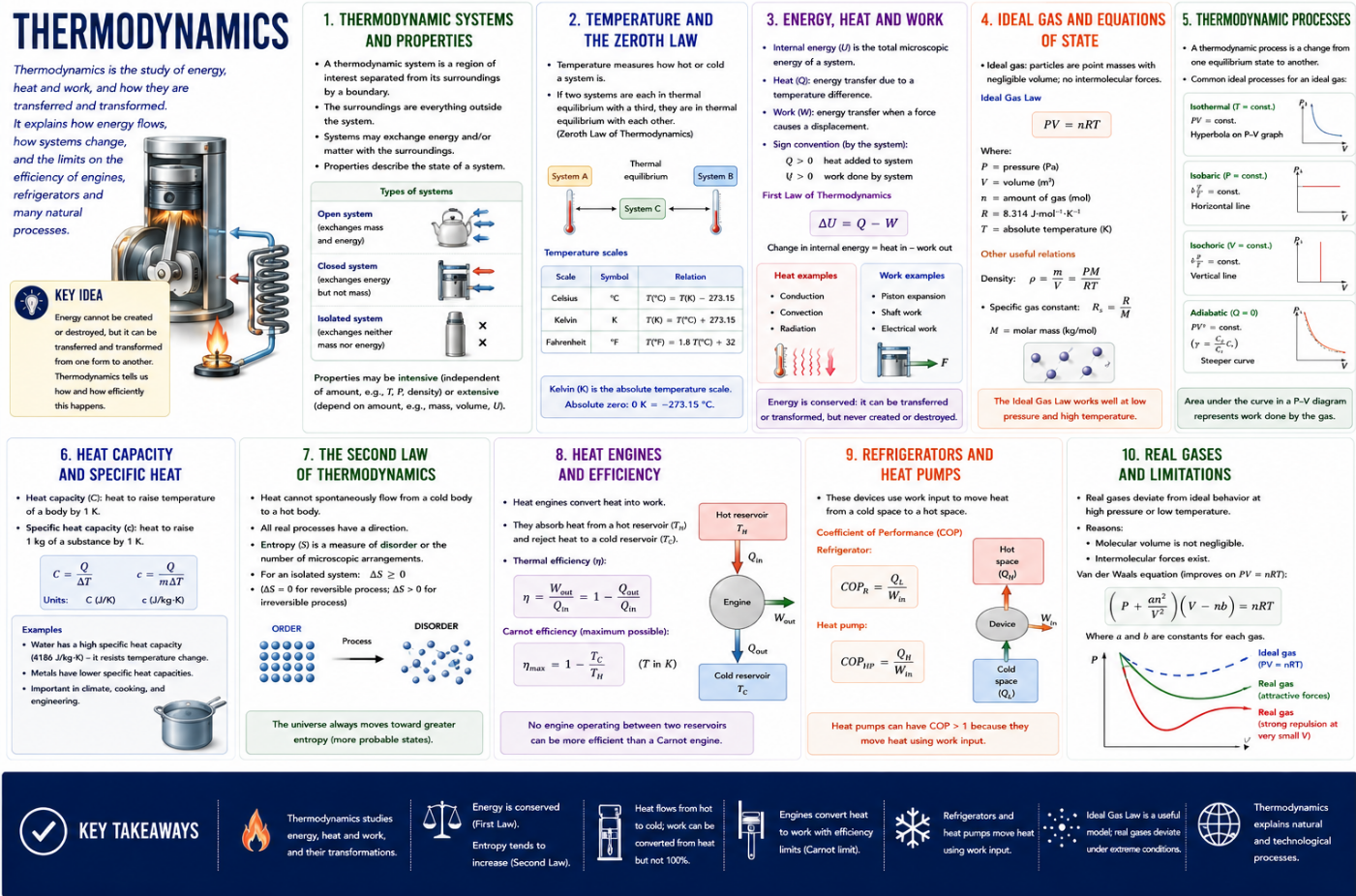
Thermodynamics is the study of energy, heat, work, and the laws that govern how energy is transferred and transformed throughout the universe. From the operation of engines and refrigerators to the behavior of Earth's climate and living organisms, thermodynamics provides the scientific principles that explain why energy flows, how systems change, and why no process is ever perfectly efficient. In this course, students build on their understanding of thermal energy and gas laws to explore the fundamental laws of thermodynamics and their applications in science and engineering.
Students begin by developing a strong conceptual foundation through the study of thermodynamic systems, state variables, equilibrium, and common thermodynamic processes. They then investigate the First Law of Thermodynamics and learn how heat, work, and internal energy are related through the principle of energy conservation. The course continues with entropy and the Second Law of Thermodynamics, introducing the concepts of irreversibility, spontaneous processes, and the direction of natural energy flow. Students then apply these principles to heat engines, refrigeration systems, and the Carnot cycle before exploring how thermodynamics influences engineering, biology, environmental science, renewable energy, and modern technology.
Throughout the course, students connect mathematical models with real-world systems while developing the analytical and problem-solving skills required for advanced studies in physics, chemistry, engineering, and related sciences.
Main Topics
Unit 1: Introduction to Thermodynamics
Develop the fundamental concepts of thermodynamics by exploring systems, energy, equilibrium, state variables, and thermodynamic processes.
Unit 2: First Law of Thermodynamics
Investigate the conservation of energy in thermodynamic systems through internal energy, heat, work, and pressure-volume relationships.
Unit 3: Entropy and the Second Law
Explore entropy, irreversibility, spontaneous processes, and the fundamental limits placed on energy conversions by the Second Law of Thermodynamics.
Unit 4: Heat Engines
Examine heat engines, refrigeration systems, the Carnot cycle, and the factors that determine the efficiency of thermal machines.
Unit 5: Applications of Thermodynamics
Apply thermodynamic principles to engineering, biology, environmental science, renewable energy, and modern technological systems.
- Teacher: Mr. Young