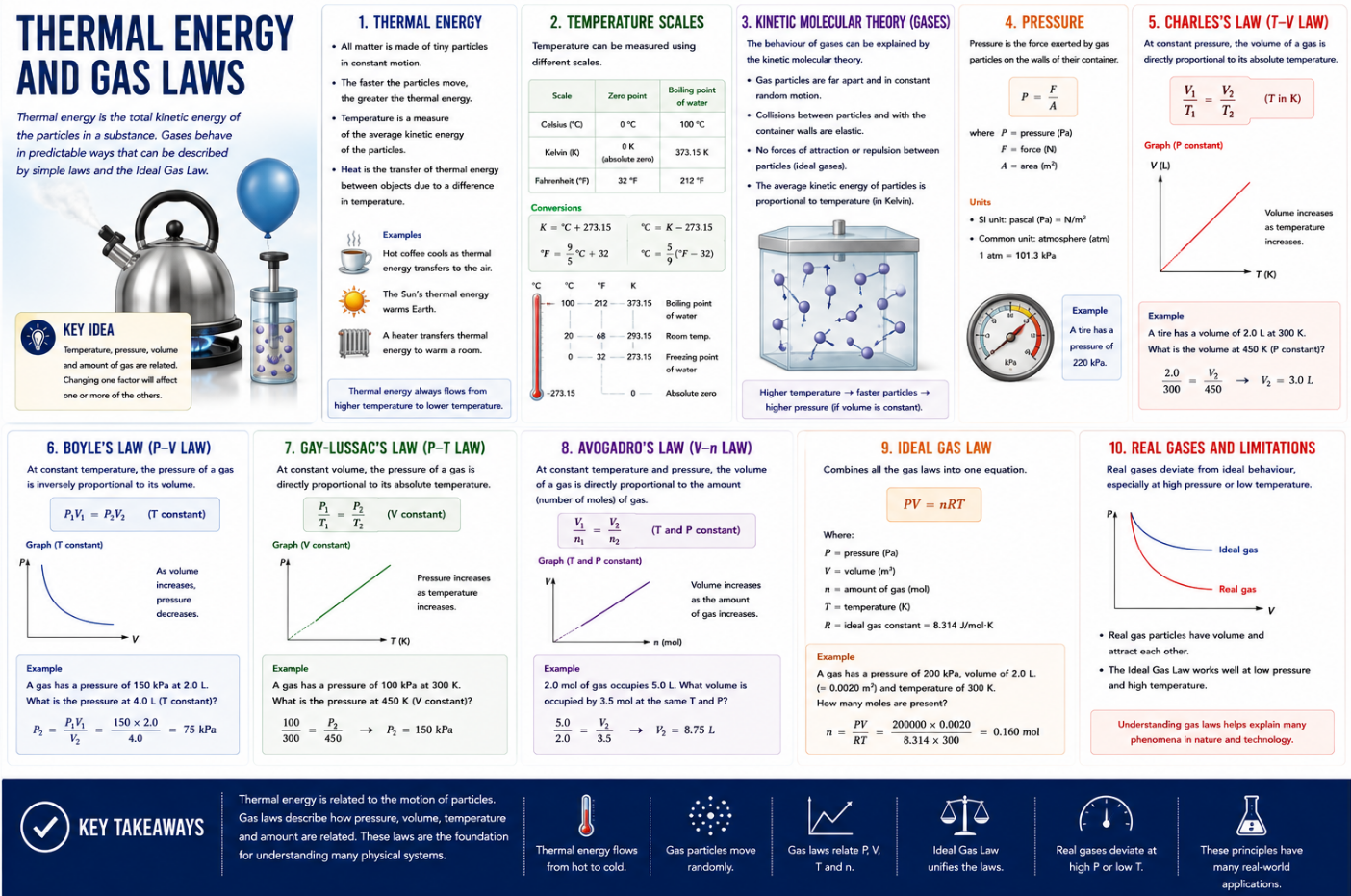
Thermal energy plays a central role in both the natural world and modern technology. From the movement of particles inside matter to the operation of engines, refrigerators, power plants, and Earth's climate system, the principles of thermal physics help explain how energy is stored, transferred, and transformed. In this course, students develop a comprehensive understanding of heat, temperature, thermal radiation, and the behavior of gases while building the quantitative problem-solving skills needed for advanced studies in physics and engineering.
Students begin by exploring the relationship between temperature and matter through the particle model, thermal expansion, and the distinction between heat and temperature. They then investigate the three methods of heat transfer—conduction, convection, and radiation—along with thermal equilibrium, evaporation, and practical methods of controlling heat flow. The course continues with calorimetry, specific heat capacity, latent heat, and heating and cooling curves, providing students with the tools to calculate thermal energy changes. Students then explore blackbody radiation and thermal emission before concluding with kinetic molecular theory, gas laws, the Ideal Gas Law, molar volume, and the relationship between temperature and molecular motion.
Throughout the course, students connect microscopic particle behavior with large-scale thermal phenomena while developing a deeper understanding of how thermal energy influences the physical world.
Main Topics
Unit 1: Temperature and Matter
Develop an understanding of temperature, particle behavior, states of matter, thermal expansion, and the relationship between heat and temperature.
Unit 2: Heat Transfer
Investigate how thermal energy moves through conduction, convection, radiation, and evaporation, and examine practical applications of heat transfer.
Unit 3: Thermal Energy and Calorimetry
Explore how thermal energy changes temperature and state, and learn how scientists measure and calculate energy transfer during heating and cooling processes.
Unit 4: Blackbody Radiation
Discover how objects emit thermal radiation, how temperature affects electromagnetic emission, and how these principles are applied in astronomy, climate science, and engineering.
Unit 5: Gas Laws and Kinetic Theory
Study the microscopic behavior of gases and learn how pressure, volume, temperature, particle motion, and molar volume are related through the gas laws and the Ideal Gas Law.
- Викладач: Young Mr.